Why Water Well Drillers Keep Choosing DTH: Five Advantages That Beat Mud Rotary Every Time
Mud rotary drilling dominates the water well industry. It's familiar, it works in most formations, and the equipment is everywhere. But there's a growing segment of water well contractors who've switched to DTH — down-the-hole air hammer drilling — for specific applications, and once they switch, they don't go back.
The advantages aren't theoretical. They show up in the invoice, in the well development time, and in the client's water quality. Here's why DTH earns its place on a water well rig.
Advantage 1: The Rig Doesn't Need to Be Massive
A mud rotary rig drilling a 200-meter, 8-inch water well needs substantial pullback capacity, high-torque rotation, and a mud system with pumps, tanks, shakers, and desanders. The rig is heavy, the setup is complex, and the mobilization costs reflect all of it.
A DTH hammer on the same hole needs modest axial pressure — just enough to keep the bit seated. Rotation speed is low — 15 to 25 RPM in most formations. Torque requirements are correspondingly low because the bit is hammering rock, not grinding it. The drill rods can be lighter and smaller in diameter because they're transmitting air and rotation, not high pullback loads.
The result: a smaller rig, lower fuel consumption, faster setup and teardown, and access to sites where a full mud rotary spread won't fit. For remote water wells — agricultural, rural community, mining camp supply — this logistical advantage alone can make DTH the only practical option.
Advantage 2: Air Is the Drilling Fluid, and Air Is Free
Mud rotary drilling requires mixing, pumping, treating, and disposing of drilling fluid. Every meter of hole generates a volume of contaminated mud that needs to be contained, settled, and eventually disposed of. The mud system runs continuously — pumps, agitators, shakers — burning fuel and demanding attention.
DTH uses compressed air. The air hammers the rock, blows the cuttings up the annulus, and disperses. There's no fluid to mix. No cuttings to settle. No pit to dig. No mud to dispose of. The only consumable is rock drill oil — a few liters per shift — and the air itself.
The time saved by eliminating fluid management is substantial on any hole, but it's game-changing on deep holes where mud volumes become logistically burdensome. A 300-meter hole produces roughly 10-15 cubic meters of cuttings mixed with drilling fluid. With mud rotary, that material has to be handled. With DTH, it blows out as dust or damp chips and stays at the collar.
Advantage 3: Casing While Drilling Through Bad Ground
Every water well driller knows the nightmare scenario: you hit a fractured zone, a cavern, or a loose gravel layer — and the hole collapses. Circulation is lost. The bit is stuck. The hole might be lost entirely.
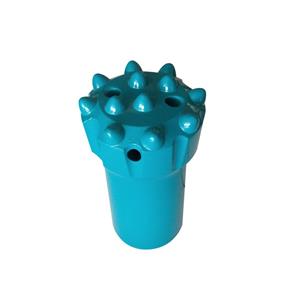
DTH hammers can run in a casing-while-drilling configuration. An eccentric or under-reaming bit assembly drills a hole slightly larger than the casing diameter. The casing follows the hammer down as it advances. When the bad ground is passed, the bit assembly is retracted through the casing, and drilling continues with a standard bit.
This turns the worst-case scenario into a planned step. Instead of fighting lost circulation with lost-circulation materials and hoping the hole stays open, the driller isolates the problem zone with steel casing and moves on. The hole is secure, the aquifer above the problem zone is protected, and the client gets a completed well instead of an abandonment.
Advantage 4: The Aquifer Stays Clean
This is the advantage that matters most to the end user — the person who drinks the water.
Mud rotary drilling forces drilling fluid into the formation. The filter cake that stabilizes the borehole wall during drilling also seals the pore spaces in the aquifer. Developing the well — removing that filter cake and restoring the formation's natural permeability — takes time, chemicals, and aggressive surging. Even with proper development, some residual formation damage is common. The well produces less water than the aquifer could theoretically yield.
DHT drilling with air doesn't form a filter cake. The borehole wall in competent rock is cut clean by the percussion action. There's no fluid invasion into the formation. The natural permeability of the aquifer is preserved. Well development time drops from days to hours, and the finished well often produces closer to the formation's theoretical capacity.
In fractured rock aquifers — where water flows through cracks and fissures rather than pore spaces — this difference is dramatic. Mud invades fractures and seals them. Air clears them. A DTH-drilled well in fractured rock routinely outperforms a mud-drilled well in the same formation.
Advantage 5: Winter Doesn't Stop the Work
Mud rotary drilling in freezing temperatures is an exercise in frustration. The mud lines freeze. The tanks ice over. The cuttings pile becomes a frozen mound. Winterizing the mud system takes hours at the end of every shift, and de-winterizing takes hours at the start.
DTH uses air. There's no fluid to freeze — just the condensate in the air lines, which is managed with a standard air dryer or alcohol injection. The rig can drill through a northern winter with minimal additional preparation. For regions where the drilling season is limited by weather, DTH extends the working window by months.
The Maintenance Reality
DTH equipment in water well service needs the same disciplined maintenance as in any other application — more so, actually, because water well holes are deeper and longer-duration than typical blast holes. The hammer internals need cleaning and inspection on schedule. The bit gauge row needs monitoring. Lubrication can never be neglected — a water well hammer running dry at 200 meters depth is an expensive recovery operation.
But for the driller who maintain their equipment properly, DTH in water well service delivers a combination of logistical simplicity, formation protection, and year-round operability that mud rotary can't match. It's not the right tool for every water well. But for the ones where it fits, it's the tool that makes the job easier and the well better.