Static Hydraulic Rock Splitters for Controlled Rock and Concrete Breaking
Static Hydraulic Rock Splitters for Controlled Rock and Concrete Breaking
Static hydraulic rock splitters are mechanical systems designed to help separate rock, concrete, and reinforced-concrete structures through controlled hydraulic force. They are commonly considered for mining, stone extraction, foundation excavation, tunnel works, demolition, and restricted construction environments.
Unlike conventional impact-breaking equipment, hydraulic splitting aims to develop controlled fractures in the material. The actual result depends on material strength, existing cracks, structure geometry, equipment selection, and site conditions.
How Hydraulic Splitting Works
Rock and concrete normally resist compression more strongly than tension. Hydraulic splitting equipment applies controlled mechanical force to exploit this difference and encourage fracture development along natural or planned weak zones.
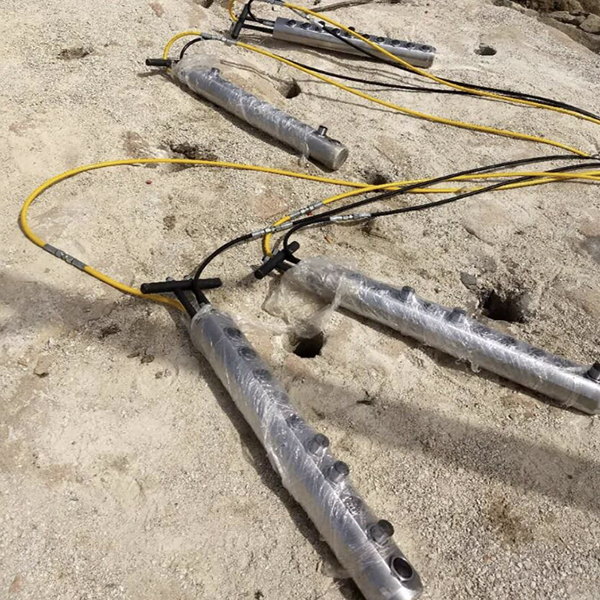
A typical system includes a hydraulic power unit, splitting tools, connections, and sealing components. However, the equipment alone does not determine project success. Installation, equipment selection, operation, maintenance, and safety management must follow approved engineering documentation and be carried out by trained, authorized personnel.
Suitable Project Applications
Hydraulic splitting equipment may be assessed for projects such as:
Rock excavation and controlled mining work
Underground exploration and tunnel construction
Marble, granite, sandstone, and dimension-stone extraction
Foundation, wall, bridge, dam, and concrete-structure removal
Indoor or narrow-space demolition
Road, railway, and utility infrastructure works
Secondary breaking of large rock or concrete sections
These applications should be evaluated individually. The technique may be useful where a project needs to manage access restrictions, structural sensitivity, or conventional-blasting constraints, but it is not automatically the best approach for all rock masses or demolition tasks.
Comparing Available Rock-Breaking Methods
Project teams can compare hydraulic splitting with mechanical breakers, static splitting agents, gas-expansion systems, and conventional drilling-and-blasting methods. The best choice depends on geology, material condition, target output, nearby assets, project schedule, environmental controls, and total cost.
Supplier claims about low disturbance, high efficiency, lower cost, or reduced environmental impact should be verified through a project-level review. Equipment price is only one part of the calculation; labor, preparation, transport, machine time, maintenance, supervision, disposal, and safety controls also matter.
Selecting a Supplier
When choosing a hydraulic splitting equipment supplier, contractors should assess manufacturing capability, technical documentation, quality control, service response, spare-parts availability, project experience, and the clarity of post-sale support.
Yantai Gaea can provide technical communication for projects considering static hydraulic splitting. Equipment suitability, expected performance, and service scope should be confirmed against the actual project conditions and contract requirements.
Safety and Compliance
Hydraulic splitting equipment involves high-force mechanical systems. Work must be carried out under an approved site safety plan, using properly maintained equipment and competent supervision. Applicable occupational-safety rules, equipment-inspection requirements, work-zone controls, and local approvals must be addressed before work starts.
A controlled hydraulic splitting solution can be a valuable option for the right project, but only when it is selected through disciplined engineering review and implemented by qualified personnel.