Running a Tricone Bit: What Your Weight-on-Bit and RPM Are Actually Doing to the Rock
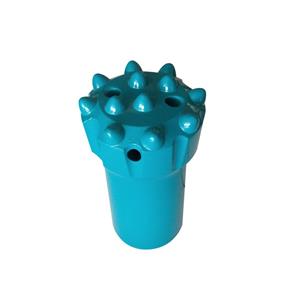
A tricone bit at the bottom of a hole is doing one of three things to the formation. Only one of them is drilling.
At low weight-on-bit — below the rock's compressive strength — the teeth aren't biting. They're skating across the bottom, grinding rock through friction. Penetration is negligible. The teeth are wearing fast for almost no progress. This is surface crushing, and it's the most expensive way to spin a bit because you're consuming carbide and bearing life for virtually zero meterage.
At intermediate WOB — approaching but not exceeding the rock's compressive strength — the teeth still aren't fully penetrating, but they're doing something useful: they're creating a network of micro-cracks in the formation surface. Each tooth impact extends the cracks a little further. Eventually, after enough cycles, the rock fatigues and chips free. It works, but it's slow. This is the fatigue crushing zone.
At full WOB — above the rock's compressive strength — the teeth sink in. Each tooth penetration creates a crater through brittle fracture. Chips fly. The bit advances. This is volume crushing, and it's the only zone where you're actually drilling.
The trick isn't just running enough weight to get into volume crushing. It's running the right weight and right speed for the rock you're in. Because the relationship between WOB, RPM, and penetration rate changes dramatically depending on what's under the bit.
What the Rock Does to the Parameters
Soft, plastic formations — clay, soft shale, unconsolidated sand. The teeth penetrate easily. The limiting factor isn't getting into the rock; it's cleaning the hole fast enough to prevent bit balling. Run moderate WOB — enough to keep the teeth engaged but not so much that the bit packs up. Run the RPM as high as your string and rig can handle, because penetration rate in these formations scales almost linearly with rotation speed. Double the RPM, roughly double the penetration. The teeth don't wear much in soft rock, so speed is free.
Medium-hard formations — firm limestone, dolomite, medium sandstone. Here the game changes. The teeth have to crush to penetrate, and crushing takes time. The impact has to propagate through the rock, cracks have to develop, chips have to separate. If you spin too fast, the teeth move off before the fracture is complete — you're leaving partial cracks in the bottom instead of removing full chips. The result: faster RPM doesn't give you proportionally faster penetration. It just wears the teeth faster because they're hitting partially fractured rock at higher surface speeds.
A real-world number: in medium rock (around 6-7 on the Protodyakonov scale), doubling RPM might get you 50-70% more penetration, not 100%. The efficiency penalty grows as hardness increases.
Hard, abrasive formations — granite, quartzite, chert. Now you've got two problems: the rock takes time to fracture, and the rock is wearing the teeth while they work. RPM above the sweet spot is actively counterproductive. The teeth can't complete the fracture cycle at higher speeds, so penetration plateaus or even drops. Meanwhile, the carbide is grinding against hard, abrasive rock at higher linear speed, so wear accelerates. Every formation has a practical RPM ceiling beyond which you're just converting bit life into noise.
The experimental data bears this out. In a controlled test across rock grades, doubling RPM gave 93% more penetration in grade-4 marble but only 28% more in grade-9 porphyritic granite. From 4 to 9, the RPM benefit follows a descending curve. In the hardest, most abrasive rocks, more RPM buys almost nothing — it just shortens bit life.
The WOB Sweet Spot, Rock by Rock
Sticky, plastic formations (clay, mudstone, soft shale): light WOB. These formations cut easily. Too much weight packs the formation into the tooth gaps and the bit balls up. Low-viscosity, low-density drilling fluid helps prevent swelling and sticking. Carbonaceous shale is especially prone to collapse — keep the hydraulics moving and the WOB light.
Abrasive formations (quartz sandstone, conglomerate): higher WOB. If you don't push hard enough to get the teeth fully into volume crushing, they spend too much time in the fatigue zone, grinding against the formation and wearing flat. More weight means less grinding and more crushing, which paradoxically reduces tooth wear. Conglomerate adds the risk of bit jumping and impact damage — keep the string stable and don't over-spin.
Fractured, cavernous formations (karst limestone, fault zones): reduced WOB. When the bit hits a void or a fracture zone, the weight suddenly unloads and then slams back on. High WOB in these conditions breaks teeth and damages bearings. Lighten up, spin steady, and let the bit work through the broken zone without fighting it.
Interbedded formations (alternating hard and soft layers): this is the hardest to dial in. The bit sees constantly changing rock strength. WOB that's right for the hard stringer is too much for the soft layer. The compromise: tune for the harder layers and accept slightly suboptimal performance in the soft ones. A bit that survives the hard streaks drills faster overall than one that optimizes for the soft and destroys itself in the hard.
The Rule That Ties It Together
WOB gets you into the rock. RPM determines how many times per minute you get a bite. But the rock sets the speed limit on how fast a bite can complete before the tooth moves on.
If you remember nothing else: soft rock loves RPM, hard rock needs time. Push too much speed into hard rock and you're not drilling faster — you're just wearing bits. Push too much weight into soft rock and you're not drilling deeper — you're packing the bit. Get the balance right, and the same bit that was "slow" on the last hole becomes the one the crew fights over.