Why the Button Bit Body Matters More Than Most Buyers Think
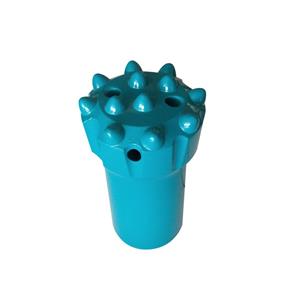
A button bit is often judged by what everyone can see first: the carbide buttons.
That makes sense. The buttons are the cutting points. They strike the rock, crush the face, and take the most obvious wear. But the carbide is only as reliable as the steel body holding it.
When a threaded button bit fails early, the cause is not always the carbide grade or the drilling parameters. The issue may begin much earlier, in the way the bit body was made.
The button bit body must hold the carbide inserts securely, carry impact energy through the drill string, resist rotation and abrasive flushing, and survive repeated stress cycles in hard rock. Its strength, toughness, dimensional accuracy, and internal structure all influence bit life.
That is why the manufacturing method matters.
The body is the structural foundation of a button bit
A rock drill bit body works in a punishing environment. Every impact pulse travels through the shank adapter and drill rod before reaching the bit. The body must transfer that energy to the carbide buttons without cracking, deforming, or allowing the button seats to loosen.
At the same time, the bit is rotating under load. Cuttings and flushing water move through the face and flushing passages. The threaded connection is repeatedly tightened, loosened, and exposed to vibration.
A good bit body must balance competing needs:
High strength to resist deformation
Toughness to survive repeated impact
Wear resistance around threads and flushing features
Accurate button-hole geometry
Stable dimensions for reliable coupling with the drill string
Consistent material properties from batch to batch
No single property is enough. A body that is very hard but brittle can crack under impact. A body that is tough but too soft can wear rapidly or lose support around the carbide buttons. The manufacturing process helps determine whether that balance is achieved.
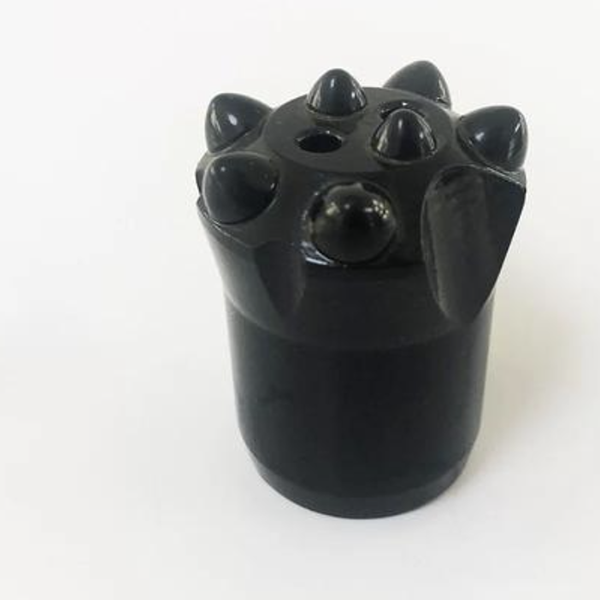
Four common ways to make a button bit body
Manufacturers may use machining, cold extrusion, warm extrusion, or hot-die forging to form a button bit body. Each method has strengths and limitations.
Machining is straightforward. A body can be cut from bar stock into the required external shape. It can be useful for prototypes, small runs, or simple designs. But it may generate more material waste and does not improve the internal metal flow or close internal discontinuities that may exist in the starting stock. For a part that will face high-frequency impact, that matters.
Cold extrusion can improve density and material utilization, but the forming load is high. It requires capable equipment and robust tooling. It is generally more practical for smaller, simpler components or tightly controlled production conditions.
Warm extrusion reduces some of the deformation resistance seen in cold forming. However, its forming capacity and process-control window can still limit its suitability for larger or more complex button-bit bodies.
Hot-die forging is widely used for impact-tool components because it combines plastic deformation at elevated temperature with controlled die shaping. When properly designed and controlled, the process can produce near-net shapes, improve material flow, and support efficient volume production.
That does not mean every hot-forged bit body is automatically superior. Tooling quality, steel selection, temperature control, forging sequence, heat treatment, machining, and inspection still determine the final result. But the process provides a strong starting platform for demanding rock-drilling applications.
Why forging changes the internal structure
The main advantage of forging is not simply that it makes the part look like a button bit body.
During controlled deformation, the metal can become denser and more structurally continuous. Internal voids or discontinuities may be reduced. Grain flow can be directed around the part geometry. In critical load-bearing areas, this can support better fatigue resistance than a body shaped only by removing material from a bar.
Think about what the bit experiences in service. The body is not carrying one clean, steady load. It is being struck, twisted, flushed, heated, cooled, and vibrated thousands of times. Small internal weaknesses can become the starting point for fatigue damage.
A well-designed forging process helps place the material where it needs to work.
It can also support a more uniform structure before final heat treatment. Heat treatment then adjusts the final hardness and toughness, but it works best when the starting body is already consistent.
Accuracy still matters after forging
Forging does not eliminate machining. It changes what machining needs to do.
A near-net forged blank can reduce the amount of material that must be removed later. The manufacturer can then focus machining effort on critical features: threads, button holes, flushing passages, faces, and precise transitions.
This is important because button-bit performance depends on geometry as much as material.
Carbide buttons need correct hole diameter, depth, spacing, and seat condition. The face design needs to support efficient rock breaking and cuttings removal. Threads need accurate form and engagement. Flushing holes must be placed and finished so they work without creating unnecessary stress concentrations.
When the forged body is dimensionally stable, these finishing operations become easier to control. Less unnecessary cutting can also mean better material utilization and more efficient production.
Process control separates a strong bit from a risky one
The hot-forging process has its own discipline.
Heating temperature must match the steel grade and forming design. Too little heat can make forming difficult and increase die loads. Too much heat can damage grain structure, increase oxidation, and shorten die life. Temperature must be controlled throughout the process, not guessed from appearance.
Die condition matters too. A worn or poorly cooled die can affect dimensions, surface quality, and repeatability. Manufacturers need to manage die temperature, lubrication, alignment, and maintenance if they want consistent output.
Then comes heat treatment. The forged body still needs a controlled thermal cycle to develop its required final properties. Cleaning, heating uniformity, quenching, tempering, and inspection all remain essential.
In other words, forging is not a shortcut around quality control. It is one stage in a quality system.
What buyers should ask a button-bit supplier
A buyer does not need to become a metallurgist. But a few practical questions can reveal whether a supplier understands the product beyond surface appearance.
Ask how the bit body is formed. Ask what steel grades are used for the intended application. Ask how button holes, threads, and flushing features are controlled. Ask what heat-treatment and hardness checks are performed. Ask whether the supplier can match the bit to your rock conditions, drill model, rod thread, and operating pattern.
Also look at the results that matter in the field:
Stable gauge life
Secure carbide-button retention
Reliable threaded connections
Resistance to body cracking
Consistent penetration performance
Predictable cost per drilled meter
A button bit is not just a collection of carbide inserts. It is a carefully loaded mechanical system. The bit body is what keeps that system together.
When the body is made with the right process and controlled with care, the rest of the bit has a much better chance of delivering the performance the drilling crew expects.