
- Gaea
- China
- 5 days
- 1000sets/month
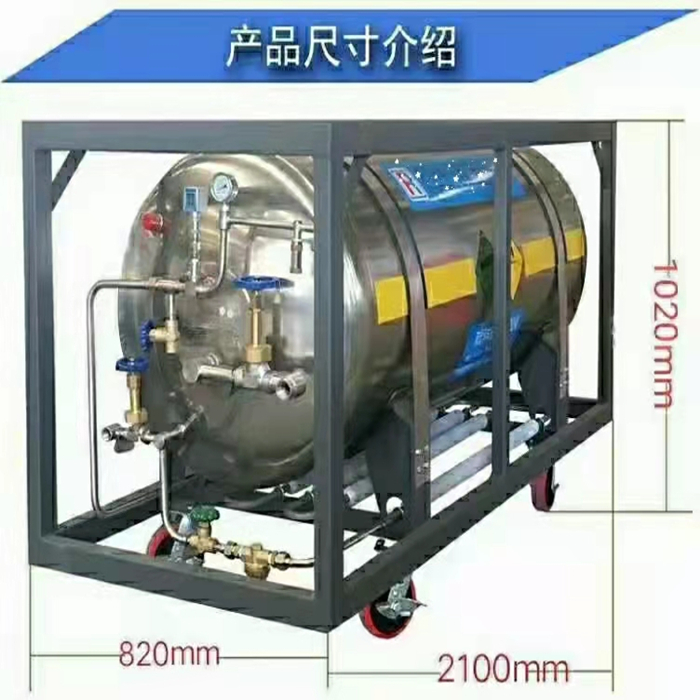
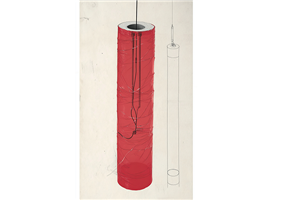
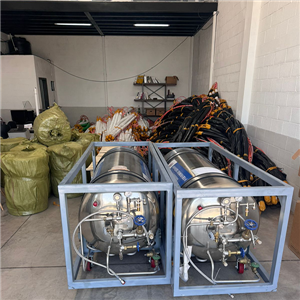
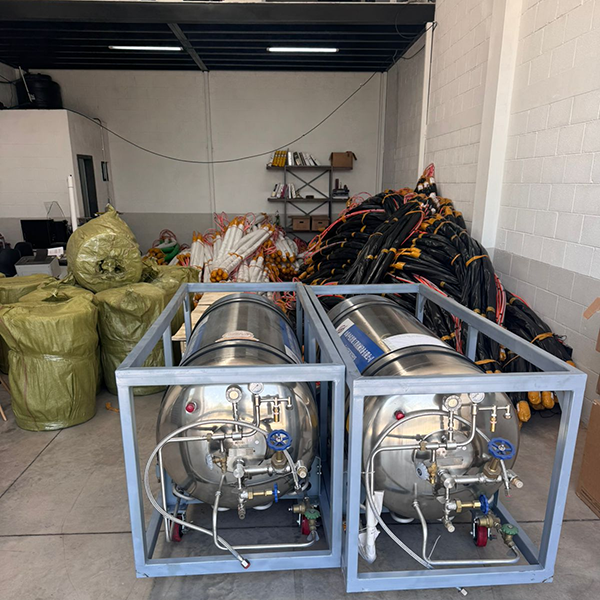
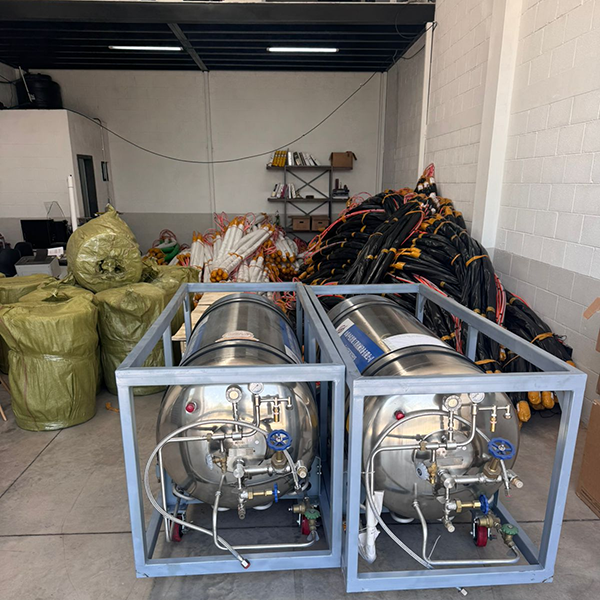
The Gaea DPW650-499-2.5 Gas Filling Tank is a high-vacuum multi-layer insulated cryogenic cylinder designed for the O2 Rock Blasting System. With 499L capacity, 2.5 MPa working pressure, and S30408 stainless steel construction, it safely stores and supplies liquid oxygen (LO2) to rock splitting tubes on-site.
Liquid Oxygen Gas Filling Tank 499L for Rock Blasting
Liquid Oxygen Gas Filling Tank for O2 Rock Blasting System — Cryogenic Cylinder 499L
What Is a Gas Filling Tank in the O2 Rock Blasting System?
The gas filling tank (also called a cryogenic cylinder, LO2 storage tank, or liquid oxygen dewar) is the core energy supply unit of the O2 Rock Blasting System. It safely stores liquid oxygen at cryogenic temperatures (-183°C) and delivers it under pressure to rock splitting tubes through a controlled filling process. Without the gas filling tank, there is no way to transport and dispense liquid oxygen efficiently on the blasting site.
The Gaea DPW650-499-2.5 is specifically engineered for rock blasting applications — rugged enough for quarry floors, tunnel portals, and underwater platforms, yet precise enough to fill each splitting tube with the exact amount of liquid oxygen required for optimal rock fragmentation.
Key Specifications
Capacity & Pressure
Dimensions & Weight
Filling Weight by Medium
Gas-Liquid Expansion Ratios
Material & Wall Thickness
Insulation Performance
Valve & Port Configuration
Ports (Nozzle Connections)
Valve System
How the Gas Filling Tank Works in the O2 Blasting System
Step-by-Step Filling Process
Pre-fill Check — Confirm the tank medium matches the filling medium. If switching media, purge the tank with dry nitrogen first. Inspect all valves and connections for leaks.
Connect Hoses — Attach the filling hose from the LO2 supply source to the liquid inlet port (Port a). Tighten all threaded connections.
Open Filling Valve (V2) — Liquid oxygen flows into the inner vessel through a spray pipe at the top of the tank, which reduces vapor pressure and re-liquefies boil-off gas, minimizing venting losses.
Monitor Level & Pressure — The capacitive liquid level gauge (DYJ-10) provides real-time level readings. The pressure gauge shows internal pressure. Fill until the net weight reaches the maximum filling capacity marked on the nameplate (541 kg for LO2).
Close & Seal — Close the filling valve (V2), disconnect the hose, and check for leaks at all connection points.
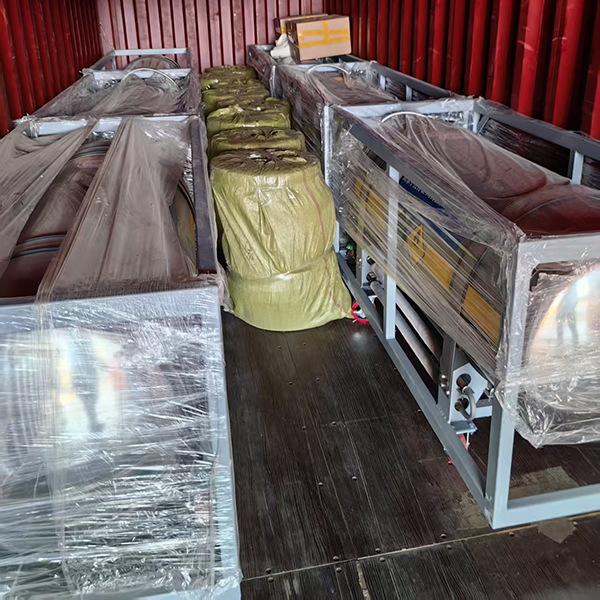
On-Site Liquid Oxygen Delivery to Splitting Tubes
When ready to blast:
Build Pressure — Open the pressure building valve (V4) to activate the pressurizer at the tank bottom. The pressurizer vaporizes a small amount of liquid to raise tank pressure. Recommended: boost to at least 0.8 MPa / 2.1 MPa before supplying liquid.
Connect to Splitting Tubes — Connect the discharge hose to Port c and attach it to the rock splitting tube's filling inlet.
Fill Splitting Tubes — Open the discharge valve (V3). Pressurized LO2 flows from the tank into each splitting tube. Each tube requires approximately 6 kg of liquid oxygen per meter of length.
Seal & Detonate — After filling, seal the splitting tube, backfill the drill hole with soil, evacuate personnel to the safety perimeter (typically < 50 m for open-air, even less for tunnel applications), and activate the remote detonator.
Safety Features
Dual Overpressure Protection
The DPW650-499-2.5 features a two-stage safety system:
Stage 1 — Safety Relief Valve: Opens at 2.86 MPa (415 psi) to release excess pressure from normal boil-off or mild overpressure conditions. Automatically reseats when pressure returns to safe levels.
Stage 2 — Bursting Disc: Ruptures at 3.6 MPa (522 psi) as a failsafe if the relief valve cannot keep up with rapid pressure buildup (e.g., fire exposure or vacuum failure). Once ruptured, the disc must be replaced.
Grounding System
When filling or dispensing liquid oxygen, all equipment must be conductive and grounded. Grounding resistance must not exceed 10 Ω. The tank base should be in direct contact with the ground; install special grounding poles if necessary.
Inherent Safety of LO2
If a filled splitting tube is not ignited within 10–20 minutes, the liquid oxygen absorbs ambient heat and vaporizes. The oxygen concentration in the tube drops below the combustion threshold, making ignition impossible. This self-neutralizing feature eliminates the risk of unexploded ordnance — a critical advantage over traditional explosives.
Operating Conditions by Application
Open-Air Blasting
Tunnel Blasting
Underwater Rock Breaking
The gas filling tank operates on the surface or platform above water, supplying LO2 via hoses to submerged splitting tubes. The tank's high vacuum insulation ensures minimal LO2 losses even in humid marine environments.
Maintenance & Care
Daily Checks
Inspect all valves for frost or leaks
Verify pressure gauge reads within normal range
Check liquid level before each shift
Monthly Checks
Leak test all piping connections with soap solution
Verify grounding resistance ≤ 10 Ω
Inspect vacuum plug integrity (do not open)
Annual Inspection
Full pressure test per GB/T 24159-2022
Safety valve calibration (opening pressure 1.0–1.2× nominal working pressure)
Vacuum performance verification (static evaporation rate ≤ 1.7%/day)
Troubleshooting
Certifications & Standards
Applicable Tank Models
The Gaea DPW series includes models for various capacity and pressure requirements:
Recommended for O2 Rock Blasting: DPW650-499-2.5 — the 499L capacity and 2.5 MPa working pressure provide the optimal balance of LO2 storage volume and delivery pressure for most blasting operations.
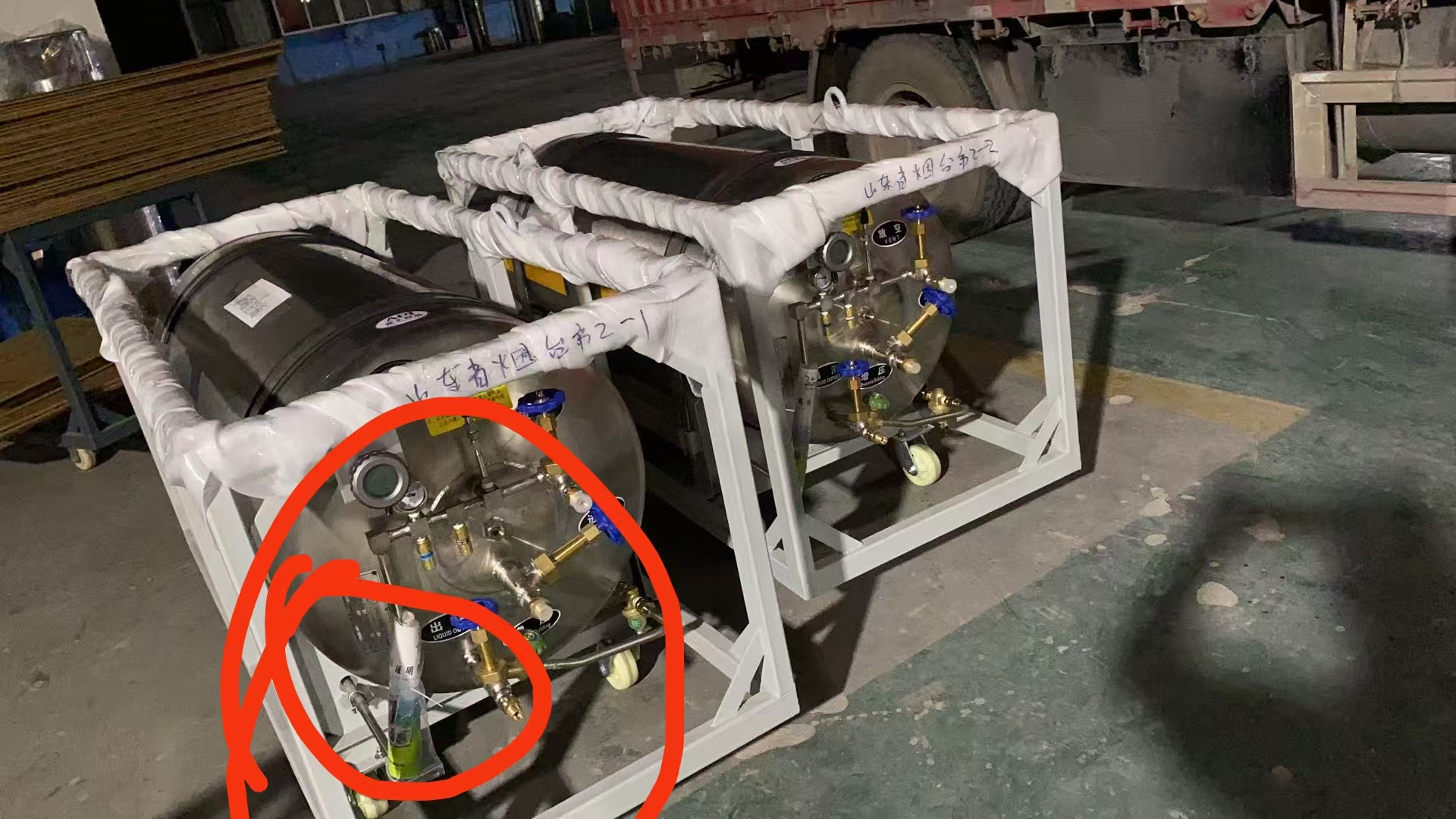
Each product comes with a product manual and a test certificate:
Why Choose Gaea Gas Filling Tanks?
Original Patent Holder — Gaea is the original designer and patent holder of the O2 Rock Blasting System. Our gas filling tanks are purpose-built for rock blasting, not generic industrial gas cylinders repurposed for the job.
Proven in the Field — Our tanks have been deployed across open-pit mines, tunnel projects, quarries, and underwater reef breaking operations throughout Asia, South America, and Africa.
Dual Safety System — Relief valve + bursting disc protection ensures safe operation even under extreme conditions.
Ultra-Low Evaporation — High vacuum multi-layer insulation delivers ≤1.7%/day static evaporation rate, meaning less LO2 waste and more blasts per tank.
Full Certification — Manufactured under GB/T 24159-2022 with third-party supervision, backed by complete batch inspection quality certificates.
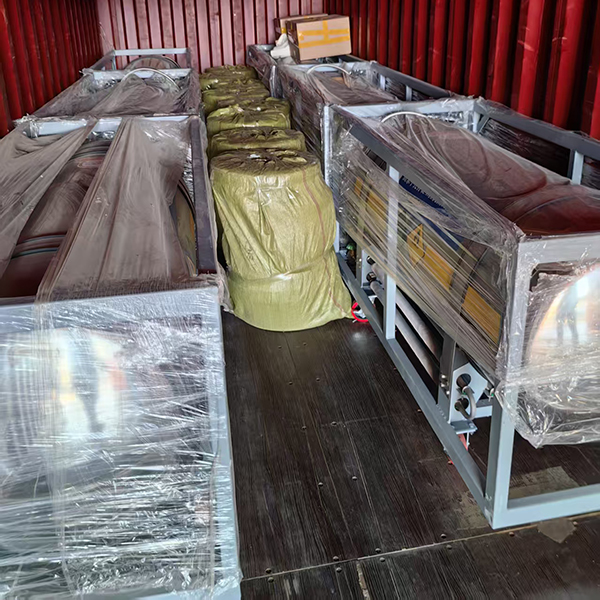
Global Shipping — Liquid oxygen tanks are classified as standard industrial equipment (not explosives), enabling straightforward international logistics.
Frequently Asked Questions
Q: How many splitting tubes can one full tank fill?
A: With 541 kg of LO2 per fill and approximately 6 kg of LO2 per meter of splitting tube, a full DPW650-499-2.5 can fill roughly 90 meters of splitting tube — equivalent to about 15 tubes at 6 m depth (open-air) or 36 tubes at 2.5 m depth (tunnel).
Q: How long can the tank hold LO2 before significant loss?
A: The static evaporation rate is ≤1.7% per day. At this rate, after 7 days you would retain approximately 88% of the original fill — still highly usable for blasting operations.
Q: Can the same tank be used for different media (LO2, LN2, LAr, LCO2)?
A: Yes, the DPW650-499-2.5 is rated for LO2, LN2, LAr, and LCO2. However, if switching between media, the tank must be completely purged with dry nitrogen before refilling with a different medium.
Q: What happens if the tank is over-pressurized?
A: The dual safety system activates in sequence: first the relief valve opens at 2.86 MPa to vent excess gas; if pressure continues to rise, the bursting disc ruptures at 3.6 MPa as a failsafe.
Q: Is special licensing required to transport this tank?
A: The gas filling tank itself is classified as standard pressure equipment, not an explosive device. Transport regulations for cryogenic vessels apply, but no explosives licensing is needed — a significant advantage over traditional blasting material logistics.
Q: How do I know when the tank needs refilling?
A: The built-in capacitive liquid level gauge (DYJ-10) provides real-time level readings on the display meter. Additionally, you can monitor the gross weight — a standard scale will show when the tank approaches its 434 kg tare weight.