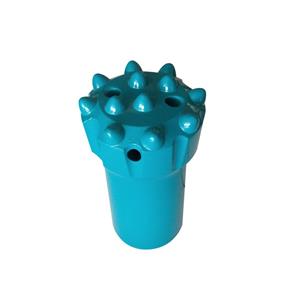
Convex, Concave, or Flat? Matching Your Button Bit Face to the Rock Before the First Hole
In ground that's pushing past 15,000 psi compressive strength, the wrong bit face design doesn't just slow you down. It can cut your penetration rate in half, chew through carbide at an alarming rate, and in fractured formations, it can contribute to hole collapse. The bit face profile isn't a cosmetic choice — it's how the bit manages energy transfer, cuttings evacuation, and button loading in the specific rock you're drilling.
Here's the matching logic that most manufacturers use but too few operators are taught.
Convex Bits: The Fast Mover in Competent Ground
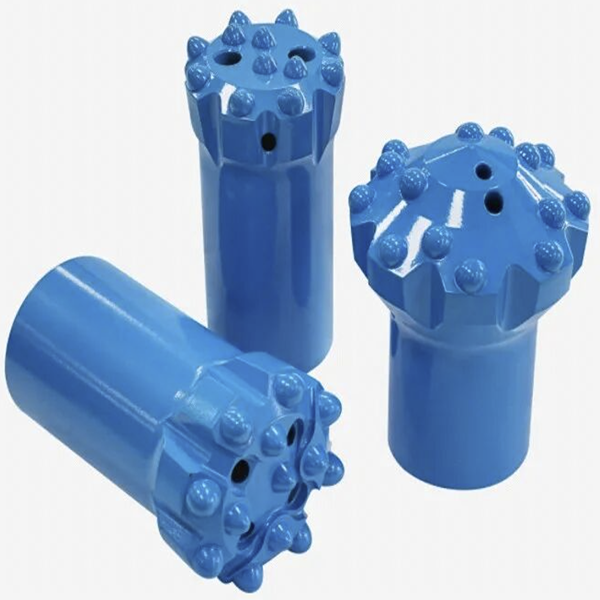
A convex face — often called a drop-center or dome profile — keeps the buttons on a curved surface that concentrates impact energy toward the center of the hole. This design works best in soft to medium rock, roughly 15,000 to 25,000 psi. Think hard limestone, competent sandstone, diorite, schist, and some granites.
The key requirement is that the rock needs to be consolidated and uniform. Convex bits rely on the rock fracturing predictably under each button strike. When the formation is solid and consistent, the curved face delivers fast penetration with even button wear because the load spreads smoothly across the face profile.
Put a convex bit into fractured, blocky ground and the energy stops transferring cleanly. Buttons on the outer edge take impact loads they weren't designed for, and wear becomes uneven fast.
Concave Bits: When the Ground Has Issues
A concave face profile — where the center of the bit face is recessed relative to the outer ring — handles a wider range: 15,000 to 30,000 psi, covering soft-medium through medium-hard formations. The big advantage here is that the face design accommodates voids, faults, and loosely consolidated zones better than a convex profile.
The recessed center creates a natural channel for cuttings to flow toward the flushing grooves. In fast drilling where chip volume is high, this makes a measurable difference in hole cleaning and penetration consistency. The outer buttons take more of the initial impact load, which helps the bit maintain stability when it crosses a void or a fracture zone.
For formations like hard limestone, granite with jointing, sandstone, and marble where the ground isn't perfectly uniform, a concave face tends to be the safest all-around choice.
Flat-Face Bits: The Brute for Hard Rock
When you're above 30,000 psi — dense granite, gabbro, the kind of rock that laughs at anything less — you need a flat-face bit. The design is simple: a heavy, blunt-nosed profile with buttons set into a nearly flat plane. There's no curvature to concentrate or disperse energy. Every button hits with maximum direct force, and the bit body is built thick to handle the reflected stress.
Flat-face bits want consolidated rock. Small voids and hairline cracks are tolerable, but heavily fractured ground will beat up a flat-face bit because there's no face geometry to help stabilize the bit when it loses full contact with the rock.
The tradeoff is penetration rate in softer ground — a flat face in 18,000 psi rock will drill slower than a convex profile would, because the energy isn't being focused into fracture initiation. But in true hard rock, nothing else survives long enough to make the comparison.
The Thirty Percent Rule
The original article claims that matching the right bit face to the rock can improve drilling efficiency by 30%. That number sounds aggressive, but having seen what happens when a crew runs the wrong profile for a full shift, I'd say it's in the ballpark. A convex bit in hard granite wears out in hours. A flat-face bit in fractured limestone drills slow and costs more than it should. Match the profile to the formation, and both problems disappear.
The bit face is the first decision. Get it right, and everything downstream — penetration rate, button life, hole quality — falls into place.