Carburized vs Surface-Hardened Drill Rods: How to Choose for Rock Drilling
Hydraulic rock drilling rigs depend on a reliable drill string to transfer impact energy, rotation, and feed force from the rock drill to the bit. While drill bit selection often receives the most attention, the drill rod is equally important. A rod must remain straight, resist wear, withstand repeated impact, and maintain strong threaded connections throughout its service life.
Two common approaches used to improve drill rod performance are carburizing and surface hardening by induction heating. Both methods are designed to create a hard, wear-resistant outer layer while retaining a tougher core. However, they differ in processing method, performance characteristics, and preferred application conditions.
Understanding these differences can help mining, tunneling, quarrying, and construction contractors choose drill rods that better match their drilling depth, rock conditions, and productivity goals.
Why Drill Rod Heat Treatment Matters
A drill rod experiences repeated stress during drilling. Each impact from the rock drill sends energy through the shank adapter, rod body, threaded joints, and drill bit. At the same time, the rod rotates under load and faces abrasion from drilling cuttings, contact with the hole wall, and wear at threaded connections.
Without suitable heat treatment, the rod body may wear too quickly, threads may become damaged, and the rod may lose the fatigue strength needed for long drilling cycles. A broken drill rod can cause more than the cost of a replacement tool. It can stop production, leave parts of the drill string in the hole, create recovery work, and potentially result in a discarded hole.
The ideal drill rod needs a balance of surface hardness and core toughness. The surface should resist abrasion and thread wear, while the core should absorb impact energy without becoming too brittle.
What Is Carburizing?
Carburizing is a heat-treatment process that enriches the surface layer of steel with carbon. For drill rods, this treatment is commonly carried out in a carbon-rich atmosphere at controlled temperature. Carbon diffuses into the rod surface and can also improve the wear resistance of internal areas such as flushing-hole walls, depending on the process design.
After carburizing, the rod is quenched and tempered to achieve a hard outer case with a tougher internal core. The source article describes a typical target result of approximately HRC 58-60 on the surface and about HRC 43 in the core. These values are useful process references, but the correct hardness profile must be confirmed for the actual steel grade, rod size, drilling method, and manufacturer’s quality specifications.
The key benefit of carburizing is the formation of a deeper, wear-resistant case. This can support good fatigue performance and abrasion resistance when the process is well controlled. For drill rods used in longer holes or high-production applications, this balance can be especially valuable.
However, carburizing requires strict process control. Carbon potential, furnace temperature, heating time, quenching method, and tempering conditions all influence the final result. Poor control can lead to uneven case depth, distortion, cracking, or insufficient core properties.
What Is Induction Surface Hardening?
Surface hardening is often performed using high-frequency induction heating followed by quenching and tempering. The process heats the outer layer of the rod rapidly, then cools it in a controlled way to create a hardened surface.
For hydraulic drill rods, induction treatment can be applied to the rod body and then repeated in critical areas such as threaded sections. This localized approach can be useful where manufacturers need to strengthen specific zones while maintaining toughness in other areas.
Compared with carburizing, induction hardening can provide faster processing and good control over the area being treated. It is often suitable for production systems that require repeatability and flexible treatment of selected rod sections.
Surface-hardened drill rods are generally considered to offer good toughness. This can be an advantage in fractured, layered, or variable rock formations where the drill string may experience irregular loading, bending, and vibration.
The trade-off is that fatigue life and overall wear resistance may differ from a properly carburized rod, depending on the material, case depth, heat-treatment parameters, and service conditions. A surface-hardened rod should therefore be evaluated through actual drilling performance rather than by heat-treatment method alone.
Key Differences Between the Two Methods
Carburized drill rods and induction surface-hardened drill rods both aim to protect the rod surface, but their performance priorities can be different.
Carburizing generally focuses on developing a durable hardened case with good wear resistance and fatigue performance. This can be a strong choice for demanding drilling applications, especially where drilling depth is greater and long service life is important.
Induction surface hardening can emphasize toughness and targeted treatment of high-wear areas. It may be well suited to drilling in interbedded or fractured rock, where sudden changes in rock conditions can create uneven impact loads and increase the risk of brittle failure.
The decision should not be made only by comparing hardness values. Contractors should also consider:
Rock hardness and abrasiveness
Presence of fractures, joints, or interbedded formations
Hole depth and diameter
Drill rig impact power and rotation speed
Required hole-straightness tolerance
Rod diameter and thread system
Flushing conditions
Expected meters drilled per rod
Availability of maintenance and inspection procedures
Drill Rod Selection for Deep Holes
As blast holes become deeper, drill rod quality becomes increasingly important. Small alignment errors, thread wear, or rod runout can contribute to hole deviation. In long-hole drilling, deviation can affect burden, spacing, charge distribution, fragmentation, and blasting results.
The original article notes that for holes deeper than 20 meters, carburized MF drill rods combined with guiding retrac button bits can help control hole deviation and extend tool life. This should be treated as a practical application reference rather than a universal rule. Final selection must be matched to the drilling system, formation, and site requirements.
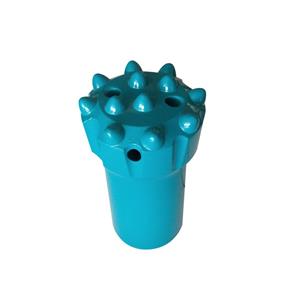
For deep-hole drilling, contractors should pay close attention to rod straightness, thread condition, coupling quality, bit gauge, and guide-tool design. A high-quality carburized rod may offer a useful combination of wear resistance and fatigue strength, but it must be used with compatible shank adapters, couplings, and bits.
Maintenance Is Part of the Solution
Even the best heat-treated drill rod requires regular inspection. Operators should check for thread wear, damaged flushing holes, visible cracks, bending, and abnormal surface damage. Thread lubrication and proper coupling procedures can reduce galling and connection wear.
Drill rod failures are often linked to operational factors, not only material quality. Excessive feed pressure, poor alignment, improper bit selection, insufficient flushing, or running worn components can all shorten rod life. Monitoring drilling parameters and removing damaged tools before failure are essential steps in protecting the drill string.
Conclusion
Carburized and induction surface-hardened drill rods both have important roles in hydraulic rock drilling. Carburized rods can offer strong wear resistance and fatigue performance when produced under strict process control. Surface-hardened rods can provide useful toughness and may be suitable for fractured or interbedded rock conditions.
The right choice depends on the complete drilling environment. By matching heat treatment, rod design, bit type, drilling depth, and rock condition, contractors can reduce downtime, improve hole quality, and lower total drilling cost per meter.