Can Cermets Replace Cemented Carbide in Mining Rock Drilling?
Can Cermets Replace Cemented Carbide in Mining Rock Drilling?
Since 2025, mining cemented-carbide prices have risen sharply because of tighter tungsten-mining quotas and export controls. Tungsten-carbide powder has reached approximately RMB 2,400 per kilogram, increasing cost pressure throughout the rock-drilling tool supply chain.
This has raised an important question: can cermets replace cemented carbide in mining drilling applications?
Raw Materials and Cost
Mining cemented carbide mainly consists of tungsten carbide (WC) and cobalt (Co), making it highly dependent on expensive tungsten resources.
Cermets are based on titanium carbonitride, Ti(C,N), or alumina, Al₂O₃, and do not use tungsten. This allows them to avoid direct exposure to rising tungsten prices.
According to March 2026 market data, industrial-grade 300-mesh titanium carbonitride was quoted at approximately RMB 535 per kilogram, substantially below the roughly RMB 2,400 per kilogram price of tungsten-carbide powder. Cermets therefore have a clear raw-material cost advantage.
Hardness and Fracture Toughness
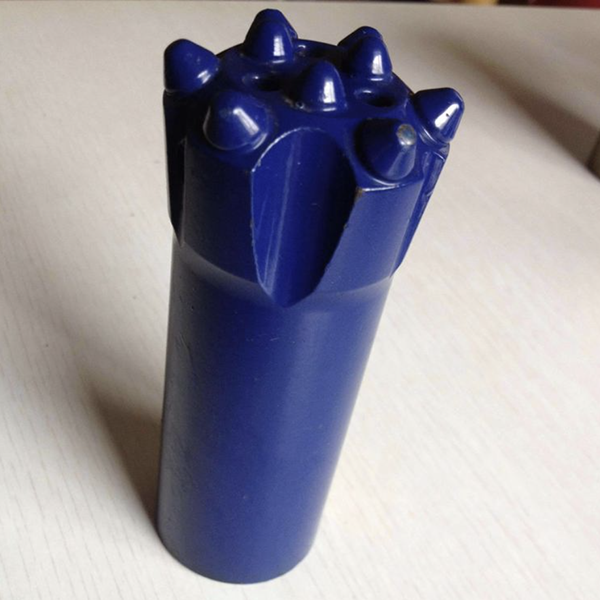
Mining cemented carbide typically has a hardness of approximately 88.0–90.8 HRA and fracture toughness of about 10–15 MPa·m¹ᐟ². This combination provides strong impact resistance and allows the material to withstand high-frequency rock-drilling impacts.
Cermets may have slightly higher hardness, approximately 90.0–92.0 HRA, but their fracture toughness is lower, around 5–10 MPa·m¹ᐟ². Under repeated impact, they are more likely to chip or fracture.
Current Replacement Limits
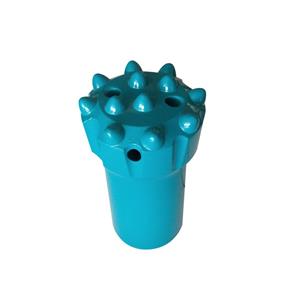
Although cermets offer a lower raw-material cost, they cannot currently replace cemented carbide across the full range of mining rock-drilling conditions.
Their lower toughness is a major limitation in heavy-load, high-frequency impact drilling and high-power equipment applications. At present, cermets may be considered only for limited applications such as extremely hard rock formations and lower-impact operating conditions.
Material selection should consider not only hardness and price, but also impact load, fatigue behavior, rock abrasiveness, bit design, and failure risk.
Future Development
Advances in cermet modification, toughening technology, and composite-material manufacturing may improve impact resistance and fracture toughness.
If these technical improvements are achieved and verified through long-term field use, cermets may expand their application in mining rock drilling. However, broader replacement of cemented carbide will depend on measurable performance improvements, field validation, and total lifecycle cost.