Cross Bit vs. Button Bit: How to Choose the Right Rock Drilling Bit
Cross Bit vs. Button Bit: How to Choose the Right Rock Drilling Bit
Selecting the right drilling bit is one of the most important decisions in rock excavation. The bit influences penetration rate, hole straightness, tool life, maintenance workload, downtime, and total drilling cost. In mining, tunneling, quarrying, and construction projects, two widely used options are the cross drill bit and the button bit.
Both tools can break rock effectively, but they use different cutting structures and perform best under different conditions. A cross bit may be a practical low-cost choice for soft or medium-hard formations. A button bit is often the preferred option for hard, abrasive, or demanding rock because it can provide longer life and more stable drilling performance.
The best choice should be based on rock properties, drilling equipment, maintenance capability, and drilling cost per meter rather than purchase price alone.
Cross Drill Bit Structure and Working Principle
A cross drill bit uses four flat carbide inserts arranged in a cross-shaped pattern across the bit face. These inserts create sharp cutting edges that break rock through a combination of impact and shearing action.
The structure is relatively simple. When the rock drill delivers impact energy and rotation, the crossed cutting edges strike and cut the rock surface. This design can provide strong initial penetration in softer formations because the flat carbide edges produce an efficient cutting action.
Common characteristics of a cross drill bit include:
Flat carbide inserts in a cross arrangement
Sharp cutting edges
Strong cutting action in soft or medium-hard rock
Simple manufacturing structure
Lower initial purchase cost
Need for regular regrinding
The main maintenance requirement is regrinding. As the carbide edges become blunt, cutting efficiency decreases noticeably. A cross bit must be reground at the correct time to restore its cutting performance. If it continues to operate after becoming dull, penetration rate may fall, drilling force may rise, and the bit can wear more rapidly.
Button Bit Structure and Working Principle
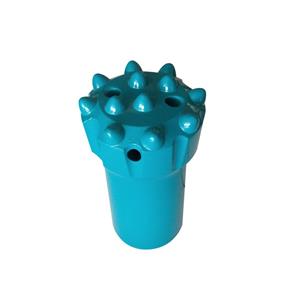
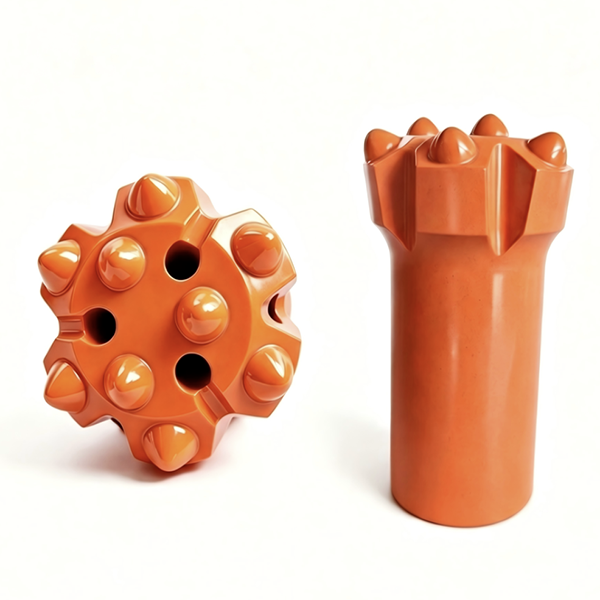
A button bit uses multiple rounded, hemispherical, or conical carbide buttons embedded in the steel bit body. Instead of relying on long cutting edges, the bit breaks rock through concentrated point contact and repeated impact crushing.
The button design distributes force more evenly across the bit face. This helps the bit tolerate high impact loading and abrasive rock conditions. In many hard-rock applications, the rounded carbide buttons are less likely to chip than flat carbide inserts.
A button bit for hard rock typically offers:
Multiple carbide buttons in a balanced arrangement
Concentrated impact crushing
Better resistance to high-impact loading
Strong wear resistance in abrasive ground
Lower need for frequent regrinding
Longer service life in suitable conditions
Button wear is usually more gradual and even than the wear of flat carbide cutting edges. This can reduce maintenance interruptions and improve drilling consistency during long production cycles.
Drilling Speed and Efficiency
For soft and medium-hard rock, a cross drill bit can often achieve a good initial penetration rate. The sharp edges cut effectively in formations such as shale, soft limestone, mudstone, and some sandstone conditions.
For very hard or highly abrasive rock, button bits usually have an advantage. Granite, basalt, diabase, quartzite, and iron-bearing rock can quickly wear or chip flat carbide edges. A button bit can maintain more stable penetration because its inserts are designed to withstand concentrated impact and abrasive contact.
However, the bit should always be matched to the rock drill, drill steel, hole diameter, flushing method, and drilling parameters. A high-quality bit used with unsuitable feed force, rotation, or flushing may still fail prematurely.
Tool Life and Maintenance
Tool life is a key difference in the cross bit vs button bit comparison. Flat carbide inserts can experience stress concentration at the cutting edge, especially in hard rock, fractured ground, or formations with frequent changes in hardness. This can lead to chipped edges, cracked inserts, and shorter service life.
Button bits generally have a more favorable stress distribution. Their rounded inserts are better suited to repeated impact and abrasive conditions. In hard rock, this often gives them a longer service life and reduces replacement frequency.
Cross bits remain suitable when a project has reliable regrinding capability and operates in favorable rock conditions. They can be a cost-effective choice for short-term work, shallow holes, small quarries, and projects with limited budgets.
Hole Quality and Anti-Jamming Performance
Hole quality affects downstream work such as blasting, support installation, grouting, and tunnel advance. In fractured ground or at boundaries between different rock layers, a cross bit may be more likely to deviate from the intended drilling direction. Its anti-jamming capability can also be lower in complex formations.
Button bits provide better guidance because of their multi-button arrangement and more stable bit face. They can support smoother cuttings removal, lower hole deviation, and reduced risk of jamming in difficult ground conditions.
For deep-hole blasting, underground mining, long tunnel drives, and continuous production drilling, these advantages can be significant.
A Practical Selection Guide
Choose a cross drill bit when:
The rock is soft to medium-hard
Rock abrasiveness is relatively low
The project has bit-regrinding capability
Initial tool cost is the main concern
Drilling is shallow or temporary
Choose a button bit when:
The rock is hard, very hard, or highly abrasive
Long service life and stable performance are required
Hole accuracy is important
Frequent regrinding would interrupt production
The project involves deep-hole drilling, tunneling, or underground mining
The best rock drilling bit selection is based on total operating value. In hard rock, a button bit may cost more to purchase but deliver a lower cost per meter because it lasts longer, needs fewer changes, and reduces maintenance downtime.