Directional Rock Fracture Blasting: Principles and Engineering Applications
Directional Rock Fracture Blasting: Principles and Engineering Applications
Directional rock fracture blasting is a controlled-blasting concept intended to guide rock breakage along a planned direction. In suitable engineering applications, the objective is to create predictable fracture paths while limiting unnecessary damage to the surrounding rock mass.
This approach can be relevant in mining, tunneling, slope work, excavation, and other projects where rock stability, excavation boundaries, and downstream work quality are important.
Controlled Rock Breakage
Conventional blasting can generate fractures in multiple directions. Directional fracture blasting instead seeks to influence where cracks initiate and how they propagate. The intended result is more controlled separation of rock, reduced overbreak, and better protection of adjacent material.
In engineering terms, the method is associated with the creation or use of preferred fracture paths. Under properly designed loading conditions, these paths can encourage cracks to extend in the required direction and form a more defined separation plane.
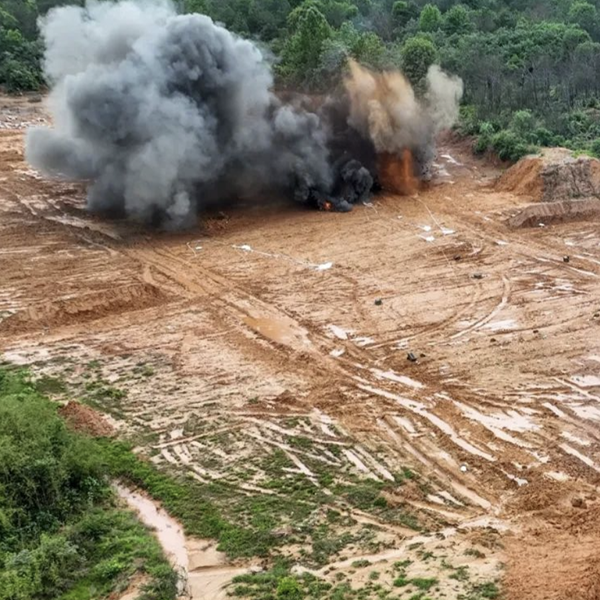
Protecting the Surrounding Rock Mass
One of the main potential benefits of controlled directional breakage is the protection of surrounding rock. Limiting unwanted fracture development can help preserve rock-mass integrity near excavation boundaries, slopes, tunnels, and other sensitive areas.
This may support safer subsequent operations, reduce unnecessary rock damage, and improve the quality of the final excavation profile. Actual results, however, depend heavily on rock properties, in-situ conditions, engineering design, and field verification.
Focused-Energy Concepts
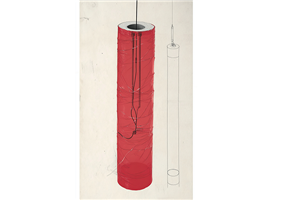
The source article also discusses focused-energy charge concepts. At a high level, these approaches are intended to influence how explosive energy is distributed so that rock damage is concentrated in a preferred direction rather than dispersed uniformly.
Such concepts involve specialized charge configurations and dynamic material behavior. They are not general-purpose field practices and must be evaluated, designed, and implemented only by licensed blasting professionals under approved engineering and regulatory controls.
Engineering Considerations
Directional rock fracture blasting should be treated as a project-specific engineering solution rather than a standard procedure. Important considerations include:
Geological structure and rock-mass quality
Required excavation geometry and permitted overbreak
Nearby structures, slopes, tunnels, or infrastructure
Vibration, flyrock, noise, and environmental constraints
Applicable regulations, permits, and exclusion-zone controls
Monitoring, trial validation, and qualified technical supervision
When properly assessed, controlled directional blasting can contribute to more precise excavation and improved rock-mass protection. All practical blasting decisions must follow the approved blast design, manufacturer guidance, site safety system, and local legal requirements.