Chisel, Cross, or Button? The Three Drill Bit Types and Where Each One Wins
Ask a driller which bit they prefer and you'll get a strong opinion. But the right answer depends entirely on the rock, the rig, and what "good enough" means for your operation. Not every hole needs the most expensive bit in the catalog. Some holes just need the right one.
Drill bits for percussion drilling break down into three families. Each has a clear place. Put the wrong one in the wrong ground and you'll know it within the first few holes.
Chisel Bits: When Simple and Cheap Is Exactly What You Need
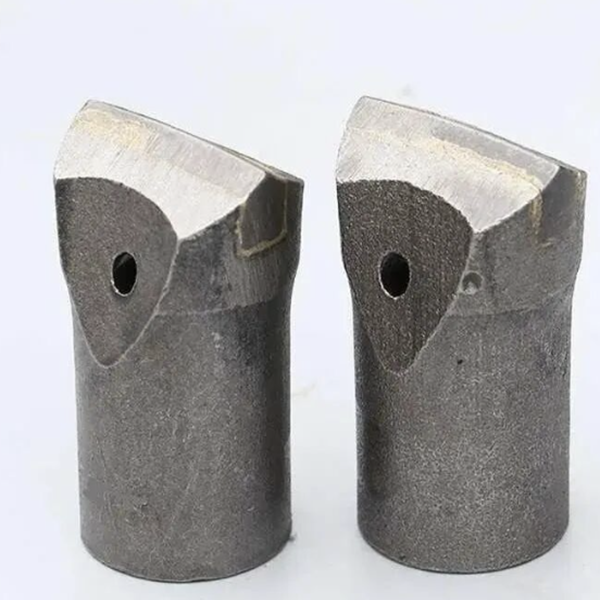
A chisel bit has a single carbide insert running across the face in a straight line — one cutting edge, one impact point per blow. The design hasn't changed much in decades because for certain jobs, it doesn't need to.
In medium-hard, consistent rock — the kind where you're not fighting fractured zones or wildly alternating hardness — a chisel bit cuts fast and leaves a clean, round hole. The single-edge design concentrates impact energy into a narrow line, which means efficient energy transfer into the rock face. For small-diameter holes in tunneling and development work where the ground is predictable, a chisel bit will match the performance of more complex designs at a fraction of the cost.
The limitation is versatility. Hit a hard seam or a void and that single cutting edge takes the full brunt. In abrasive ground, the carbide wears faster than multi-insert designs because all the work is concentrated on one edge. And if you're drilling larger-diameter holes, the single-edge geometry starts losing efficiency — there's only so much rock one cutting line can fracture per blow.
Cross Bits: The Mid-Range Workhorse
A cross bit adds a second carbide insert at ninety degrees to the first, giving you four cutting edges instead of two. More edges mean more impact points per blow, which means faster penetration in harder rock and more even wear distribution across the bit face.
These are the step up from chisel bits for operations that have outgrown the single-edge design but don't yet need the full versatility of a button bit. In hard, competent rock — granite, basalt, dense quartzite — a cross bit will out-drill a chisel bit by a meaningful margin. The cross geometry also helps keep the hole straighter in fractured ground because there's cutting contact in two planes instead of one.
Large open-pit operations running medium-diameter blast holes often settle on cross bits as the sweet spot between cost and performance. They're more expensive than chisel bits but deliver enough extra speed to justify the price — and they're still simpler and cheaper than button bits.
Button Bits: The Modern Standard
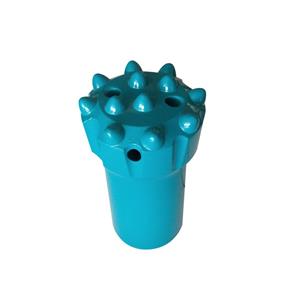
A button bit replaces blades with spherical tungsten carbide inserts pressed into the bit face — anywhere from five to over a dozen buttons, arranged in a pattern that's engineered for specific rock types and hole sizes. The buttons protrude from the face, so each impact creates multiple fracture points instead of a single cutting line.
The advantage is adaptability. A button bit with a convex face profile and aggressive button protrusion will tear through soft rock. The same bit with a flatter face and recessed buttons will survive in abrasive, blocky ground that would destroy a chisel bit in an hour. Change the button grade, the face design, or the flushing groove configuration, and you've tuned the bit for a different set of conditions.
Button bits dominate modern mining and tunneling for a reason: they're the closest thing to a universal solution in percussion drilling. The tradeoff is cost — a quality button bit is an investment — and regrinding requires specialized equipment. But in production drilling where downtime is the real expense, button bits pay for themselves in consistency and longevity.
Don't Let the Bit Make the Decision Alone
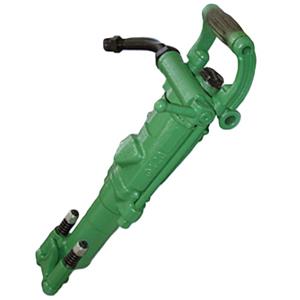
The bit doesn't work in isolation. A chisel bit on a high-power hydraulic drifter will self-destruct — too much energy for too little cutting surface. A button bit on a low-power pneumatic drill won't transfer enough energy to the rock face to justify its price. Match the bit to the rig and the rock, not just to the budget.