Drill Bit Water Holes Keep Clogging? It's Probably Not Your Water Pressure
There's a diagnostic shortcut in pneumatic drilling that's wrong more often than it's right: "water holes are blocked — must be a pressure problem." Crank up the pump, swap a hose, call the mechanic. And when the bit clogs again fifteen minutes later, everyone stands around scratching their heads because the pressure gauge says everything is fine.
Here's the thing most troubleshooting guides miss: when water pressure is normal and the bit still won't flush, the problem usually isn't in the pump or the plumbing. It's in the rock you're drilling and the water you're pumping. Fix those two things, and the clogs disappear without touching a single valve.
The Mud Problem: When the Formation Fights Your Flush
Soft, weathered, or clay-rich formations — mudstone, heavily weathered granite, shale with high clay content — have a nasty habit that catches drillers off guard. The rock that looked manageable at the collar turns into something completely different once water hits it underground.
In dry cutting, these formations are crumbly but manageable. Add water — which you have to, because the bit needs cooling and the hole needs flushing — and the rock transforms. The clay minerals hydrate, swell, and break down into a sticky paste that has the consistency of modeling clay. This paste doesn't flush out like granular cuttings. It smears. It coats the borehole wall. And most critically, it packs around the bit face, forcing its way into the water holes and solidifying into a plug that even full pump pressure can't dislodge.
The timing makes it worse. High-impact drilling in soft ground generates cuttings at an extraordinary rate — the bit is eating through meters per minute. The flush water simply can't keep up. The ratio of cuttings produced to cuttings removed tilts hard toward accumulation, and every second the bit keeps drilling, more paste is getting packed around the water holes.
You'll know this is happening before the bit completely clogs. The telltale sign is the return water at the collar — it starts running dirty and thick, then turns muddy, then stops flowing entirely while the pump is still running. That's the moment the water holes have sealed shut, and the bit is now drilling dry in a hole full of paste. If you keep going, the carbide inserts will overheat, the bit body will score from dry friction against the hole wall, and the drill rod will start binding as cuttings pack the annulus.
The fix for mud-clogged water holes isn't more pressure — it's less aggression. Lower the impact power and slow your feed rate. Give the flush water time to do its job. Instead of drilling continuously and hoping the water catches up, drill in shorter intervals — a meter at a time, then pull back slightly and let the water flush the hole clean before advancing again. In clay-rich ground, that extra flushing pause between intervals is the difference between a clean bit and a plugged one.
After each hole, before you shut down, run the flush water for an extra 30 to 60 seconds with the bit still near the bottom. That final purge clears any paste that's starting to accumulate around the water holes before it has a chance to dry and harden into something that needs a chisel to remove.
The Dirty Water Problem: You're Pumping Abrasive Slurry Through Precision Passages
Most construction and small-scale mining sites don't have treated water on tap. They're pulling from a settling pond, a nearby stream, or a tank filled from whatever source is available. And that water is carrying silt, fine sand, organic particles, and whatever else was suspended in it when it got pumped into the supply.
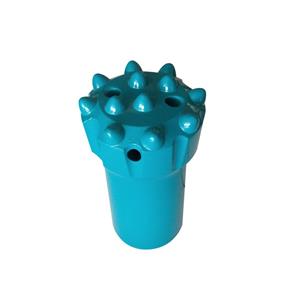
Here's what happens inside the bit when dirty water is forced through at high pressure: the water holes in a rock drill bit aren't just simple drilled passages — they're engineered flow channels with specific diameters and angles designed to direct coolant precisely onto the carbide insert cutting zones. When water carrying fine sediment hits the constriction at the nozzle, the flow accelerates. The suspended particles, now moving at high velocity, impact the edges of the water hole. Under sustained pressure, those particles compact against the hole walls, layer by layer, like sediment building up inside a pipe.
The buildup starts as a thin film. After a few hours of drilling, it's a crust. After a full shift, the water hole diameter has narrowed from, say, 3 millimeters to barely 1, and the flush flow has dropped to a trickle. The operator notices the bit running hot, the penetration slowing, the rod starting to bind — and blames the rock, the bit quality, or the pump, when the real culprit has been accumulating silently inside the bit all day.
The solution has two parts, and both are simple. First: filter the water at the source. A basic multi-stage filter — coarse mesh to catch sand and grit, fine mesh for silt — costs almost nothing compared to the bits and drill rods you're saving. Install it at the tank outlet or pump intake, and clean it every shift.
Second: establish a maintenance rhythm. At the end of every shift, pull the water filter and rinse it. Weekly, pull the bit and inspect the water holes with a flashlight — if you can see mineral crust building up around the hole edges, soak the bit in a descaling solution or carefully rod out the passages before the buildup becomes permanent. Replace any bit where the water holes can't be restored to full diameter — a partially blocked water hole will overheat the adjacent carbide insert, and that insert will fail long before the rest of the bit is worn out.
The Bit-Rod Flushing System: It's One Path, Not Two
One last thing worth remembering: the water holes in the bit are only the final section of a flushing path that starts at the pump and runs through the entire drill rod. A clean bit won't flush if the rod's center hole is packed with dried mud from three shifts ago. A clean rod won't help if the bit's water holes are crusted with mineral deposits.
When you're troubleshooting a flushing problem, check both ends. Pull the rod and look through it. Pull the bit and inspect the water holes. The blockage is rarely in the middle of the system — it's almost always at one end or the other, where flow constrictions and temperature changes make deposits form fastest.
Nine times out of ten, the fix isn't more water pressure. It's cleaner water and a slower, more patient approach in sticky ground. The pump is almost never the problem.