Matching Drill Speed to Rock: Why "Hard Rock Slow, Soft Rock Fast" Matters More Than You Think
Every pneumatic drill has a throttle. And every driller has an instinct about where to set it. But here's the thing about instinct: it's usually based on what feels right at the collar, not what's actually happening at the bottom of the hole where the drill bit meets the rock.
The rule sounds simple enough — hard rock, slow speed; soft rock, fast speed. But most drillers who understand the rule still get the application wrong because they don't understand why it works. And when you don't understand the why, you can't adjust when conditions change. Here's the physics behind the throttle, and why getting it wrong destroys drill bits and drill rods faster than anything else on the rig.
What Happens at the Bit Face When Speed Is Wrong
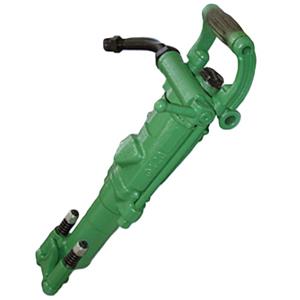
A pneumatic rock drill delivers two things to the drill bit through the drill rod: percussive impact energy — the piston hammering the shank — and rotation. The impact breaks the rock. The rotation indexes the carbide inserts to fresh rock between each blow so you're not hammering the same spot twice.
The relationship between impact frequency and rotation speed determines whether the bit is cutting efficiently or just beating itself to death.
Spin too fast in hard rock, and the bit rotates too far between impacts. The carbide inserts land on uncrushed ridges left by the previous blow, not in the craters they just created. Instead of the bit indexing into already-fractured rock and extending the cracks, it's hitting intact rock at a shallow angle on every blow. The inserts bounce. The penetration rate drops. And because the bit isn't bedding into the rock properly, the impact energy reflects back up the drill rod instead of being absorbed by the rock. That reflected energy manifests as vibration — the kind you feel in your hands and the kind that puts cyclic fatigue loads into every threaded connection in the string.
Spin too slow in soft rock, and you've got the opposite problem. The inserts are overlapping too much between blows, re-crushing already broken material instead of cutting fresh rock. The bit regrinds cuttings into powder, generates excess heat, and the penetration rate drops because the bit is spending energy on material that's already been reduced to dust. Meanwhile, the slow rotation means cuttings aren't being swept out of the way fast enough, so the bit face starts packing. A packed bit face in soft ground is the prelude to a plugged water hole and a burned set of carbide inserts.
Large-Diameter Bits in Hard Rock: Why Slow Is the Only Option
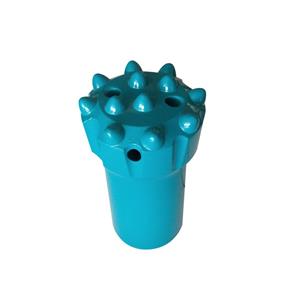
A 45-millimeter tapered button bit drilling granite is a completely different mechanical problem than a 32-millimeter bit in limestone. The larger the bit diameter, the greater the contact area between the bit face and the rock. More contact area means more resistance to rotation — the bit has to overcome friction across a wider gauge circle — and more resistance to penetration because the impact energy is being distributed across more carbide inserts.
In hard, dense, abrasive rock, that large contact area works against you. If you spin a 45 mm bit at the same RPM you'd use on a 32 mm bit in the same formation, the peripheral speed at the gauge row is proportionally higher — the outer inserts are traveling faster, hitting harder, and wearing faster than the center inserts. The gauge row wears out first, the bit diameter shrinks, and suddenly you can't hold hole size for the rest of the drilling program.
The fix is to drop both impact frequency and rotation speed. Lower impact frequency means each blow has more time to transfer energy into the rock and create a proper crater before the next blow arrives. Lower rotation speed means the bit indexes a shorter distance between blows, ensuring the inserts land on already-fractured material rather than intact ridges. The combination gives you cleaner energy transfer, more even insert wear across the bit face, and a hole that stays on gauge.
In practical terms, for a typical 36 to 45 mm tapered button bit in hard granite or quartzite, you're looking at rotation speeds in the range of 150 to 250 RPM — toward the lower end for the larger diameters. Impact frequency should be dialed back to keep the blow energy high and the indexing distance appropriate. The trade-off is slower penetration, but a bit that finishes the hole at the right diameter is worth more than a bit that drills fast for ten meters and then can't hold gauge.
Small-Diameter Bits in Soft Rock: Speed Is Your Friend
A 32 or 34 mm button bit in weathered sandstone, mudstone, or soft limestone has the opposite problem set. The contact area is small, the rock is weak, and the bit can penetrate quickly with relatively low impact energy. If you run this setup at hard-rock speeds, the bit spends too much time in contact with the same spot of rock, regrinding instead of cutting, building heat instead of making progress.
Bump up the rotation speed — 300 to 400 RPM, sometimes higher depending on the rock — and the bit indexes farther between blows. Each insert hits fresh, unfractured rock on every blow, shearing clean chips instead of pulverizing dust. The higher rotation speed also helps with cuttings evacuation: the bit's rotation mechanically sweeps debris out of the junk slots and into the annular flow, where the flush water carries it up and out.
The risk zone in soft rock isn't insert breakage — it's overheating from insufficient cooling and bit packing from poor cuttings flow. Higher RPM addresses both by reducing dwell time and improving mechanical clearance. Just don't go so fast that the bit starts bouncing — in very soft, friable ground, excessive speed can cause the bit to skate across the surface rather than engage, especially if the feed pressure is too light.
The Pre-Shift Check That Prevents Most Problems
Before you put a bit in the hole, take two minutes to verify your setup:
Check that the drill's impact frequency and rotation speed are set for the bit diameter and rock type you're about to drill — not for whatever the last guy was doing. Settings that worked fine on yesterday's sandstone will chew up a bit in today's granite.
Make sure the drill rod is straight and the bit is seated properly on the taper or thread. A slightly misaligned bit will wobble at speed, and the wobble gets worse as RPM increases. What starts as a subtle vibration at the collar turns into an oval-shaped hole at depth, uneven insert wear, and accelerated thread fatigue at the rod connection.
Confirm that the flush water is flowing clean and steady before the bit touches rock. Starting a hole with a partially blocked water passage is the fastest way to overheat a new bit.
None of this is complicated. But the difference between a drilling program that runs smoothly and one that burns through rock drill bits and drill rods at twice the expected rate usually comes down to whether someone took those two minutes at the start of the shift.