The Shape of the Bit Face Decides the Shape of the Hole: A Guide to DTH Bit Face Designs
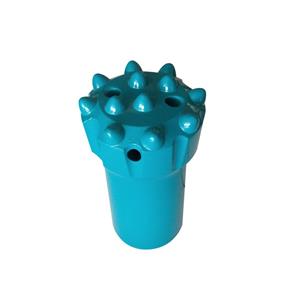
You can spec the right diameter, the right thread, the right insert grade — and still get lousy results if the bit face geometry is wrong for the job. The shape of the front of a DTH bit determines three things simultaneously: how fast it drills, how straight the hole stays, and how long the bit body survives. And you can't optimize all three at once. You have to pick.
Here are the four face designs you'll see in high-pressure DTH bits, what each one is good at, and where each one falls short.
The Convex Face: Fast, but Wandering
A convex bit face bulges outward — the center is higher than the gauge row. Think of it as a dome.
That dome shape does one thing extremely well: it puts the center inserts into the rock first. In medium-hard to hard, abrasive formations, those center inserts pre-fracture the rock core before the gauge row opens the hole to full diameter. The result is high penetration rates — the bit is always cutting into rock that's already cracked.
The tradeoff: hole straightness. A dome has no centering mechanism. The bit rides on the highest point of contact, and in uneven or fractured rock, that point shifts. The hole wanders. If you're drilling blast holes where deviation tolerances are relaxed — production quarry work, for example — this is an acceptable trade. If you need straight holes for presplit lines or close-spaced patterns, a convex face is the wrong tool.
The Flat Face: The Survivor
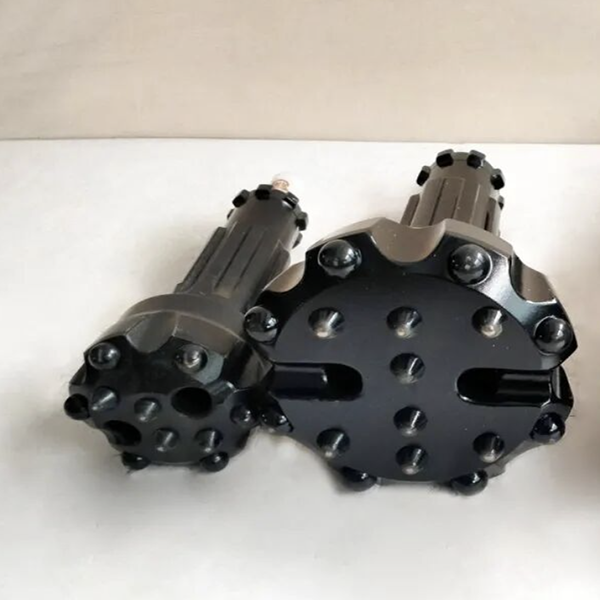
A flat face bit is exactly what it sounds like — the face is a plane, or nearly so. No dome, no depression, just inserts on a flat surface.
This is the most structurally robust design. There's no thin section at the center to crack under heavy impact. The inserts are well-supported by the bit body steel behind them. Flat face bits handle the highest impact energies and the hardest, most abrasive rock — granite, quartzite, dense basalt — without the body fatigue issues that plague more sculpted designs.
The downsides: flat faces don't center well, so hole straightness is average at best. Penetration rates are moderate — there's no pre-fracturing effect, so every insert is breaking virgin rock on every blow. And chip evacuation can be sluggish because there's no natural funnel geometry to guide cuttings into the flushing channels.
Flat face bits are the choice when rock hardness is the dominant constraint and hole straightness is a secondary concern. They're workhorses that rarely fail catastrophically but rarely impress on speed.
The Concave Face: The All-Rounder
A concave face has a shallow conical depression in the center. The outer gauge row sits slightly proud of the center inserts.
That depression creates a mild coring effect. As the bit drills, a small rock pillar forms in the center depression. That pillar acts like a pilot — it keeps the bit centered in the hole. The result is measurably better hole straightness than convex or flat designs.
The concave shape also funnels cuttings toward the flushing channels at the center, improving chip evacuation. Better evacuation means fewer cuttings grinding against the bit face between blows, which means faster penetration and lower insert wear.
This is the most common high-pressure DTH bit face design on the market, and for good reason. It balances penetration rate, hole straightness, and durability across a wide range of rock types. If you're not sure which face design to use, start with concave and adjust from there.
The Deep Concave Center: Straightest Holes, Softest Rock
A deep concave center bit takes the coring concept further. The center depression is pronounced — a deep recess that forms a substantial rock pillar during drilling. The centering effect is strong. Deep holes drilled with this design stay remarkably straight, even in conditions where other face designs would wander.
The cost: structural weakness. The deep center recess removes steel from the highest-stress region of the bit face. Under heavy impact loads — especially in hard rock — the center section can fatigue and crack. Deep concave bits are strictly for soft to medium-hard formations where impact loads are lower and the risk of face cracking is minimal.
Use a deep concave center when hole straightness is the primary requirement and the rock doesn't punish the design. Water well drilling, deep exploration holes, and anchor holes where deviation tolerances are tight are the natural applications.
How to Choose
The decision tree is simple once you know the tradeoffs:
Hard, abrasive rock + speed matters + straightness doesn't: convex face.
Hard, abrasive rock + durability matters + straightness doesn't: flat face.
Mixed conditions + balanced performance needed: concave face. This covers most applications.
Soft to medium rock + straightness is critical: deep concave center.
The face design is printed on every bit that comes out of the hole. Look at the wear pattern. A convex bit that wore evenly across the face was well-matched to the rock. A deep concave bit with a cracked center was pushed past its design envelope. The bit tells you whether you chose right. Read it, and adjust the next order.