When Is a DTH Bit Actually Done? The Numbers That End the Argument
A DTH bit comes out of the hole. The gauge row inserts are worn. The striking face has a depression. The body diameter is down a couple of millimeters. The operator says it's shot. The supplier says it's still got life. And now you've got a conversation that shouldn't need to happen, because there are numbers for this.
The problem isn't that DTH bits fail unpredictably. It's that "failed" means different things to different people. An operator who's pushing for penetration rate calls a bit dead sooner than a purchasing manager who's looking at cost per unit. Without an agreed standard, every worn bit becomes a negotiation.
Here are the numbers. They're not opinions. They're the thresholds at which continued use stops being economical and starts being destructive.
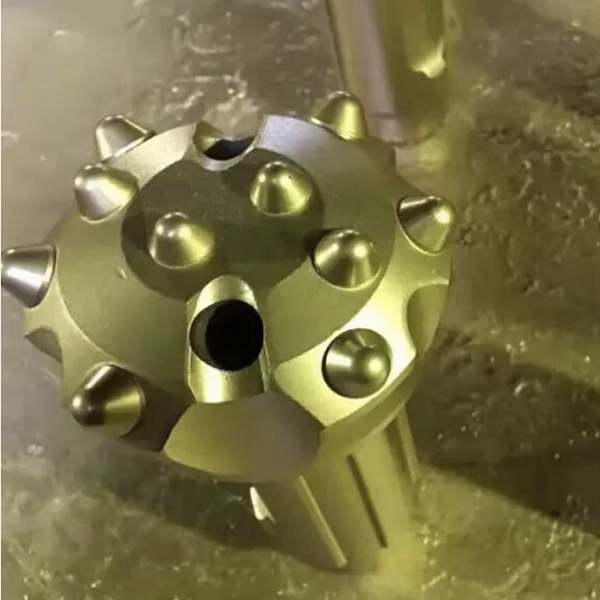
The Hard Rock Rule: 60% of Gauge Insert Diameter
When you're drilling rock above F10 on the Protodyakonov scale — hard granite, quartzite, dense basalt — the limiting factor is almost always the gauge row inserts. These are the inserts on the outer edge of the bit face. They cut the hole diameter and take the highest combination of impact load and abrasive wear.
The retirement threshold: when the wear flat on a gauge insert reaches 60% of the insert's original diameter, the bit is done.
A concrete example: a bit with 14 mm diameter gauge inserts. At 60% wear, the wear flat measures 8.4 mm across. At that point, the contact area between the insert and the rock is so large that the impact energy disperses instead of concentrating. Penetration drops sharply. But more importantly, the worn insert geometry generates higher bending stresses in the carbide, and the risk of insert fracture climbs rapidly.
Keep running past 60%, and you're gambling. The inserts can shatter. A shattered gauge insert takes the bit body with it, because the gauge row is what keeps the bit centered in the hole. Once a gauge insert is gone, the bit body contacts the hole wall directly, and the body erodes in minutes.
The Soft-to-Medium Rock Rule: It's Not Always the Inserts
In rock at F10 and below — limestone, dolomite, medium sandstone — the bit body often reaches its fatigue limit before the inserts wear out. This catches people off guard because the inserts still look serviceable. But the steel has been through millions of impact cycles, and it's done.
Two thresholds apply, and whichever one comes first means retirement:
Striking face depression ≥ 0.6 mm. The top of the bit shank, where the piston hits, develops a shallow depression over time. This is cold working of the steel under repeated high-energy impact. At 0.6 mm of depth, the impact face geometry has changed enough that the piston blow isn't transmitting cleanly — energy scatters, the bit doesn't seat properly in the chuck, and the altered contact pattern accelerates wear on both the bit shank and the piston face. Continuing to run risks bit shank fracture, which can damage the chuck and the piston.
Spline wear ≥ 0.6 mm. The splines that engage the chuck transmit rotation torque. As they wear, the clearance between bit and chuck increases. The bit starts to rattle rotationally. That rattle converts smooth torque transmission into impact loading on the spline faces, accelerating wear further. At 0.6 mm of wear, the spline fatigue life is essentially spent. Continuing risks spline stripping — a failure that can damage the chuck and leave the bit free-spinning at the bottom of the hole.
Critically, both of these thresholds can be reached while the carbide inserts still show significant life remaining. The body fails before the cutting elements. A bit retired at 0.6 mm of striking face wear or spline wear is structurally retired, not cutting-performance retired. Ignoring the body to chase the last bit of carbide life is how you turn a predictable bit change into an emergency repair.
Body diameter wear ≥ 3 mm or face erosion ≥ 1 mm. The outer diameter of the bit body wears from contact with the hole wall and from abrasive cuttings flowing past. At 3 mm of diameter loss, the bit is undersized — it's drilling a smaller hole than spec, and if a new full-gauge bit replaces it mid-hole, the new bit will wedge. (See Rule 9 from article #42.)
Face erosion — the steel between the inserts wearing away — exposes more of the carbide insert body. The inserts stand proud, unsupported by the bit body steel behind them. Bending loads on the inserts increase. At 1 mm of face erosion, the risk of insert breakage from bending overload rises sharply.
Why the Numbers Matter
These thresholds exist for a reason: they're the points at which continued operation predictably leads to catastrophic failure rather than gradual wear. Running a bit past 60% gauge wear in hard rock, or past 0.6 mm of striking face depression in medium rock, isn't squeezing extra value out of the tool. It's converting a predictable, budgetable bit replacement into a random, expensive failure that may take other components with it.
The best drilling operations track these numbers. They measure bits when they come out of the hole. They retire bits at the threshold, not after the failure. And they don't argue with suppliers about whether a bit "should have lasted longer," because both sides agreed on the retirement criteria before the first hole was drilled.
A bit retired on schedule costs the price of the bit. A bit run to failure costs the bit, plus whatever else it took down. The numbers are the difference.