DTH hammer failures in hard‑rock conditions — causes for four major fault types
Down‑the‑hole (DTH) hammers used in hard‑rock drilling are prone to a range of faults because of high formation hardness, heavy drilling loads, and harsh operating environments. These faults directly affect penetration rate, hole quality, and equipment life. Based on the typical conditions of hard‑rock drilling, common failures cluster into four categories: degraded impact performance, mechanical wear/sticking, cuttings‑removal system problems, and power‑transmission faults. The following explains the symptoms and root causes of each category.

Impact performance degradation This is one of the most common faults and shows up as a sudden drop in rock‑breaking efficiency: reduced impact force, lower impact frequency, and a bit that can no longer effectively fracture hard rock, causing penetration to slow dramatically or stop. Key causes include:
1.1 Power‑medium supply problems
For pneumatic hammers, insufficient compressor pressure (below the 0.6–1.2 MPa range typically needed for hard rock), unstable airflow, or leaks/blockages in supply lines reduce the pressure available to drive the piston.
For hydraulic hammers, low pump pressure or clogged hydraulic circuits from contaminated oil lower the hammer drive force.
Contaminants in the power medium (moisture or dust in compressed air; metal particles in hydraulic oil) accelerate seal wear and further reduce medium efficiency.
1.2 Internal flow or valve failures
Valve‑type hammers often suffer valve‑plate wear, deformation, or sticking, disrupting timely valve switching and preventing high‑frequency piston reciprocation.
Valveless designs can be impacted by wear or blockage of the piston/cylinder flow grooves; cuttings buildup delays flow reversal, disturbs the impact cycle, and sharply reduces impact energy.
1.3 Piston‑to‑bit interface issues
High‑frequency impacts wear the piston face and the bit tail, increasing contact clearances and causing energy transfer losses.
Eccentric bit installation or loose locating pins cause off‑center strikes, reducing impact efficiency and accelerating localized wear.
Mechanical wear, sticking, and structural failure These issues are major causes of downtime. Under repeated impacts and rotational torque, mechanical parts can wear excessively, seize, or break. Typical manifestations and causes include:
2.1 Piston seizure and wear
Heavy loads increase friction between piston and cylinder. Inadequate lubrication (e.g., missed lubrication intervals for pneumatic hammers or degraded hydraulic oil) and ingress of rock cuttings reduce clearances and lead to piston seizure. Long‑term high‑frequency operation also wears piston surfaces and can produce cracks; in severe cases, the piston may rupture.
2.2 Drill‑string damage
The drill string transmits torque and supports the hammer. If string material strength is insufficient, threads are loose, or hole deviation occurs, the string can experience extra bending moments that cause buckling, deformation, or thread failure. Abrasion from rock cuttings on the outer wall further accelerates wear and shortens service life.
2.3 Joint and seal damage
Front and rear subs are critical connection components; intense vibration and torque can strip or deform threads. Seals (O‑rings, seal rings) exposed to abrasive media and elevated temperatures age and crack, causing power‑medium leaks and allowing cuttings into internal assemblies, which accelerates wear.
Cuttings‑removal system abnormalities Hard, coarse cuttings produced in hard‑rock drilling require reliable removal. When the cuttings‑removal system underperforms, the result is hole clogging, poor evacuation, and increased drilling resistance—sometimes leading to stuck pipe. Main causes include:
3.1 Insufficient flushing medium or flow
Pneumatic hammers with too little flushing air, or hydraulic hammers with inadequate flushing fluid flow, cannot remove bottom‑of‑hole cuttings promptly. Prolonged abrasive flow also wears and deforms transport passages (e.g., the bit center hole or piston center bore), narrowing channels and reducing evacuation efficiency.
3.2 Mismatch of drilling parameters and cuttings removal
Excessive penetration rate can generate more cuttings than the removal system can carry. Incorrect rotation speed or bit thrust settings can produce overly coarse cuttings that cannot pass through flow passages, causing accumulation and blockage.
3.3 Hole deviation and cuttings deposition
Hole deviation creates low spots where cuttings collect and are not effectively carried out by the flushing medium. Over time these deposits form a packed cuttings bed that impedes hammer advance and bit action.
Power‑transmission faults These faults interrupt drilling when torque transmission is lost or impact energy fails to reach the bit. They commonly occur at drill‑string/hammer and hammer/bit interfaces. Causes include:
4.1 Loose or damaged connections
Loosened or stripped threads between the drill string and the hammer rear sub, or wear of locating pins or splines, prevent reliable torque transfer and stop the hammer from rotating with the string.
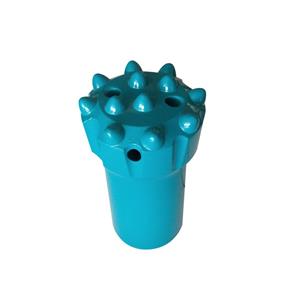
Worn or deformed front‑sub/bit connection components (lock nuts, snap rings, etc.) can allow bits to work loose, producing dry strikes where energy does not reach the rock and synchronous rotation is lost, causing uneven cutter wear.
4.2 Bit damage causing transmission failure
Cutter wear, chipping, or loss (tungsten‑carbide buttons, PDC/diamond cutters) prevents effective engagement with the formation. Impact energy then fails to transmit through the cutters to the rock and instead reflects back into the hammer’s internals, increasing internal shock loads and causing secondary failures.
Summary and main influencing factors In sum, common DTH hammer failures in hard‑rock drilling stem from the defining characteristics of the work: high loads and harsh environments. The principal influencing factors fall into three groups:
Inadequate equipment fit: hammer model, bit type, or component materials not matched to hard‑rock conditions.
Improper operation and maintenance: inappropriate drilling parameters, failure to clean or lubricate regularly, and delayed replacement of worn parts.
Poor auxiliary‑system coordination: unstable power‑medium supply and a mismatch between cuttings‑removal capacity and drilling cycle.
Understanding these root causes provides the basis for targeted troubleshooting and preventive measures to keep hard‑rock drilling continuous and efficient.