How to Double the Life of a Chisel Bit: It's Not the Steel, It's the Routine
A chisel bit costs fifteen, maybe twenty dollars. Nobody budgets for them — you just grab a handful from the tool crib and go. But a crew that burns through ten bits a shift versus one that uses three isn't seeing a fifteen-dollar difference. They're seeing a productivity difference in the hundreds, because every bit change is stopped work, and every prematurely dead bit that broke instead of wearing out is a potential stuck-string recovery job.
The difference between short-lived and long-lived chisel bits isn't usually the brand. It's the habits around them. Here's a lifecycle approach that squeezes the maximum meters out of every bit.
Before the First Hole: The Fit Check
A chisel bit and its tapered rod are a friction-fit pair. The bit doesn't screw on — it's driven onto a precisely ground cone and held by interference. The quality of that interference determines everything that happens next.
Push a bit onto a rod and wiggle it. If there's any play at all — any rocking, any rotational slop — the taper doesn't match. The bit will walk during drilling. Even if it doesn't come off, the poor fit converts impact energy into heat and deformation at the contact band instead of transmitting it cleanly to the cutting edge. The bit body galls. The taper seat wallows out. Both bit and rod degrade faster than they should.
Use matched pairs from one manufacturer. It's the cheapest quality control step in drilling and the most commonly skipped one, because "they all look the same" — until they don't fit.
The First Ten Seconds: Low and Slow
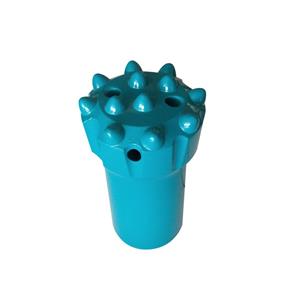
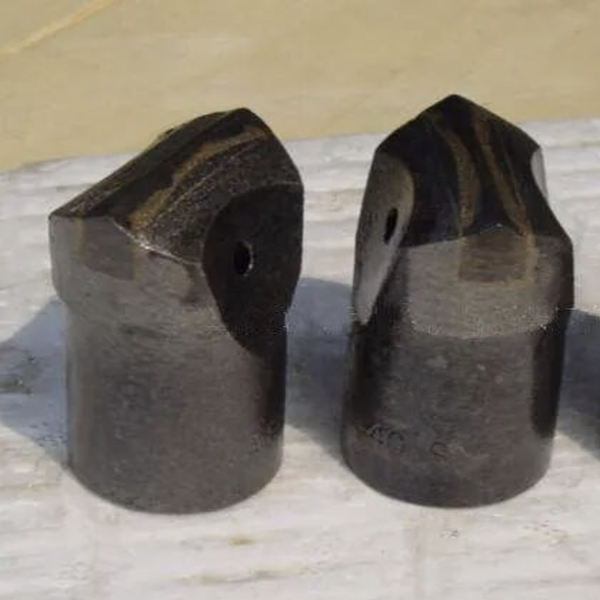
A chisel bit cutting edge is a single line of carbide. That line needs full contact with the rock to distribute the impact. When the bit first touches an uneven rock face, the contact might be a single point.
Hit that point with full hammer force and you'll chip the carbide corner. The chip propagates across the edge over subsequent blows, and within a few minutes you've lost a chunk of the cutting edge that can't be reground.
Drop the air to a whisper for collaring. Let the bit scribe a groove. Once the full edge is in contact, bring the pressure up. The ten seconds you lost at low power buys you hours of bit life.
The Wear Cycle: 3 mm and the Reverse Taper Trap
As the bit drills, the sharp cutting edge wears into a flat. This is normal. What's not normal is letting that flat grow past 3 millimeters wide.
At 3 mm, two things happen simultaneously. First, the impact energy disperses over too large an area, so penetration drops and the bit heats up from friction instead of cutting. Second, the wider flat acts like a wedge in fractured rock — it catches instead of cutting, increasing the risk of jamming.
But the wear flat isn't the only thing to watch. Feel the bit body just behind the cutting edge. If the body diameter is shrinking — the bit is wearing narrower toward the front — that's reverse taper. A reverse-tapered bit is a wedge. Once it enters a hole, it tightens with every blow. Reverse taper is the leading cause of stuck chisel bits, and a stuck bit that has to be pulled by force often takes the rod with it.
At 3 mm wear land or any sign of reverse taper: pull the bit. Regrind it properly or replace it. A reground bit with a restored cutting edge and correct body profile drills almost as well as new, for a fraction of the cost.
Water: The Forgotten Lifeline
Chisel bits on pneumatic drills often run with water flushing through a central hole in the bit body. The water does two things: it clears cuttings so the bit is always hitting clean rock, and it cools the carbide.
A chisel bit running dry or with low water volume overheats. Carbide can take high temperatures, but the braze joint that holds the carbide to the steel body cannot. Overheat the braze, and the insert loosens. Once loose, it cracks within a few dozen blows because it's no longer fully supported by the steel behind it.
Adequate water volume keeps the cutting edge cool, the braze intact, and the hole clean. It also reduces dust — which matters for crew health — and reduces the risk of jamming from cuttings packing around the bit body. Check your water flow before you start. If it's weak, fix it. A dry bit is a dying bit.
When the Rock Is Fighting Back: Know When to Switch
Sometimes the problem isn't the bit — it's the mismatch between the bit and the ground.
In fractured, blocky rock with irregular faces and frequent cracks, chisel bits jam. The single cutting edge catches on ledges, wedges in crevices, and hangs up. If you're fighting the bit on every hole, switch to a cross bit. The second cutting edge at 90 degrees prevents ledge-catching. If cross bits still jam, go to button bits — the distributed insert pattern is virtually immune to the kind of mechanical trapping that kills chisel bits.
In hard, abrasive rock, chisel bits wear their cutting edges down to 3 mm in a fraction of the normal interval. The regrinding frequency becomes uneconomical — you're spending more time at the grinder than at the face. Switch to a more wear-resistant bit type with a carbide grade suited to abrasive formations.
In rock with embedded steel — old reinforcement, abandoned bolts, scrap metal — chisel bits are the wrong tool entirely. A single carbide edge impacting ductile metal will fail at the braze joint. Move the hole or switch to a bit type that can handle the abuse.
The Routine That Pays
A chisel bit that's inspected before mounting, collared gently, pulled at 3 mm of wear, reground promptly, and run with adequate water will drill two to three times the meterage of one that's grabbed off the rack, slammed in at full throttle, and run until it stops cutting.
The difference isn't in the catalog price. It's in the ten seconds before every hole, the thirty-second inspection after every shift, and the willingness to walk a bit to the grinder instead of pushing it past the red line. That's not a purchasing decision. That's just doing the job right.