Four-Wing Diamond Drill Bits: How You Start a Hole Determines How It Finishes
The first thirty seconds of a drilling cycle are where most diamond bit damage happens. Not the middle of the hole. Not the hard layer at depth. The very beginning — when the bit touches down at the bottom and the operator has to decide whether to ease in or punch it.
I've seen a brand new four-wing diamond bit destroyed in less than a minute because an operator dropped it onto the hole bottom at full RPM and full weight. The diamond cutters hit the rock like a hammer instead of a blade, and by the time the rig stabilized, two cutters were chipped and the bit was vibrating hard enough to feel through the drill rod. That hole, and that bit, were done before they really started.
Here's how to avoid being that guy, and what to do when the ground doesn't cooperate.
The Slow-Start Rule: Non-Negotiable
Every diamond drill bit — four-wing, six-wing, doesn't matter — has the same vulnerability at the start of a hole: the cutters are cold, the bit isn't centered yet, and the full weight of the drill string hasn't settled into a stable alignment. If you spin up to 400 RPM and drop the feed pressure before the bit has found its groove, you're asking a hardened steel body with brittle diamond inserts to absorb an impact load it wasn't designed for.
The right sequence takes maybe an extra two minutes and saves you from pulling a destroyed bit:
Touch down gently. Just enough weight to confirm the bit is on bottom — maybe 2-3 kN on the feed gauge. Rotate slowly, around 100-150 RPM. Let the gauge cutters scribe the hole wall and the face cutters establish their cutting tracks. You'll feel the rig stabilize — the vibration will smooth out, the torque will settle into a steady band. That's your signal that the bit has seated itself.
Now you can bring the RPM up to your target range and start adding weight incrementally. Don't jump from 3 kN to 12 kN in one move — step it up over thirty seconds or so. Diamond doesn't like sudden loading.
This sequence matters even more if you're re-entering an existing hole with a fresh bit. The new bit's gauge diameter might be imperceptibly different from the old one, and the worn hole wall might have slight spiraling. A fast entry on a re-run is an excellent way to chip gauge cutters.
Steady Does It: The Middle of the Hole
Once the bit is running, the temptation is to set it and forget it — punch the feed and let the rig do the work. But stable drilling doesn't mean hands-off. Keep an eye on the torque gauge. If torque starts creeping up without changes in formation, it usually means one of two things: cuttings are packing around the bit, or a cutter has started to fail and is dragging instead of cutting.
Flush flow is your first line of defense. Diamond bits generate fine cuttings — more like dust than chips in hard rock — and those fines can pack into the waterways faster than you'd expect. If you're running water flush, keep the flow rate high enough that return water at the collar is clear, not muddy. Muddy return means cuttings are staying in the hole, and a packed annulus is the prelude to a stuck bit.
When you hit a formation change — and in coal measure rock you'll hit several per hole — don't just power through. That transition zone between a soft shale and a hard sandstone lens is where bits get knocked off course. Four-wing diamond bits have an advantage here: the symmetric four-point contact gives them better self-centering than three-wing designs. But you still need to give the bit time to adjust. When the torque spikes, back off the weight by 20-30% and let the bit work through the transition at reduced load. The penetration rate will drop temporarily, but the hole will stay straight and the cutters will stay intact.
Three Emergencies and How Not to Make Them Worse
The bit is stuck. You already know this one from the anchor bit guide, but it bears repeating because every formation sticks bits differently. In diamond drilling through fractured ground, the most common cause is a chunk of detached wall rock wedging against the bit body. The fix is the same: stop feeding, maintain slow rotation, and crank up the flush volume. If the bit freed up enough to rotate a quarter turn, you're making progress. Keep working it. What you absolutely cannot do is yank the drill rod upward with the rig's full retract force — that's how rods snap at the connections.
The hole is drifting. Four-wing bits resist deviation better than most, but no bit is immune. If you notice the drill rod vibrating in a circular pattern at the collar — rather than the normal axial vibration — the bit is probably walking off-center. Reduce RPM to around 120-150 and back off the weight by half. The bit's wings need time to re-cut a centered path. If the drift continues after a meter of reduced-parameter drilling, pull the string and check the bit. A worn gauge section — where the outer diameter of the bit has worn undersize — will cause drift no matter how carefully you drill. Replace the bit, and if the problem persists, check the drill rods for straightness.
The bit is smoking. This one is unmistakable. Steam and smoke at the collar, the sound of the flush flow hissing where it shouldn't, and a torque reading climbing fast. The bit isn't being cooled. Stop the rig immediately — not after this rod, right now. The diamond segments are likely already damaged, but continuing for even ten more seconds can delaminate the diamond table from the substrate, at which point the bit is scrap metal.
Check your flush supply. Is the water line kinked? The pump running dry? The internal waterways in the drill rod blocked? Clear the obstruction, restore flush flow, and let the bit cool completely before restarting — the steel body holds heat longer than you think.
When to Call It
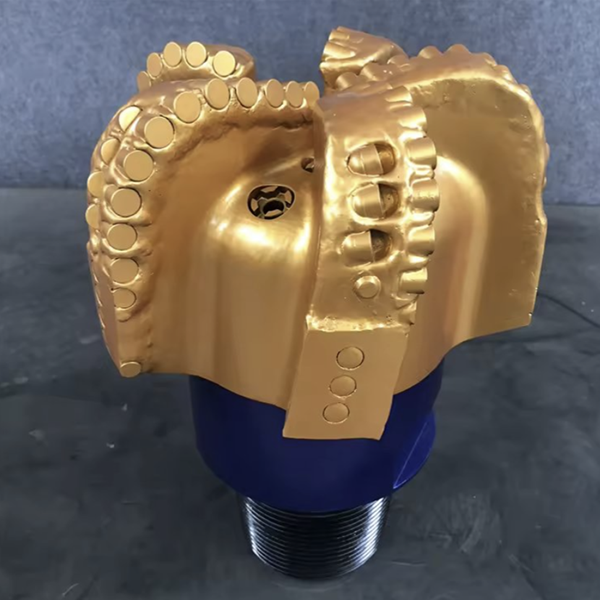
A four-wing diamond bit is done when: the gauge cutters are worn flat and the hole diameter is undersized; more than two face cutters are chipped or missing; or the steel body shows any visible cracking. Don't try to squeeze "one more hole" out of a dying bit. The cost of a replacement bit is nothing compared to the cost of losing a hole, redrilling, or fishing a broken bit body out of a collapsed borehole.