Hollow Steel Quality for Heavy-Duty Drill Rods
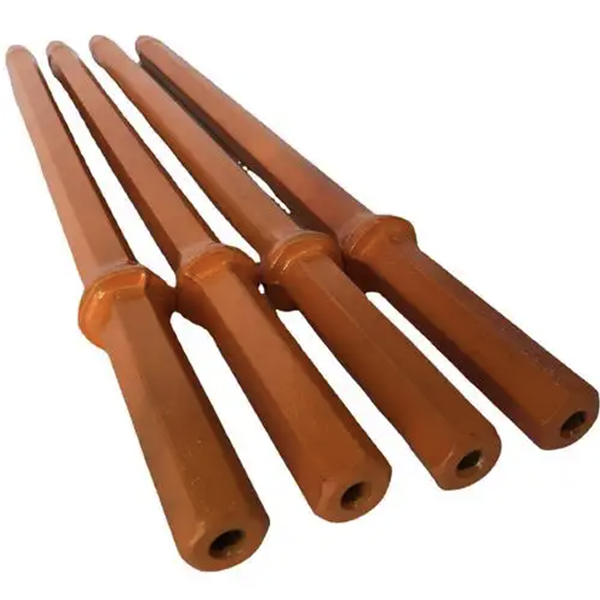
Heavy-duty drill rods transfer impact energy and rotation from hydraulic rock drills to the bit. Their hollow steel body must withstand repeated high-energy impacts, torque, abrasion, and corrosive flushing water or air. As drilling equipment becomes more powerful, the quality and consistency of the hollow steel become increasingly important to rod life and drilling reliability.
The manufacturing route used to produce hollow steel affects its dimensions, internal structure, surface condition, and fatigue performance. This article reviews two common production methods and the quality factors that influence heavy-duty drill rod performance.
Demands on Heavy-Duty Drill Rods
Heavy-duty drill rods operate under severe conditions. The source article describes hydraulic rigs delivering thousands of impacts per minute, with high impact energy and substantial torque. The rod must transmit that energy through stress waves while rotating and carrying flushing media through its internal passage.
During operation, the rod body experiences impact, bending, torsion, and fatigue loads. Its outer surface contacts the rock and hole wall, while the internal flushing hole is exposed to pressurized water or air and abrasive cuttings. This combination makes the hollow steel a critical part of the complete drilling system.
The article describes a growing market for heavy-duty rods, including T51, T45, and H35 product families. It also reports that domestic rods have gained substantial market share, while variability in service life and fatigue fracture remains a concern for some products. These market figures reflect the article’s reporting and should be checked against current regional data.
Two Production Routes for Hollow Steel
The article outlines two manufacturing routes for hollow steel.
The first route creates the internal hole by drilling a solid billet and then rolling it with a mandrel or core bar. A simplified process is:
Steelmaking and refining
Continuous casting of a large billet
Initial rolling to open and shape the billet
Mechanical drilling of the center hole
Insertion of a core bar
Rolling to form the hollow steel
The second route uses hot piercing and hot rolling. A round billet is heated, pierced to create a central hole, reduced in diameter, and rolled into the final hollow section.
Each process has tradeoffs. Drilling and core-bar rolling can provide a controlled internal geometry and favorable metal flow when executed well. Hot piercing and rolling may offer advantages in yield, production cost, and manufacturing flexibility. The best route depends on the steel grade, product dimensions, equipment, quality targets, and production volume.
How Manufacturing Affects Product Quality
The internal geometry of hollow steel affects how the drill rod carries load. In the drilled-hole route, an off-center bore can create uneven wall thickness. Sharp internal transitions may concentrate stress and become fatigue-crack initiation points.
Hot-pierced and rolled hollow steel can have its own challenges. Helical marks or small surface cracks on the inside or outside may affect service life if they are not controlled. These defects can become more serious when the rod is exposed to repeated impact and bending.
Manufacturers should therefore monitor:
Outside dimensions and profile
Internal-hole diameter and concentricity
Wall-thickness uniformity
Straightness
Internal and external surface condition
Decarburization and scale
Mechanical properties
Steel cleanliness and inclusion level
Inspection requirements should reflect the rod design and operating conditions. Surface and dimensional acceptance criteria should be defined before production and applied consistently.
Steel Cleanliness and Consistency
The article identifies 23CrNi3Mo as a commonly used steel for heavy-duty drill rods and notes that nominal chemistry and mechanical requirements may be comparable across suppliers while cleanliness and consistency still differ.
Key factors include sulfur and aluminum content, dissolved gas levels such as nitrogen and hydrogen, inclusion morphology, and stability of the low-magnification microstructure.
These factors matter because inclusions, gas-related defects, and local nonuniformity can reduce fatigue resistance. Under repeated impact, a small internal or surface defect may become the starting point for a crack. Improved steelmaking control and inspection help reduce this risk.
Chemical composition alone does not determine quality. Two heats with similar nominal chemistry can perform differently if their cleanliness, segregation, internal defects, or microstructure vary.
Matching Hollow Steel to the Rod-Making Process
Hollow steel is only the starting material. The finished drill rod also depends on machining, thread production, heat treatment, straightening, and final inspection.
The steel must be suitable for the manufacturer’s full process. Variations in hardness or microstructure can affect machining and heat-treatment response. Poor straightness or inconsistent wall thickness can create problems during thread machining and service.
A reliable supply program should include material certification, heat traceability, agreed dimensional tolerances, defect limits, and periodic performance review. Field data on meters drilled, fracture locations, thread wear, and downtime can help identify whether a problem originates in the hollow steel, downstream processing, or operating conditions.
Conclusion
Both drilled-hole and hot-pierced production routes can provide hollow steel for heavy-duty drill rods when the process is properly controlled. Their performance depends on internal geometry, wall-thickness consistency, surface quality, steel cleanliness, and stable mechanical properties.
For drill rod manufacturers and drilling contractors, the goal is to evaluate the complete material and manufacturing chain. Consistent hollow steel gives the rod a stronger foundation for reliable fatigue life, predictable machining, and dependable drilling performance.