How Hollow Steel Rolling Processes Affect H22 Drill Rod Service Life
How Hollow Steel Rolling Processes Affect H22 Drill Rod Service Life
Hollow drill steel is the basic raw material used to manufacture rock drill rods. Its rolling process has a direct influence on internal-hole quality, microstructure, fatigue resistance, and overall service life.
For H22 drill rods made from 40SiMnCrNiMo steel, three production routes are commonly compared: drilled-and-core hot rolling, hot piercing followed by hot drawing, and hot piercing followed by hot rolling. Each method creates different internal-surface conditions and therefore affects the way a drill rod performs in mining applications.
Three Hollow Steel Production Methods
Drilled-and-Core Hot Rolling
This process begins by drilling a through-hole in a solid steel billet with a deep-hole drilling machine. The billet is then hot rolled over a mandrel.
Because the internal hole is produced by machining, the inner surface is smooth and free from typical piercing defects such as tearing and scoring. It also provides high dimensional accuracy. The main disadvantages are lower material utilization, higher machining cost, and lower production efficiency.
Hot Piercing and Hot Drawing
In this process, the heated billet is pierced on a Mannesmann piercer to form a hollow blank. The blank is then reduced to size through hot drawing.
This route offers high productivity and a high yield rate, making it a common process for H22 hexagonal hollow drill steel. However, the piercing operation can create tears and microcracks on the internal wall. These defects may become fatigue-crack initiation points during drilling.
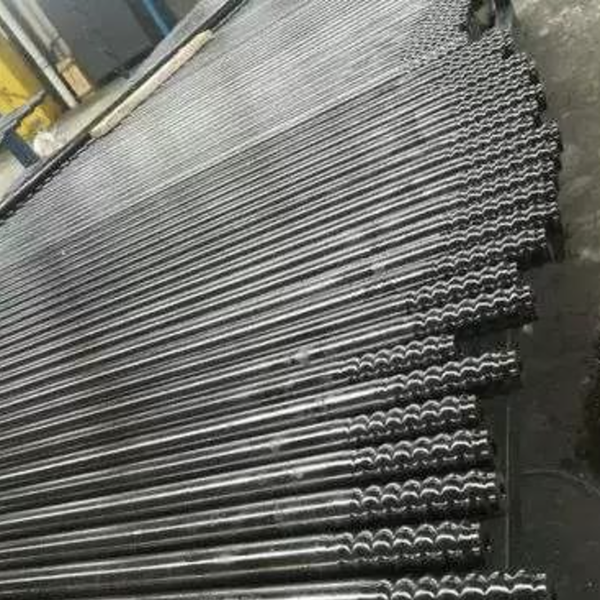
Hot Piercing and Hot Rolling
This method also starts with hot piercing, but the hollow blank is reduced using mandrel-supported hot rolling rather than hot drawing.
Compared with hot drawing, hot rolling produces more uniform deformation and better metal continuity. It can offer stronger potential for microstructure improvement and longer ultimate service life.
Internal Surface Quality Matters
The internal surface of hollow steel is important because defects inside the flushing hole can concentrate stress under repeated impact loading.
Drilled-and-core hot rolled steel typically has a smooth inner wall with no tearing or folding defects. Hot-pierced materials may show different degrees of tearing, scoring, and oxidation. Among the two hot-piercing routes, hot piercing followed by hot rolling can provide slightly better internal-hole quality than hot piercing followed by hot drawing.
Industrial Life Testing Results
In field testing, H22 hexagonal hollow steel was produced from the same heat of 40SiMnCrNiMo billet using all three methods. The subsequent heat-treatment process was standardized, and the finished drill rods were tested in mining drilling operations.
The drilled-and-core hot rolled drill rods achieved the highest average service life. The average life of drill rods made by hot piercing-hot drawing and hot piercing-hot rolling was generally similar.
However, the failure modes were different. Hot-pierced and hot-drawn rods were more likely to experience early fatigue fracture originating from the internal hole. Hot-pierced and hot-rolled rods had a more uniform structure and showed greater potential for higher maximum life after further process optimization.
Conclusion
Hollow steel rolling technology directly affects drill rod fatigue life. Drilled-and-core hot rolling offers the best internal-hole quality and fatigue-life performance, although it has higher cost and lower efficiency.
Hot piercing followed by hot rolling provides more uniform deformation than hot drawing and has stronger potential for improving microstructure and extending the maximum service life of H22 drill rods. For manufacturers and drilling contractors, controlling internal-hole quality is essential for reducing fatigue failures and improving rock drilling reliability.