How Hot Die Forging Doubles Button-Bit Body Performance
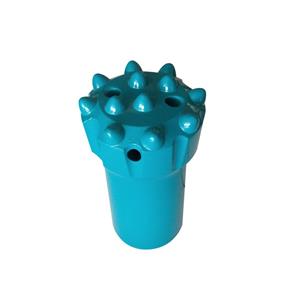
The performance of the button-bit body directly determines the service life of a drill bit and is a core component in rock drilling. Current manufacturing processes for button-bit bodies include machining, cold extrusion, warm extrusion, and hot die forging. Among these, hot die forging stands out as the industry’s mainstream choice because it offers the best combined benefits in mechanical properties, production efficiency, and cost-effectiveness.
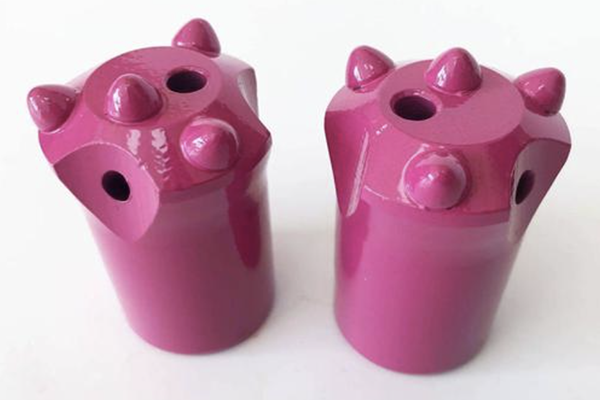
Comparison of mainstream manufacturing processes Each process has distinct technical characteristics, performance outcomes, and applicable scopes:
Machining: Simple to operate and requiring no complex equipment tuning, but with severe drawbacks. Material utilization is very low and the process cannot optimize the internal metal structure, resulting in weak mechanical performance. Machined bodies are prone to fracture under the impact loads of rock drilling, limiting their application.
Cold extrusion: Improves metal density and local properties but faces high deformation resistance. This requires high-precision, high-strength equipment and tooling, driving up production costs. Cold extrusion is therefore suited only for small batches or small-size bodies.
Warm extrusion: Lowers deformation resistance compared with cold extrusion, but requires very tight control of heating temperature—temperature fluctuations easily degrade forming quality. Its forming capability is limited to simple, light-structure button-bit bodies and cannot meet demands for more complex or heavy-duty applications.
Hot die forging: Involves heating the metal blank to 1100–1250°C and forming it under pressure using dedicated dies. Hot die forging balances mechanical performance and production economics and currently accounts for over 80% of the market, making it the mainstream process.
Core technical advantages of hot die forging Hot die forging relies on the principle of high-temperature plastic deformation combined with precise die control, delivering simultaneous gains in performance and efficiency across two main dimensions:
Optimizing metal microstructure to strengthen mechanical properties:
Elimination of internal defects and increased density: Forging at high temperature compacts internal porosity and inclusions in the metal blank, significantly reducing failure risk and improving structural stability.
Grain refinement and balanced strength-toughness: Forging breaks down coarse grains into a fine, equiaxed microstructure, enabling stable hardness in the Rockwell C range of HRC35–45 while retaining excellent impact toughness. This resolves the traditional trade-off between “hard-but-brittle” and “tough-but-soft.”
Formation of continuous metal flow lines: Under die pressure, the metal flows along load paths to form continuous grain-flow structures that greatly enhance fatigue life in critical load-bearing regions, making the body suitable for prolonged, high-frequency impact service.
Precise, efficient forming that controls production cost:
Accurate one-step forming reduces downstream machining: Critical geometries can be produced to high dimensional accuracy in the die, requiring only finish machining of features like threads. This reduces cutting and machining labor by over 60% compared with traditional methods and substantially increases throughput.
Improved material utilization: High-temperature plastic deformation maximizes use of the metal blank and reduces scrap, lowering per-piece material cost.
Suited for large-scale production: The process stability and repeatability of hot die forging support high-volume, standardized manufacturing, addressing industry needs for mass production.
Application considerations for hot die forging To fully realize hot die forging’s advantages, strict control of two critical areas is required to avoid quality and cost penalties:
Precise control of heating temperature: Heating schedules must be set according to the steel grade. Excessive temperature promotes grain coarsening and degrades properties; insufficient temperature increases deformation resistance and accelerates die wear.
Tight control of die operating temperature: Employ a circulating water cooling system to stabilize die temperature in the 200–300°C range. This preserves forming accuracy, extends die life, and reduces equipment wear costs.
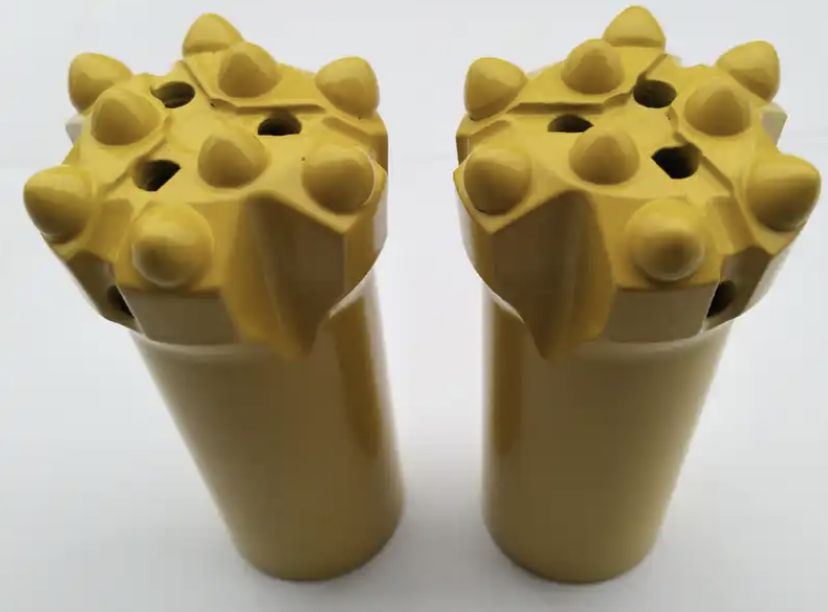
Conclusion By optimizing metal microstructure, improving forming precision, and reducing production costs, hot die forging has become the dominant solution for manufacturing button-bit bodies. It resolves the performance–economy contradictions of traditional methods and provides essential technical support for improving bit quality and drilling efficiency, making it indispensable in rock drilling equipment manufacture.