How Hydraulic Drill Rods Are Manufactured for Reliable Rock Drilling
A hydraulic drill rod may look like a simple steel tube, but it is a highly engineered part of the rock drilling system. It must transmit powerful impact energy, rotation, flushing media, and feed force through the drill string while maintaining straightness and resisting fatigue.
In mining, quarrying, tunneling, and infrastructure drilling, the drill rod connects the rock drill to the bit. If the rod bends, wears excessively, develops thread damage, or breaks under load, drilling stops immediately. The result can include lost production time, damaged tools, recovery work, and an unusable hole.
That is why high-quality hydraulic drill rods are produced through a controlled sequence of inspection, machining, heat treatment, straightening, and corrosion protection. Each step contributes to the rod’s final performance in the field.
Starting with Hollow Drill Steel
The manufacturing process begins with hollow drill steel. Unlike solid steel bar, hollow steel has an internal flushing hole that allows air or water to travel through the drill string and remove cuttings from the bottom of the hole.
Before production begins, each steel tube should be inspected. Straightness is particularly important. If the incoming material has excessive curvature, it must be corrected before additional machining and heat treatment. Starting with a straight, consistent tube helps reduce final runout and supports better hole accuracy during drilling.
Hydraulic point-straightening equipment is commonly used for this work. Adjustable supports position the rod, and controlled pressure is applied at selected points to correct bending. This process requires care because excessive force can introduce local damage or residual stress.
The goal is not only to make the rod look straight. The goal is to ensure that the rod rotates smoothly, transfers energy efficiently, and helps keep the drill bit on the intended hole path.
Machining the Drill Rod Body and Thread Sections
After incoming inspection and straightening, the drill rod moves into machining. The exact route depends on the rod design, thread system, coupling style, and manufacturer’s process capability.
Threaded sections are critical because they connect the drill rod to the shank adapter, coupling sleeve, and drill bit. These joints must withstand repeated impact and rotation without loosening, galling, or losing dimensional accuracy.
The thread area may be upset forged before machining. Upsetting increases the material cross-section in the connection zone, which can provide more material for the thread and improve the strength of the joint area. Depending on the design, manufacturers may also use friction welding to join a threaded adapter or end section to the rod body.
Friction welding can be used in two common ways. One approach joins the end component first and then machines the final thread. Another approach machines the thread section before the friction-welded component is joined to the rod body. The best method depends on the product design, weld qualification, machining sequence, and quality-control requirements.
After forging or welding, hydraulic copy lathes or CNC lathes machine the external profile and thread geometry. Accurate thread dimensions are essential. A poor thread fit can lead to reduced energy transfer, accelerated wear, difficult uncoupling, or early connection failure.
Additional machining may include handle slots, wrench flats, or drive-related features. A horizontal milling process can create these details with consistent location and size.
Surface Preparation Before Heat Treatment
Before heat treatment, the rod surface must be clean. Sandblasting or shot blasting is commonly used to remove oil, scale, and oxidation products from the rod body.
This step is important because surface contamination can affect heat-treatment consistency and make later inspection more difficult. A clean surface also allows the manufacturer to identify obvious machining defects, weld irregularities, or surface damage before the rod enters the furnace.
Surface preparation is not only cosmetic. It supports repeatable heat treatment, better shot-peening results, and more effective corrosion protection after production.
Heat Treatment for Wear Resistance and Fatigue Strength
Heat treatment is one of the most important stages in drill rod manufacturing. Hydraulic drill rods are often made from low-carbon, high-alloy air-hardening steels or related alloy steel grades selected for their ability to develop a hard outer layer while keeping a tough core.
Two common treatment routes are carburizing and induction surface hardening.
Carburizing enriches the rod surface with carbon in a carbon-rich furnace atmosphere. This process can create a wear-resistant case on the outside of the rod and, depending on the process, within the flushing-hole wall. After carburizing, the rod is cooled and tempered to achieve the desired balance between surface hardness and core toughness.
The source article describes a carburizing temperature of about 925°C and gives a surface-hardness reference of HRC 58-60 with a core hardness near HRC 43. These figures should be treated as process examples rather than universal specifications. Actual settings must be confirmed by qualified heat-treatment engineers based on steel grade, rod dimensions, case-depth requirements, and local production standards.
Induction surface hardening uses high-frequency heating, followed by quenching and tempering, to harden selected zones. The rod body can be treated first, followed by additional treatment in the thread sections. This approach allows manufacturers to focus hardening where wear is highest while preserving toughness in other areas.
Both methods can produce reliable drill rods when properly controlled. The choice depends on the required fatigue life, rock conditions, drilling depth, rod design, available equipment, and economic targets.
Shot Peening and Internal Hole Treatment
After heat treatment, the rod may receive shot peening. This process bombards the surface with small steel shots or other media to introduce beneficial compressive stress in the outer layer.
For drill rods, shot peening can help improve fatigue resistance by reducing the effect of small surface imperfections. Since the rod experiences repeated impact and rotation, fatigue performance is a major concern.
The flushing hole may also receive internal shot treatment. The inner surface is exposed to high-velocity air, water, and abrasive drill cuttings. Improving its surface condition can support longer service life and reduce the chance of internal wear-related problems.
The process must be controlled carefully. Improper shot size, intensity, coverage, or surface preparation can reduce the benefit or create unwanted surface damage.
Final Straightening and Inspection
Heat treatment can cause small dimensional changes or distortion. For this reason, finished rods often undergo precision straightening after heat treatment and shot peening.
A hydraulic straightening machine with dial-indicator control can help ensure that the rod meets the required straightness tolerance. Straightness is essential for stable rotation and hole quality. A rod with excessive runout can increase vibration, accelerate thread wear, and contribute to drill-hole deviation.
Final inspection should include checks for:
Overall length and outside diameter
Thread profile and thread fit
Rod straightness and runout
Surface condition
Heat-treatment hardness
Flushing-hole condition
Weld integrity where friction welding is used
Corrosion-protection coverage
For demanding applications, manufacturers may also use additional non-destructive testing or metallurgical checks to verify the quality of welds, case depth, and internal material condition.
Corrosion Protection and Storage
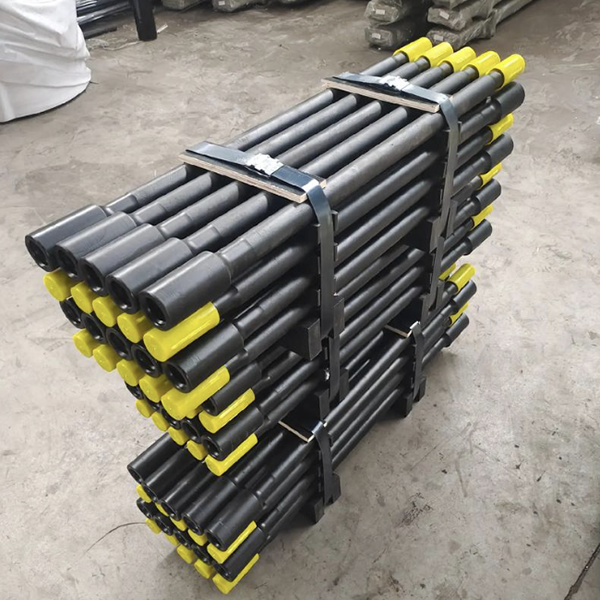
The final stage is corrosion protection. Special anti-corrosion coatings or oils can be applied to the external rod surface and internal flushing hole. This protects the tool during transport, storage, and periods of non-use.
Corrosion can damage threads, reduce connection quality, and create pitting that may become a fatigue initiation point. Proper packaging, dry storage, and thread protection are therefore part of maintaining drill rod quality after manufacturing.
Conclusion
Hydraulic drill rods are produced through much more than simple cutting and threading. Their final performance depends on material inspection, straightening, precise machining, controlled heat treatment, surface strengthening, final alignment, and corrosion protection.
For drilling contractors, the value of a drill rod should be measured by reliable meters drilled, stable hole straightness, reduced downtime, and lower total drilling cost. For manufacturers, consistent process control is the foundation for delivering drill rods that can withstand demanding rock drilling conditions.