How to Choose Rock Drill Rods: Types, Working Principles, and Maintenance Tips
How to Choose Rock Drill Rods: Types, Working Principles, and Maintenance Tips
In top hammer drilling, the drill rod is the essential link between the rock drill and the drill bit. Whether the work involves underground development, quarry drilling, or surface blasting, the rod must transfer impact energy, rotation, and flushing media efficiently.
A poorly selected drill rod can reduce penetration rate, increase thread wear, create stress-related failures, and cause unnecessary downtime. Understanding rod types, thread systems, material quality, and maintenance practices helps drilling teams improve productivity and tool life.
What Is a Rock Drill Rod?
A rock drill rod is a high-strength alloy-steel component that connects the rock drill to the drill bit. It performs three important functions:
Transfers impact energy to break rock.
Transmits rotational torque to keep the bit cutting.
Carries air or water through the flushing hole to remove rock cuttings.
In simple terms, the drill rod is the energy-transfer bridge of the drilling system. If its connection, alignment, or material quality is compromised, the entire drilling process can suffer.
Main Types of Rock Drill Rods
Integral Drill Rods
Integral drill rods are manufactured from a single steel bar, with the rod and drill bit connected as one piece. Because there is no threaded joint, they offer efficient energy transmission and a simple, stable structure.
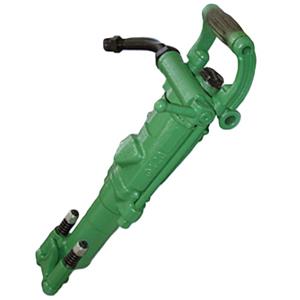
They are commonly used with hand-held rock drills for shallow holes, small blasting holes, quarry work, and small-diameter hard-rock drilling.
Tapered Drill Rods
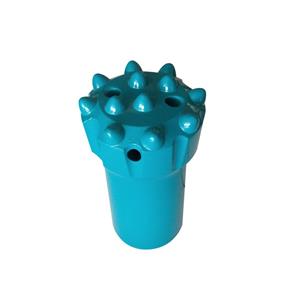
Tapered rods use a conical connection between the rod and a replaceable tapered bit. Common taper angles include 7°, 11°, and 12°.
This friction-fit design does not use threads and is generally suitable for shallow drilling, often less than four meters. Tapered drill rods are frequently used in quarries, secondary blasting, and light construction work.
Threaded Drill Rods
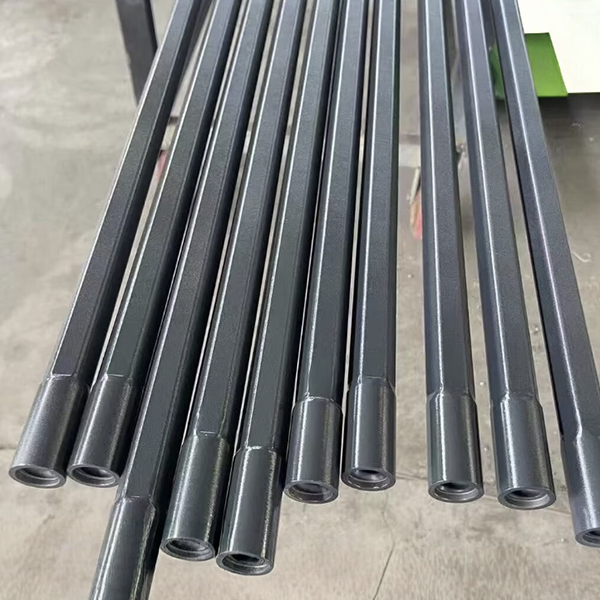
Threaded drill rods can be joined with coupling sleeves, allowing multiple rods to be connected for deeper holes. They are widely used in mining, tunneling, bench drilling, and production drilling.
Common thread systems include:
R series: R25, R28, R32, and R38, often used for underground mining and tunneling.
T series: T38, T45, and T51, commonly used for surface drilling and long-hole work.
MF extension rods: male and female threads are machined directly on opposite ends of the same rod, allowing rods to connect without a separate coupling sleeve.
How Rock Drill Rods Work
During drilling, the rod transmits three forces at the same time. The piston delivers high-frequency impact energy through the rod to the bit. Rotational force turns the bit continuously to support rock breaking. Flushing media carries cuttings out of the hole.
These actions must work together. Poor matching between impact, rotation, and flushing can reduce drilling efficiency and shorten the service life of both the rod and the bit.
How to Select the Right Drill Rod
Start with material and heat treatment. High-quality carburized alloy steel, such as 23CrNi3Mo, provides a tough core, a hard surface, and strong fatigue resistance.
Thread matching is equally important. The shank adapter, coupling sleeve, drill rod, and bit should use compatible thread specifications. Mixing thread systems can lead to energy loss, thread damage, and safety risks.
Drilling conditions also matter. Hard rock requires higher-strength alloy steel, while abrasive formations require greater wear resistance. The flushing-hole design must support reliable cuttings removal; poor flushing can overheat the bit and lower penetration rates.
Essential Drill Rod Maintenance
Regular maintenance can significantly extend drill rod life.
Always apply suitable thread grease before connecting rods to prevent thread galling, also known as cold welding. Check rod straightness and remove bent rods from service, as continued use can cause rod breakage or damage to the drill machine.
Inspect threads for wear, chipped teeth, and cracks. Finally, match impact pressure and rotation speed to the rod and rock conditions. Incorrect operating parameters increase thread wear and raise the risk of failure.