How to Extend Rock Drilling Tool Life: Design, Materials and Operation
Extending the life of rock drilling tools requires more than choosing stronger steel or harder carbide. Drill bits, drill rods, couplings and shank adaptors work as one system under impact, rotation, bending, corrosion and abrasive wear. A weakness in design, manufacturing, maintenance or operating practice can shorten the life of every component.
The most effective approach is to identify the dominant failure mode, then improve the complete drilling system around it.
Understand How Rock Drilling Tools Fail
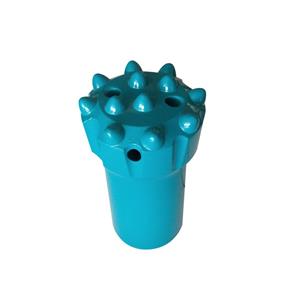
Drill tools can fail through normal wear, but early failures are usually linked to avoidable causes. Common bit failures include chipped carbide inserts, broken buttons, button loss, cracked bit bodies, gauge wear and deformation around the flushing grooves.
Drill rods may fail through thread wear, shank-end damage, fatigue cracking, brittle fracture or corrosion fatigue. Each pattern provides clues about the source of the problem.
For example, repeated fractures near a thread root may indicate poor thread geometry, worn couplings, insufficient lubrication or misalignment. Carbide button loss may indicate inadequate button retention, weak steel support or inappropriate drilling parameters. A cracked bit body may result from abrupt section changes, stress-wave reflection, unsuitable heat treatment or excessive drilling load.
Improve Bit Design for the Rock Formation
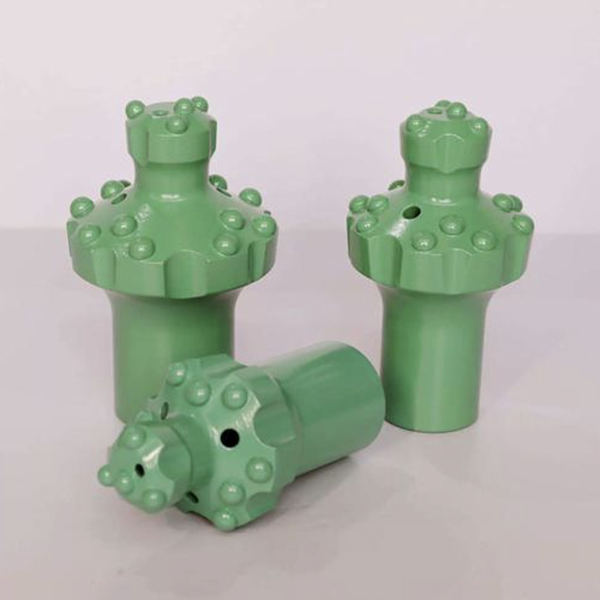
Bit design has a direct effect on drilling speed, stability and service life. The best design depends on rock hardness, abrasiveness, fracture pattern, drill type and hole diameter.
Important design factors include:
Carbide grade and button geometry.
Number and arrangement of face and gauge buttons.
Gauge protection.
Bit-body strength around carbide inserts.
Flushing-hole position and groove geometry.
Thread or taper connection design.
Steel-body material and heat treatment.
Older bit designs may have thin steel support, poor flushing performance or low geometric stability. In demanding hard-rock applications, these weaknesses can lead to early gauge wear, steel-body cracking, carbide breakage and reduced penetration.
Modern button-bit and advanced insert-bit designs aim to provide better carbide support, more stable cutting geometry and improved cuttings removal. The goal is to maintain hole diameter, reduce stress concentration and transfer drilling energy efficiently into the rock.
Select Carbide for Wear and Impact Resistance
Carbide must balance hardness and toughness. A highly wear-resistant grade may perform well in abrasive rock but can be vulnerable to heavy impact. A tougher grade may survive shock better but wear faster.
Button failures should be analyzed by location and appearance. Gauge buttons commonly experience more complex loads because they contact the hole wall and may receive side loading. If edge buttons break repeatedly, the problem may involve bit geometry, insufficient steel support, poor alignment or an unsuitable carbide grade.
Proper button retention is equally important. Carbide must be held securely without excessive installation stress. Inaccurate button holes, poor interference fit or weak surrounding steel can allow buttons to move, crack or fall out.
Prevent Drill Rod Fatigue
Drill rods are subjected to combined impact, torsion, bending and corrosion loading. Fatigue is therefore a major cause of failure. Small defects can grow into cracks after many drilling cycles, especially near threads, shoulders, shank transitions and damaged surfaces.
To improve rod life, manufacturers should control:
Steel cleanliness and alloy composition.
Hollow-bar geometry and wall-thickness consistency.
Thread accuracy and surface finish.
Heat-treatment uniformity.
Hardness and toughness balance.
Straightness and residual stress.
Corrosion protection.
Operators also play an important role. Forcing misaligned rods into couplings, drilling with worn threads or running bent rods can quickly create fatigue problems. Routine inspection of threads, shanks, couplings and rod surfaces helps remove weak components before they fail in the hole.
Match the Whole Drilling System
A high-quality bit cannot compensate for poor drill-steel quality, and a premium rod cannot overcome incorrect drilling parameters. The drill, bit, rod, shank adaptor, coupling, flushing system and rock formation must be matched.
When selecting a tool system, evaluate:
Rock strength, abrasiveness and jointing.
Hole diameter and drilling depth.
Impact power, feed force and rotation speed.
Bit profile and flushing design.
Rod diameter, thread type and coupling length.
Water or air flushing capacity.
Maintenance and grinding capability.
Field trials are useful because the best tool combination depends on actual rock and operating conditions. Track drilled meters, penetration rate, bit wear, rod failures, downtime and total cost per meter.
Use Correct Maintenance Practices
Tool life can be extended significantly through simple maintenance:
Inspect bits before and after drilling.
Grind carbide buttons or inserts before wear becomes severe.
Keep threads clean and use approved lubricant where required.
Replace worn couplings before they damage new rods.
Check rod straightness and remove damaged components.
Maintain adequate water or air flushing.
Avoid excessive feed force, poor alignment and aggressive collaring.
The goal is not only to make tools last longer. Better maintenance improves penetration rate, protects drilling equipment and reduces the risk of costly stuck-tool incidents.
Build Reliability into Every Stage
Longer tool life comes from reliable design, accurate manufacturing, correct material selection and disciplined use. By treating the rock drill, drill string and bit as one connected system, drilling teams can reduce early failure, improve productivity and lower total drilling cost.