How to Select Rock Drilling Tools for Hydraulic Drill Rigs
Selecting rock drilling tools for a hydraulic drill rig is not simply a matter of choosing a bit diameter or thread type. The shank adaptor, coupling, drill rod and bit must match the rig, hole depth, rock conditions and production target. A poor combination can reduce penetration rate, increase hole deviation and create costly downtime.
The most effective selection strategy considers the full drilling system and focuses on total cost per drilled meter rather than purchase price alone.
Match the Tool System to the Drill Rig
Hydraulic drill rigs are used in underground development, production drilling, open-pit mining, quarrying, tunneling, hydropower and civil infrastructure. Each application has different requirements for tool strength, rod length, connection type, flushing and bit design.
Development jumbos are commonly used for tunnel and drift excavation. Their drilling tools need reliable impact transfer, rapid penetration, effective flushing and good resistance to bending. Because holes are often drilled in a face pattern, operators also need stable hole direction and predictable bit performance.
Underground production rigs drill longer blast holes, often in a wide range of directions. These applications typically use extension rods and require reliable threads, high rod straightness and good fatigue resistance. Hole quality is important because poor deviation can affect the blast pattern and reduce ore recovery.
Surface hydraulic rigs are commonly used for down-the-hole blast patterns in quarries, open-pit mines and infrastructure projects. The tool system must support deeper holes, maintain straightness and withstand high feed force and rotation. Larger-diameter rods and MF thread systems are frequently used in demanding surface drilling.
Start with Hole Diameter and Hole Depth
Hole diameter and planned hole depth are the first technical factors in tool selection. Small holes require lighter rods and smaller bits, while larger or deeper holes require a more rigid drill string with greater torque capacity.
As hole depth increases, rod straightness becomes more important. A small deviation near the collar can become a large positional error at the bottom of a deep hole. This can affect burden, spacing, explosive loading and fragmentation results.
For deeper holes, operators may select:
Larger-diameter extension rods.
Stiffer rod profiles.
Reliable threaded connections.
Guide rods or stabilizing tools.
Bit faces designed to support straight drilling.
Couplings matched to the thread system and operating load.
The correct combination depends on rock conditions, rig configuration and the required drilling accuracy.
Tool Quality Is a Productivity Requirement
High-quality drilling tools cost more at the time of purchase, but they can lower total operating cost by reducing unplanned tool changes, failures and lost drilling time.
A broken rod can lead to a lost bit, a damaged hole and time-consuming recovery work. A worn or damaged shank adaptor may reduce impact transfer and require the drill to be taken out of production. A poorly performing bit can reduce penetration rate and increase energy use.
For hydraulic drilling operations, the cost of idle equipment is often much higher than the cost of a single tool. This is why professional drilling operations evaluate tool quality through working life, drilling speed, reliability and service support.
Important quality indicators include:
Drill rod straightness and fatigue resistance.
Thread accuracy and coupling fit.
Shank adaptor wear resistance.
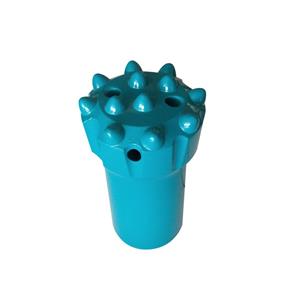
Bit-body strength and carbide retention.
Carbide grade and button geometry.
Flushing-hole quality.
Heat-treatment consistency.
Manufacturing traceability.
Penetration Rate Influences Total Cost
Penetration rate is one of the most important performance measures in rock drilling. Faster penetration means the rig spends less time on each hole, reducing labor, equipment, energy and project costs.
However, maximum speed is not always the correct goal. Excessive feed, rotation or impact settings can increase tool wear, cause deviation or damage carbide buttons. The best drilling rate is one that delivers consistent meterage while maintaining bit life, rod life and hole quality.
Tool selection should therefore consider:
Rock strength and abrasiveness.
Fracture pattern and ground variability.
Drill impact power and rotation speed.
Bit face design and carbide grade.
Flushing medium and pressure.
Rod diameter and stiffness.
Thread profile and coupling design.
A tool that produces slightly lower penetration but lasts much longer may be more economical than a tool that drills quickly but fails early.
Hole Straightness Is Critical for Blast Results
Hole deviation has a direct effect on blasting performance. In long-hole mining and surface production drilling, inaccurate holes can reduce explosive distribution accuracy, create uneven fragmentation and increase the risk of oversized rock.
Modern hydraulic rigs can control collar position and drilling angle very accurately. Once these initial errors are minimized, drilling-tool structure becomes one of the main influences on hole straightness.
Tool selection can help control deviation through:
Stiff, straight extension rods.
Appropriate rod diameter for hole depth.
Guide or stabilizing rod sections.
Suitable bit face geometry.
Correct coupling length and thread engagement.
Consistent drilling parameters.
The deeper the hole, the more important these factors become.
Evaluate the System by Cost per Meter
A well-managed drilling operation records more than bit consumption. It measures penetration rate, drilled meters per shift, rod life, bit life, coupling wear, hole deviation, downtime and recovery work.
These records make it possible to compare tool systems objectively. A lower-cost bit may appear attractive, but if it requires frequent changes, produces slower drilling or increases deviation, the total cost may be higher.
The right tool choice supports three key goals:
Reliable tool quality and long service life.
High, stable penetration rate.
Low hole deviation and consistent blast-hole quality.
When drill tools are selected as a complete system rather than as separate consumables, hydraulic drill rigs can achieve better productivity, lower operating cost and more reliable drilling results.