R-Thread or T-Thread? How to Pick the Right Shank Adapter for Your Hydraulic Rock Drill
A shank adapter does exactly two things: it takes the piston's impact and sends it down the drill string, and it channels flushing media through to the bit. Simple job. But pick the wrong thread type for your rig, and neither of those things happens efficiently. You'll feel it in penetration rate, you'll see it in component wear, and you'll pay for it in replacements.
The adapter market breaks down along a few clear lines. Know them, and the choice gets a lot easier.
Female vs. Male: It Starts With the Interface
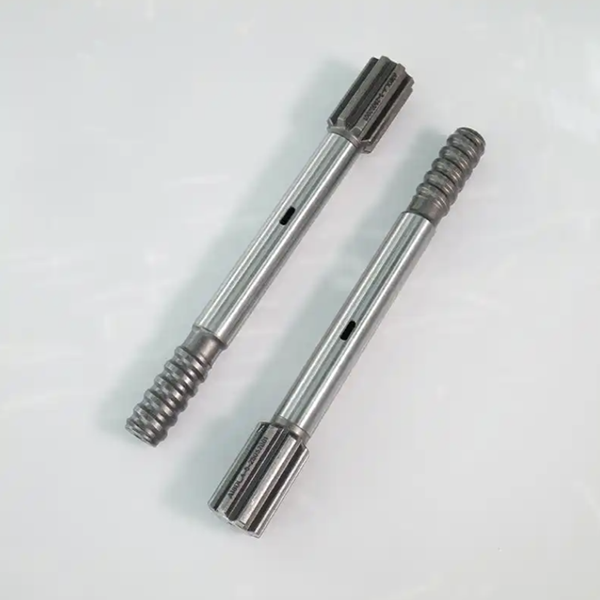
The most basic distinction is which end carries the threads. A female shank adapter has internal threads and mates with a male rod or coupling. These tend to be shorter and lighter — they work well on small-diameter holes where compact tooling matters more than brute force.
A male shank adapter carries external threads and connects into a female coupling or directly into a threaded drill rod. These are built for larger holes and higher impact loads. The larger cross-section at the thread root handles more energy without fatigue cracking.
Neither is better in the abstract. The choice is dictated by the rig's front-end configuration and the hole sizes you're drilling. But if you're running production holes above 64mm in hard rock, you're almost certainly looking at male adapters with heavy thread profiles.
R-Thread: The Workhorse for Medium-Duty Drilling
R-type threads — R28, R32, R35, R38 — are designed for moderate impact energy and moderate thread loading. They're the standard on smaller hydraulic drifters and pneumatic rock drills where impact energy stays in the mid-range. The thread profile is simpler, the connection is straightforward, and the parts are widely available.
If you're running a smaller jumbo in tunneling, doing roof bolting, or drilling in ground that doesn't demand maximum percussion, R-thread adapters will serve you well. They're cost-effective, easy to source, and when the parameters are matched to the rock, they last.
The limitation is impact ceiling. Push an R-thread adapter past its design load — either because the rig is too powerful or the rock is too hard — and the threads become the failure point. They'll gall, strip, or fatigue-crack at the root. Not because the adapter was bad, but because it was the wrong class for the job.
T-Thread: When the Hammer Gets Serious
T-type threads — T35, T38, T45, T51, and the heavier ST58, ST68, EL60, GT60 — are engineered for high-impact hydraulic drifters. The thread geometry is deeper, the load-bearing flanks are larger, and the connection is designed to handle the kind of percussion that would destroy an R-thread in a shift.
On a production drill punching 89mm or 102mm holes in hard granite, a T45 or T51 adapter isn't an upgrade — it's the baseline. These threads also tend to be easier to break loose after a long run, which matters when your crew is making up and breaking down strings all day.
The tradeoff is cost and availability. T-thread tooling is more expensive, and in remote locations, some sizes can be harder to stock. But the math tends to work out: one T-thread adapter that lasts three months costs less than three R-thread adapters that each last a month, especially when you factor in the downtime.
The Matching Rule That Saves You Money
The thread type on the shank adapter has to match the drill rod and coupling sleeve it connects to. This sounds obvious, but I've seen sites where the purchasing department bought adapters and rods from different suppliers with nominally "compatible" threads that didn't actually seat properly. The threads looked close enough, but the pitch or the flank angle was off by a fraction, and the connection never ran true.
Buy the adapter and the rods as a matched system — ideally from the same manufacturer. Check the thread spec, not just the nominal size. And if you're switching from R-thread to T-thread because you've upgraded to a more powerful rig, switch the entire string. Mixing thread families in the same drill string is asking for a failure at the weakest link.