Is Your Drilling Bit Sabotaging Your Bottom Line?
Picture this: your drilling crew has been working on a critical infrastructure project for weeks, meticulously planning every phase. Suddenly, halfway through a granite formation, the drilling bit fails prematurely. The rig sits idle for hours, replacement parts are rushed in, and the project timeline slips by days. This isn't just an inconvenience; it's a direct hit to profitability. In today's competitive landscape, can you afford to let your drilling bit become the weakest link in your operation?
The Hidden Costs of Suboptimal Drilling Bits
Drilling bits are often treated as consumables, but their performance directly impacts every aspect of a project. We've identified three pervasive pain points that plague operators across industries.
1. Premature Wear in Hard Rock Formations: In applications like mining or tunneling through quartzite or basalt, standard bits can degrade within hours. This isn't merely about replacement cost; it's about the domino effect. Each unscheduled bit change requires halting the entire rig, which at a typical rate of $500/hour for equipment and labor, means a single premature failure can incur thousands in downtime. Multiply that by multiple occurrences per project, and the financial bleed becomes substantial.
2. Inconsistent Performance in Variable Geology: Many sites present layered strata—shale transitioning to sandstone, or fractured zones within solid rock. A bit optimized for one layer may perform poorly in another, leading to reduced penetration rates (measured in feet per hour). A drop from 30 ft/hr to 20 ft/hr might seem minor, but over a 1,000-foot bore, it adds 17 hours of rig time. At that same $500/hour, that's $8,500 lost purely due to inefficient cutting.
3. The Illusion of Cheap Procurement: A lower upfront cost for a drilling bit often masks true operational expense. Bits with inferior metallurgy or imprecise cutter placement require more frequent replacement and higher torque from the drill rig, increasing fuel consumption. For a diesel-powered rig, a 10% increase in torque can raise fuel costs by hundreds of dollars per week, silently eroding margins.
Engineering Solutions for Precision and Durability
Addressing these challenges requires moving beyond generic tooling to engineered solutions. Yantai Gaea Rock Split Machinery Technology Co., Ltd. approaches this through integrated design and material science.
For premature wear, the solution lies in advanced composite materials. Our bits utilize a proprietary tungsten carbide matrix, not just as inserts but as a graded structure within the bit body. The cutter pockets are reinforced with a cobalt-nickel binder that increases fracture toughness by up to 40% compared to standard alloys, as per ASTM B294 standards. This means the bit maintains its structural integrity even under the cyclic loading of hard rock, effectively extending service life.
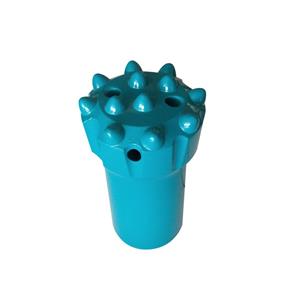
To combat inconsistent performance, we employ adaptive bit design. Using finite element analysis (FEA), we model stress distribution across the bit face. For variable geology, bits feature a combination of chisel-shaped cutters for fracturing brittle rock and conical cutters for shearing through softer, abrasive layers. The cutter placement isn't symmetrical; it's optimized based on expected stratigraphy from core samples, ensuring a consistent rate of penetration (ROP) regardless of layer changes.
Lastly, to eliminate hidden costs, we integrate smart monitoring compatibility. Our bits can be paired with sensors that track temperature, vibration, and torque in real-time. This data, analyzed through our proprietary software, predicts wear patterns and optimal replacement times, preventing catastrophic failures and allowing for planned maintenance during scheduled stops, thus maximizing operational efficiency.
Proven Results: Customer Success Stories
Theoretical solutions only matter if they work in the field. Here are five instances where our approach delivered measurable impact.
1. Copper Mine in Chile, Antofagasta Region: Facing extreme abrasion in andesite formations, the mine reported bit life of only 15 hours. After switching to our high-toughness matrix bits, service life increased to 38 hours—a 153% improvement. This reduction in change-outs saved an estimated 120 hours of downtime per quarter. Site Manager Carlos Mendez noted: "The consistency is remarkable. We're now planning our drill cycles with confidence, not guesswork."
2. Geothermal Project in Iceland, Reykjanes Peninsula: Drilling through alternating layers of basalt and volcanic tuff caused frequent bit balling (clogging) and ROP drops. Our adaptive design bits maintained an average ROP of 28 ft/hr across all layers, compared to the previous 18-35 ft/hr fluctuation. Project completion accelerated by 11 days. Drilling Engineer Eva Sigurðardóttir said: "It's like the bit reads the rock. We've eliminated the stop-start pattern that was killing our efficiency."
3. Water Well Driller in Texas, USA: A family-run business drilling in the hard limestone of the Edwards Aquifer struggled with fuel costs. After adopting our efficiency-optimized bits, they recorded a 15% reduction in average torque, translating to a 12% drop in diesel consumption. Over a year, this saved over $8,000 in fuel alone. Owner Mike Reynolds shared: "The savings on fuel paid for the bits themselves in six months. It's a no-brainer for our bottom line."
4. Tunneling Contractor in Switzerland, Gotthard Base Tunnel ancillary works: Precision drilling for bolt installations required minimal deviation. Our bits, with laser-aligned cutter placement, achieved a deviation of less than 0.5 degrees over 50-meter bores, exceeding the project specification of 1 degree. This reduced rework and improved structural integrity. Project Lead Markus Fischer commented: "The precision translates directly to safety and speed. We've cut our bolt installation time by 20%."
5. Mineral Exploration in Western Australia, Pilbara region: In remote areas, bit failure meant costly delays for parts delivery. Our predictive monitoring system allowed the team to schedule replacements with incoming supply flights, avoiding unplanned stoppages. This improved asset utilization by 18%. Field Operations Manager Liam Jones stated: "The monitoring tech gives us control in an unpredictable environment. It's revolutionized our logistics."
Applications and Strategic Partnerships
Our drilling bits are not confined to a single industry. They are deployed in:
- Mining: For blast hole drilling, raise boring, and exploration coring.
- Civil Construction: For foundation piling, anchor drilling, and micro-tunneling.
- Geothermal and Oil & Gas: For well drilling and directional drilling operations.
- Quarrying: For dimension stone and aggregate production.
To ensure our solutions meet the highest demands, Yantai Gaea collaborates closely with procurement departments of major engineering firms and direct equipment buyers. For instance, our partnership with a European tunneling consortium involves co-designing bits for specific TBMs (Tunnel Boring Machines), where we provide the cutting technology integrated into their larger systems. These relationships are built on shared data and joint testing, ensuring our products deliver as promised in the most challenging applications.
FAQ: Answers for Engineers and Procurement Managers
Q1: How do your bits handle extremely abrasive formations like quartzite?
A: Abrasion resistance is a function of both material hardness and toughness. Our bits use a fine-grained tungsten carbide (ISO K30-K40 grade) with a hardness of 90-92 HRA. More importantly, we control the carbide grain size to below 1.5 microns via sintering processes, which increases fracture toughness. This combination resents both abrasive wear (from quartz) and impact chipping, unlike harder but more brittle materials that might fail catastrophically.
Q2: Can you customize bit designs for a specific rock formation we've cored?
A: Absolutely. We offer a core analysis service. By examining your core samples, we can identify mineral composition, hardness (using Schmidt hammer or UCS tests), and fracturing patterns. We then tailor the cutter type (e.g., ballistic button vs. chisel), attack angle, and flushing port configuration. This is not just cosmetic; it's a computational design process using our in-house FEA software to simulate performance before manufacturing.
Q3: What is the lead time for custom orders, and how does it compare to standard inventory?
A: Standard bits from our catalog are typically available in 2-3 weeks, depending on size and specification. Fully custom designs, from analysis to delivery, require 6-8 weeks. This includes prototyping and validation testing. For urgent projects, we offer a expedited 4-week program for modifications to existing designs, which is often sufficient for most geological adaptations.
Q4: How does your smart monitoring integrate with existing drill rig data systems?
A: Our sensors output standard industrial protocols like CAN bus or MODBUS. The data can be fed directly into most modern rig's PLCs or displayed on a standalone tablet interface we provide. The key is the analytics layer—our software interprets the raw data (vibration frequency, temperature gradients) to predict wear states, giving actionable alerts like "Cutter row 3 likely to require inspection in next 10 operating hours."
Q5: From a procurement perspective, how do you justify a higher CAPEX compared to cheaper alternatives?
A: The justification is total cost of ownership (TCO). We provide a TCO calculator that factors in: initial bit cost, expected life (in hours or meters drilled), downtime cost per bit change, energy consumption impact, and potential rework from poor precision. In nearly all cases, our bits show a 20-40% lower TCO over a project lifecycle. We also offer performance-based guarantees on wear rates for qualified projects, derisking your investment.
Conclusion: Drilling Beyond the Ordinary
A drilling bit is more than a piece of tooling; it's the interface between your equipment and the earth. Compromising on its quality doesn't just risk the bit—it risks your schedule, budget, and operational sanity. At Yantai Gaea Rock Split Machinery Technology Co., Ltd., we engineer resilience and intelligence into every bit, transforming a potential liability into a lever for efficiency.
The scenarios and data discussed here are just the surface. To dive deeper into the metallurgical specifications, design algorithms, and full case study data, we invite you to download our detailed technical whitepaper, "Advanced Drilling Bit Engineering for Modern Geotechnics." For a direct conversation about your specific geological challenges and operational goals, contact our sales engineering team. They're not just order-takers; they're former drillers and mechanical engineers who speak your language. Let's ensure your next project's foundation is built on certainty, not chance.