Key Operating Tips for Tapered Chisel Bits
In rock drilling operations, the drill bit is the core component that comes into direct contact with the rock. Among various rock drilling bits, tapered chisel bits are the most widely used in China due to their simple structure, strong adaptability, and practical performance.
These bits are mainly connected through a tapered shank system and are typically used together with tapered drill rods. Proper use of tapered chisel bits has a direct impact on drilling efficiency, bit service life, and operational safety. To help users operate them correctly and avoid common issues, it is important to understand the following key precautions.
1. Reduce Air Pressure When Starting the Hole
The hole-opening stage is the first step in protecting the bit, yet it is often overlooked in practice.
If the rock drill delivers excessive air pressure at the beginning of drilling, the carbide tip of the chisel bit may be subjected to excessive localized stress. This can easily lead to edge chipping, cracking, or premature damage.
For this reason, the air supply should be reduced during hole starting. Once the bit has fully entered the rock and the load becomes evenly distributed, the air pressure can be returned to normal. This helps prevent sudden impact damage to the carbide insert and ensures smoother drilling performance.
2. Ensure Proper Matching Between the Bit and the Drill Rod
The fitting accuracy between the tapered chisel bit and the tapered drill rod directly affects whether the bit remains securely in place and whether the load is transmitted evenly during drilling.
When using the bit, make sure that:
the taper angle of the bit and rod is fully matched,
the insertion depth of the drill rod into the bit taper hole is greater than 25 mm,
the top of the rod does not bottom out inside the bit.
If the rod head touches the bottom of the bit hole, it may cause uneven force distribution, which can result in bit loosening or even bit loss during operation.
For better compatibility and reliability, it is recommended to use tapered bits and tapered drill rods from the same manufacturer whenever possible. This helps ensure taper consistency and improves connection stability from the source.
3. Avoid Drilling Into Hard Foreign Objects
During operation, attention should be paid to any hard foreign materials in the drilling path, such as steel reinforcement bars or embedded metal objects.
If such obstacles are encountered, do not continue drilling by force. Instead, immediately adjust the drilling position. Forced impact against hard foreign objects may cause:
cutting edge breakage,
carbide insert damage,
bit deformation,
irreversible structural damage.
Avoiding such interference in time can effectively protect the drill bit and reduce unnecessary downtime.
4. Inspect the Bit Regularly and Regrind or Replace It in Time
Regular inspection is one of the most effective ways to extend the service life of a tapered chisel bit.
When the flat wear area on the cutting edge reaches 3 mm or more, rock drilling speed will decrease significantly. At this stage, the bit may also become more likely to develop cracks, chips, or broken fragments. The bit should be reground or replaced promptly.
In addition, if the bit develops a reverse taper wear pattern, it will accelerate self-wear, reduce drilling efficiency, and may even lead to rod jamming. This issue should also be addressed without delay.
Timely maintenance not only extends bit life but also improves drilling safety and performance.
5. Select the Right Bit Type According to Rock Conditions
Adjusting the bit type according to the characteristics of the rock can greatly improve drilling efficiency and reduce bit consumption.
If the rock is particularly hard and causes:
severe wear on the chisel bit,
slow penetration,
excessive bit fragmentation,
then users may consider switching to:
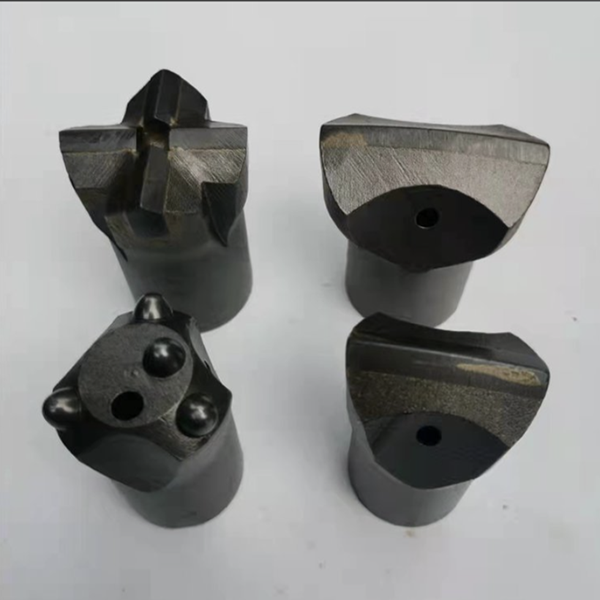
a tapered chisel bit with a different carbide grade,
a tapered cross bit,
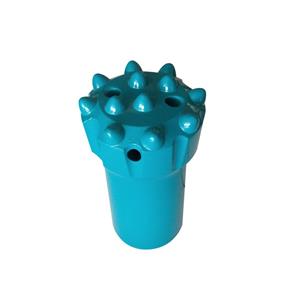
or a tapered button bit.
Likewise, if rod jamming occurs frequently during operation, replacing the chisel bit with a cross bit or button bit may help reduce jamming problems and prevent bit damage or work interruption.
Choosing the proper bit design for the application is essential for maintaining productivity in different rock formations.
6. Maintain Adequate Water Supply During Drilling
Water supply is another critical factor in rock drilling performance.
During operation, a sufficient amount of water should be provided to:
cool the bit,
improve flushing,
reduce dust,
prevent rod jamming,
extend bit service life,
improve drilling efficiency.
Without adequate water, the bit may overheat, wear faster, and perform less efficiently. Proper flushing also helps remove cuttings from the hole and keeps the drilling process stable.
7. Choose Integral Drill Steel for Soft Rock When Appropriate
If the rock formation is relatively soft and easy to drill, users may choose integral drill steel, where the bit is forged directly onto the drill rod.
Compared with separate tapered bit systems, integral drill steel can offer:
faster drilling speed,
lower operating cost,
simpler tool management in suitable formations.
This makes it a practical option for certain soft-rock applications.
Conclusion
The correct use of tapered chisel bits depends on three key principles: proper matching, standardized operation, and timely maintenance.
By following the precautions above, users can fully utilize the drilling advantages of tapered chisel bits, extend their service life, improve rock drilling efficiency, and reduce safety risks. In this way, drilling operations can become not only more productive, but also safer and more cost-effective.