Long-Life Impact Drill Rods: How to Improve Reliability in Rock Drilling
Impact drill rods are essential links between a rock drill and the bit. They transmit impact waves, rotation and feed force into the rock while working in abrasive, wet and highly dynamic conditions. In mines, quarries, tunnels and civil projects, rod failure can stop drilling, damage connected tools and raise the cost per meter drilled.
Longer drill rod life is therefore not achieved through one material upgrade alone. It depends on a complete system: steel cleanliness, rod geometry, rolling process, heat treatment, thread quality, bit matching, drilling parameters and operating discipline.
Why Impact Drill Rods Fail
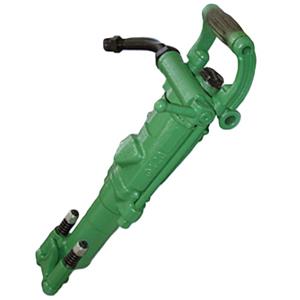
A drill rod is exposed to several loads at once. Each blow from a top-hammer rock drill sends an impact wave through the steel. At the same time, the rod experiences rotation, feed pressure, bending, vibration and friction against the hole wall. Water or compressed-air flushing introduces further wear, while groundwater can accelerate corrosion.
The most common failure mode is fatigue. Repeated impact cycles can initiate cracks at locations where stress is concentrated, including thread roots, shoulders, shank transitions, damaged surfaces and geometric changes. Once a crack begins, it can grow rapidly under continued drilling.
Poor drilling conditions make this process worse. Misalignment between the drill, feed beam, rod and hole increases bending stress. Excessive feed pressure can overload the bit and rod. Insufficient feed may cause bouncing, poor energy transfer and damaging stress-wave reflection. Inadequate flushing allows cuttings to recirculate and can contribute to binding, overheating and accelerated wear.
Drill Steel Quality Is the Starting Point
The inner quality of the drill steel is fundamental to rod life. Suitable alloy composition must be combined with good steel cleanliness, uniform microstructure and controlled mechanical properties. Chromium, nickel and molybdenum are commonly used in high-performance alloy steels because they can help provide the required combination of strength, toughness and hardenability.
However, nominal chemical composition alone is not enough. Inclusions, segregation, internal defects and inconsistent grain structure can become fatigue initiation points. For that reason, refined steelmaking, controlled billet quality and carefully managed rolling processes are important for demanding drilling applications.
The hollow form of the drill steel must also be produced accurately. A centered and consistent flushing hole helps maintain balanced wall thickness and stable mechanical properties. If the hole is eccentric, one side of the rod may be weaker, increasing the risk of bending failure.
Geometry and Connections Matter
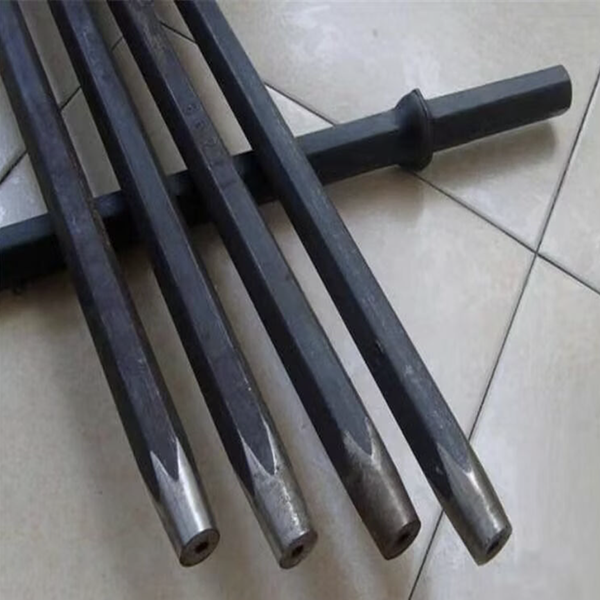
Drill rods are available in hexagonal and round profiles, with dimensions selected according to the drill type, hole size, required depth and operating conditions. Smaller taper rods are common for light drilling applications, while threaded extension rods are used with hydraulic rigs and longer holes.
Threaded connections require particular attention because they carry impact, torque and axial force while being assembled and disassembled repeatedly. Accurate thread geometry, correct coupling design and good shoulder contact help reduce energy loss and prevent local overstressing.
To maximize connection life:
Keep threads clean and free from rock dust.
Apply appropriate thread lubricant where recommended.
Avoid mixing worn couplings with new rods.
Check for galling, deformation and loss of thread profile.
Make up connections according to the correct operating procedure.
Remove damaged components before they cause secondary failure.
A poor connection can damage more than one component. It may accelerate thread wear, reduce impact transfer, loosen the bit or create bending loads that shorten the life of the entire drill string.
Manufacturing Processes Influence Service Life
The production route has a direct effect on drill rod reliability. High-quality rods require controlled processing from steelmaking through final inspection.
Important production stages include:
Refining alloy steel to improve cleanliness and consistency.
Forming hollow billets with controlled dimensions.
Rolling the rod body while maintaining uniform wall thickness.
Forging shanks, shoulders and other load-bearing sections.
Machining or forming threads accurately.
Applying carburizing, quenching or other heat treatment as required.
Straightening, shot blasting, corrosion protection and inspection.
Heat treatment is particularly important for threaded rods. The connection area needs sufficient surface hardness to resist wear, but the rod also needs a tough core to absorb repeated impact. Too much hardness can increase brittleness, while insufficient hardness can lead to rapid thread deformation and wear.
Match the Rod to the Bit and Rock Drill
A drill rod should never be selected in isolation. The bit, shank adaptor, coupling, rock drill and drilling parameters must form a compatible system.
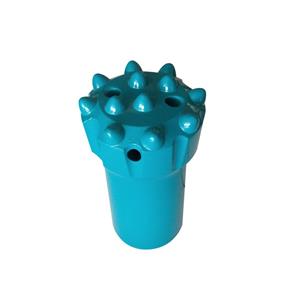
For example, a powerful hydraulic rock drill combined with an undersized rod or poorly matched thread system can create excessive stress. A bit that wears out of gauge or fails to flush properly may increase vibration and bending loads on the rod. In hard, abrasive or fractured rock, the best solution may require a different bit face design, carbide grade, rod diameter or drilling parameter.
A proper selection process should consider:
Rock strength, abrasiveness and fracture pattern.
Hole diameter and drilling depth.
Drill impact power, rotation speed and feed capacity.
Drill rod profile, diameter and connection type.
Bit design, carbide grade and flushing layout.
Expected operating environment, including water and corrosion.
Maintenance practices and spare-parts availability.
Field trials are often the most reliable way to compare options. Instead of evaluating only purchase price, operators should track drilled meters, penetration rate, rod failures, bit consumption, maintenance time and total cost per meter.
Operating Practice Extends Rod Life
Even a premium drill rod can fail early if it is used incorrectly. Proper alignment is one of the most effective ways to reduce avoidable bending loads. The feed beam should be stable, the rod should enter the hole straight and the operator should avoid forcing a bent or damaged rod into service.
Flushing must be adequate throughout drilling. It removes cuttings, cools the bit and reduces the risk of regrinding broken rock at the bottom of the hole. When drilling conditions change, such as moving from competent rock into fractured ground, feed and rotation settings may need adjustment.
Routine inspection should be part of every drilling shift. Operators should look for thread wear, rod straightness, corrosion, surface damage, blocked flushing holes and visible cracking. Early removal of a worn rod is generally less costly than a broken rod that damages a coupling, bit, shank adaptor or rock drill.
The Goal Is Lower Cost per Meter
Long-life impact drill rods are not simply stronger rods. They are the result of better steel, better geometry, better manufacturing, better tool matching and better operation. The real performance target is not the lowest rod purchase price; it is stable drilling, fewer failures, reduced downtime and lower cost per drilled meter.
For drilling contractors and mining operations, investing in reliable drill steel and disciplined maintenance creates value across the entire drilling and blasting cycle.