Building Longer-Lasting Rock Drill Steel: Materials, Manufacturing and Tool System Strategy
Rock drilling tools have shaped mining, tunneling, water development and infrastructure construction for centuries. Modern blasting and drilling may rely on powerful hydraulic rigs, precision machining and advanced consumables, but the basic challenge remains the same: transfer energy to rock efficiently while preventing premature tool failure.
Among all drilling components, the drill rod is one of the most demanding. It must carry repeated impact waves, torque, feed force, bending loads, abrasive wear and corrosive flushing conditions. A reliable rock drilling system therefore depends on far more than a high-power drill. It requires the right combination of drill steel, carbide bit, connection geometry, heat treatment, manufacturing quality and operating practice.
From Steel Chisels to Carbide Rock Tools
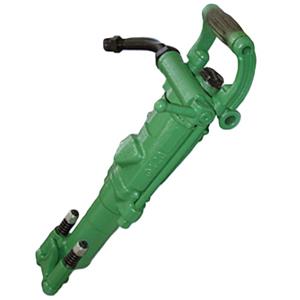
The introduction of industrial explosives created a strong need for faster and more consistent blast-hole drilling. Pneumatic rock drills and hollow drill steel made it possible to transfer impact energy through a rod while flushing cuttings from the hole. The later introduction of tungsten carbide changed drilling productivity again.
Carbide inserts and buttons provided much higher wear resistance than steel cutting edges. This enabled drill bits to maintain their cutting shape longer, increase drilling speed and reduce the amount of frequent sharpening required in many applications. Chisel bits, cross bits, button bits and composite cutting structures were developed for different rock conditions and drilling methods.
Today, rock drilling tools serve underground mines, surface mines, quarries, tunnels, hydropower projects, road construction, geotechnical work and resource exploration. Despite this variety, their success still depends on the efficient interaction of three elements: the drilling machine, the drilling tool and the rock.
Why Drill Rod Life Is So Difficult to Improve
A drill rod is a long, slender component that operates in an unusually harsh environment. During drilling, it may be exposed to:
Repeated impact waves from the rock drill.
Rotational torque and axial feed force.
Bending caused by hole deviation, poor alignment or unstable ground.
Abrasive contact with rock particles and hole walls.
Water, compressed air and corrosive mine-water exposure.
Fatigue loading at threads, shoulders and other stress-concentration areas.
The combined effect of these loads makes fatigue failure a major concern. A rod may not fail because of one overload event. Instead, tiny defects or stress concentrations can grow gradually under thousands of impact cycles until a crack forms and propagates.
Connection zones are especially important. Taper connections, thread roots, shoulders and coupling interfaces must be designed and manufactured accurately. Poor contact, inadequate thread engagement, incorrect tightening or worn parts can reduce energy transfer and increase the risk of breakage.
The most important point is that drill rod life cannot be judged by steel strength alone. High strength is useful, but a successful drill steel must also have toughness, fatigue resistance, dimensional accuracy, controlled surface condition and an appropriate heat-treatment profile.
Material Design for Rock Drill Steel
Hollow drill steel is commonly produced in hexagonal or round cross-sections with a central flushing hole. The geometry must provide enough stiffness and torsional capacity while allowing reliable flushing of cuttings and water or air.
Alloy steel systems containing chromium, nickel and molybdenum are widely valued in demanding rock-drilling applications. These alloying elements can support hardenability, toughness and fatigue performance when combined with controlled steelmaking and heat treatment. The exact material selection should match the rod diameter, drilling method, impact energy and operating environment.
Smaller drill rods used in light rock drills have different requirements from heavy threaded extension rods used on hydraulic surface rigs. Lightweight rods must resist repeated shock while remaining economical for frequent handling and replacement. Larger rods must tolerate higher torque, longer drilling depths and demanding thread loads.
Material cleanliness also matters. Non-metallic inclusions, segregation and internal defects can reduce fatigue life. For this reason, advanced drill-steel production emphasizes refined steelmaking, controlled billet preparation, rolling quality and inspection.
Manufacturing Has a Direct Effect on Performance
High-quality drill steel depends on a chain of manufacturing steps rather than a single material choice. Important processes include:
Steelmaking and refining to control composition and cleanliness.
Billet preparation and rolling to create a uniform hollow section.
Forming of shanks, shoulders and other load-bearing features.
Thread machining or taper finishing with accurate geometry.
Carburizing, quenching or other heat-treatment processes where required.
Straightening, shot blasting, corrosion protection and final inspection.
The flushing hole deserves particular attention. It must be consistent, smooth and properly centered. An off-center hole can reduce the rod’s effective wall thickness and create an uneven stress distribution. For applications exposed to severe corrosion, improved internal-surface protection can also help extend working life.
Threaded drill rods require a careful balance between surface hardness and core toughness. Threads need good wear resistance, but excessive brittleness can shorten fatigue life. Heat treatment, machining precision and correct coupling design must therefore work together.
Carbide Bits and Drill Steel Must Be Matched
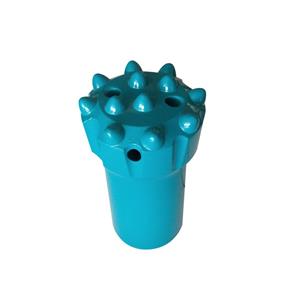
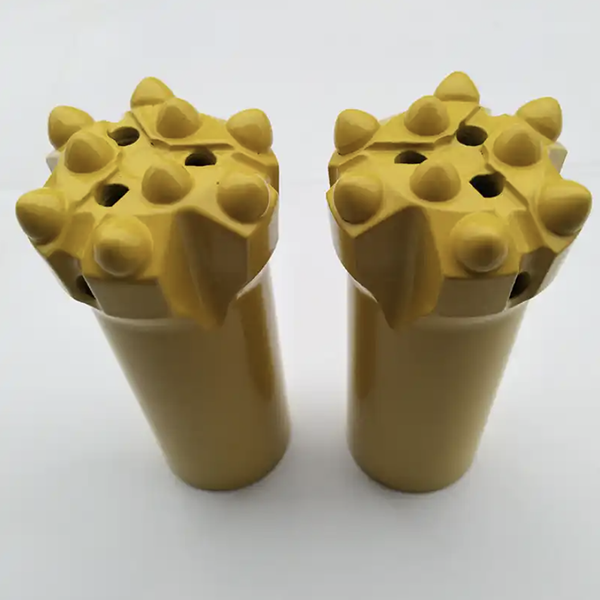
A durable rod alone does not ensure efficient drilling. The drill bit must match the rock formation, hole diameter and drill energy. Carbide grade, button shape, face design, gauge protection and flushing layout all influence penetration rate and service life.
Hard and abrasive rock may require a wear-resistant carbide grade and strong gauge protection. Highly fractured or variable ground may place greater emphasis on button toughness, bit stability and effective flushing. If a bit wears unevenly or loses gauge early, it can increase rod bending and create poor drilling conditions for the entire tool string.
This is why tool selection should consider the complete drilling system. A high-quality rod paired with an unsuitable bit may still fail early. Likewise, a premium bit cannot compensate for poor thread quality, poor shank contact or severe rod misalignment.
Operating Practice Protects Tool Life
Drill rod performance is strongly affected by how tools are used. Operators can improve service life by maintaining correct feed pressure, rotation, flushing and alignment. Excessive feed can overload the bit and rod. Insufficient feed can cause excessive bouncing and impact reflection. Inadequate flushing allows cuttings to recirculate, increasing wear and the risk of bit binding.
Routine inspection should focus on thread wear, shoulder damage, rod straightness, flushing-hole blockage, corrosion and surface cracks. Removing worn rods before complete failure helps prevent more costly damage to couplings, shank adaptors and rock drills.
A System Approach Produces the Best Results
The future of rock drilling tools lies in system optimization. Better alloy design, cleaner steel, improved hollow-bar production, precise thread machining, controlled heat treatment and more durable carbide inserts can all contribute to longer life. But the largest gains usually occur when these improvements are combined with correct bit selection, suitable drilling parameters and disciplined maintenance.
For mines, quarries and contractors, the goal should be lower cost per drilled meter rather than simply a lower purchase price. A drilling tool that lasts longer, maintains hole quality and reduces interruptions can create value throughout the drilling and blasting cycle.