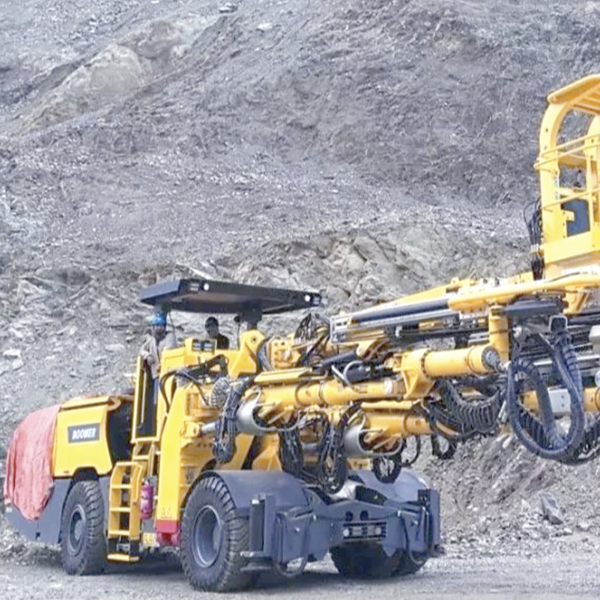
Operating Instructions for a Rock Drilling Rig
Use of the Rock Drilling Rig
(1) Before Operation
Check whether the pump, air compressor, and related equipment are operating normally.
Inspect pipelines and joints for oil, water, or air leakage. Start operation only after confirming there are no abnormalities.
Check all control levers, control devices, and instruments to ensure proper sensitivity and normal readings, preventing safety incidents caused by control component failure.
(2) Traveling Operation
Before moving the rig, lower the lifting platform, retract the sliding worktable, retract the boom, place the feed beam in the horizontal position, keep the rock drill in starting condition, and retract the stabilizer legs before traveling.
Before movement, observe the surrounding area and confirm there are no personnel or obstacles in front, behind, or on either side. Operate strictly according to the guide person’s signals, and never touch control levers accidentally.
Keep movement smooth during travel; avoid sudden operations that may cause accidents, especially on slopes. Because the rig body is long, even small steering angles can cause large swing at the front and rear ends—operate with extra caution.
When traveling in narrow tunnels, closely monitor the surroundings. During cable winding, the operator must strictly follow the guide person's instructions.
Hydraulic oil temperature must be controlled within 30–70°C. If it exceeds 70°C, stop traveling immediately and resume only after temperature returns to normal range.
(3) Rock Drilling and Other Operations
Before drilling, remove loose rock from the work face. This is especially critical when drilling anchor bolt holes; strengthen protective measures to prevent injuries from falling rock.
Before connecting the water hose, use compressed air to blow out dust inside the hose to prevent internal equipment damage.
Connect insulated power cables correctly to the power supply, ensuring firm connections and reliable insulation to prevent electric leakage accidents.
Stabilizer legs must be fully deployed and rig stability confirmed before rock drilling or any lifting-platform operation begins.
During drilling and lifting-platform work, the rig body must not be moved; otherwise, the boom and feed beam may be damaged, reducing equipment life.
If boom movement is required, retract the feed beam first so its tip leaves the work face. Confirm no personnel are below the boom, and all personnel remain at a safe distance outside the boom’s movement range. Prevent collision between dual booms to avoid hose damage.
When operating the lifting platform, use gestures or signals to alert personnel below. Continuously check whether boom and feed beam positions below are correct to prevent collision.
When moving the boom, arrange hoses properly to prevent twisting or crushing and avoid pipeline damage.
During operation, closely observe dust discharge from drilled holes. If discharge is abnormal, promptly check for blockage to keep drilling smooth.
It is strictly forbidden to use the rig for scaling or removing dangerous loose rock, to avoid equipment damage or personal injury.
(4) Parking
Never park the rig on soft ground or in areas where sidewall or roof rockfall/collapse is possible, to prevent tilting, damage, or impact from falling rocks.
After parking, set the feed beam and boom to travel position and horizontal orientation, return all control valves to neutral, shut down the electric motor and engine, and cut off power.
Avoid parking on slopes whenever possible. If slope parking is unavoidable, deploy stabilizer legs and place wheel chocks (triangular blocks) to prevent sliding and ensure stable parking.
If the operator leaves the rig temporarily or stops work, the rig power supply must be disconnected and protective measures must be in place to prevent accidental startup.