Percussion Tools vs. Rotary Drilling Tools: They Both Make Holes, but That's Where the Similarity Ends
In mining and civil engineering, the terms "percussion tooling" and "rotary drilling tooling" get thrown around interchangeably on too many job sites. They both put holes in rock. But how they do it, what they're made of, and where each one belongs are fundamentally different. Using the wrong category for your application isn't just inefficient — it's expensive.
Here's the breakdown.
Percussion Tooling: Impact Is the Business
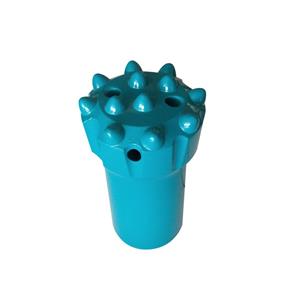
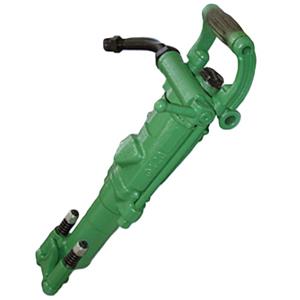
Percussion tools — what the Chinese industry calls “Qianju” — are designed for hard, brittle materials like rock and concrete. They work by hammering. A piston in a rock drill or a DTH hammer strikes the top of the drill string, sending a stress wave through the shank adapter, down the rock drill rod, and into the button bit. The bit fractures the rock through concentrated impact energy, and rotation simply indexes the bit to a fresh spot for the next blow.
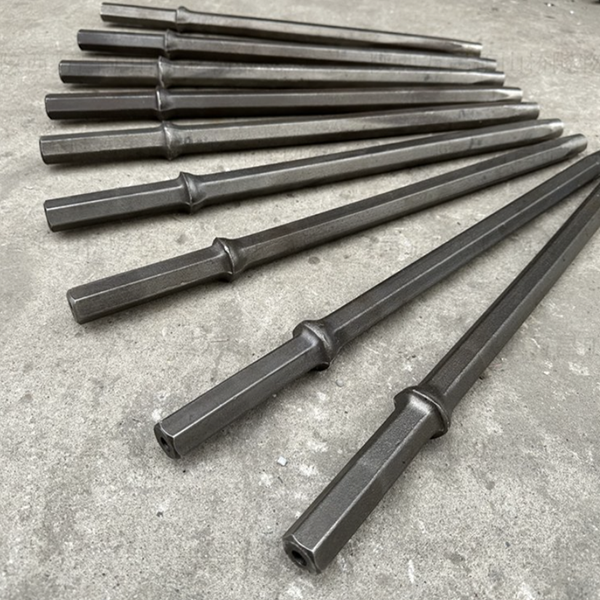
The tooling itself is relatively simple compared to rotary systems. A typical percussion string has three or four components: the shank adapter that takes the piston impact, the drill rod that transmits energy and flushing media, the coupling sleeve that connects rod sections, and the button bit at the face. That's it. No stabilizers, no drill collars, no complex bottom-hole assemblies.
Percussion tooling dominates in mining, tunneling, underground construction, and rock anchoring — anywhere you're drilling blast holes, bolt holes, or grout holes in competent rock. The holes are typically shorter (a few meters to a few tens of meters) and the primary objective is speed: drill the hole, load the charge or the bolt, move to the next one.
Rotary Drilling Tools: Weight, Rotation, and Circulation
Rotary drilling tools — “Zuanju” — operate on a different principle. Instead of hammering, they rely on weight on bit and continuous rotation to cut, scrape, or crush the rock. The drill string is heavier and more complex. Below the drill pipe, you'll typically find drill collars to provide weight, stabilizers to keep the assembly centered, and a bit — often a tricone, a PDC, or a drag bit — that cuts through rotation and downward pressure.
Flushing serves a dual purpose: cooling the bit and carrying cuttings up the annulus. In deep holes, the hydraulic design of the flushing circuit becomes as important as the mechanical design of the bit.
Rotary systems are the standard in oil and gas, deep water well drilling, geothermal, and geotechnical investigation — applications where holes run hundreds or thousands of meters, where core samples matter, and where directional control over long distances is critical. The holes take longer, the tooling costs more, and the engineering behind every component in the string is correspondingly deeper.
Where the Lines Blur
There's a gray zone worth acknowledging. Down-the-hole hammer drilling sits between the two categories: it uses percussion at the bit (like percussion tooling) but runs on a rotary-style drill string with high-pressure air as the flushing medium. Tricone bits bridge the gap from the other direction — they crush rock through a combination of weight and rotation, but can handle harder formations than pure drag bits.
For a company like Gaea Rock, the core products — shank adapters, rock drill rods, button bits, DTH hammers — live firmly in the percussion world. But the tricone drill bits in the catalog extend into rotary territory, and understanding where each tool family belongs helps buyers match the right product to the right application the first time.