Quick-Change vs. Integral Drill Rods: The Choice That Shapes Your Entire Drilling Operation
Walk onto any two drill sites and you might see the same rig model punching the same rock — but one crew swaps rods in seconds while the other wrestles with coupling sleeves and thread grease for half the shift. The difference usually isn't the crew. It's the drill rod system they chose before the first hole was ever drilled.
Quick-change rods and integral threaded rods aren't just different connection styles. They represent two fundamentally different approaches to how you manage depth, speed, and labor on a drilling operation. Pick the wrong one for your setup, and you'll feel it in every shift.
The Quick-Change Rod: Built for Speed and Automation
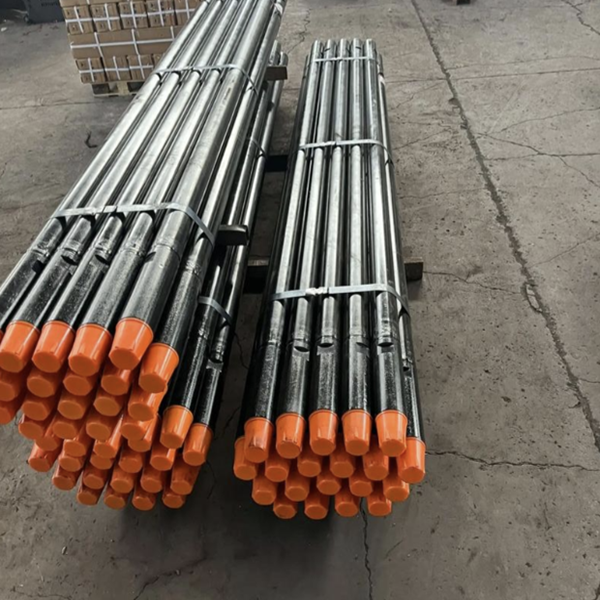
A quick-change drill rod uses a tapered shank with a snap-ring retention system. It mates directly with a quick-change shank adapter on the rig and is designed to be handled by a rod manipulator — no coupling sleeves, no thread alignment, no manual wrestling. The operator commands the change, the manipulator executes it, and the rig is back to drilling.
Typical sizes run from T38 through T51 and R32, with lengths spanning 800mm to 6,400mm. These rods are designed for medium-to-deep hole applications where you're adding multiple rods to a string and can't afford to lose minutes per connection.
The math is straightforward: if your shift target demands continuous drilling with minimal idle time, and your rig has the automation to support it, quick-change rods pay for themselves in labor savings alone. But they require the full ecosystem — a compatible shank adapter, a functional manipulator arm, and an operator who knows how to keep the system timed correctly. If any piece of that chain is missing, the speed advantage evaporates.
The Integral Rod: Universal, Tough, and Forgiving
An integral threaded drill rod is the workhorse in the other corner. Standard thread profiles — R22, R25, R32, T38, T45 — with coupling sleeves between sections. Lengths typically range from about 2,500mm to 5,500mm. No special shank adapter required beyond a standard threaded driver.
Where integral rods shine is versatility. If your hole depths vary widely across the site — some shallow, some deep, changing by the hour — you can mix and match rod lengths without being locked into a specific automation system. If your maintenance crew is small and your spare parts budget is tight, the parts commonality across standard threaded components is hard to beat. A coupling sleeve and a tube of thread grease are a lot cheaper than a replacement manipulator gripper.
The tradeoff is time. Every rod change is manual. Threads need to be cleaned, greased, and properly made up. On a deep hole with a long string, those minutes stack up. In the right application — shallow holes, variable ground, small crews — it's the right call. In high-production deep-hole drilling, it'll hold you back.
How to Make the Call
Ask yourself three questions:
First, does your rig have the automation? A quick-change shank adapter and a working rod manipulator aren't optional for quick-change rods — they're the entire point. If your rig doesn't have those, you're buying rods you can't use.
Second, what's your typical hole depth? If most of your work is shallow — under five or six meters, single rod territory — the speed advantage of quick-change never really kicks in. You're paying for capability you won't use. Integral rods will do the job for less money and less complexity.
Third, what does your maintenance situation look like? Quick-change systems need the manipulator calibrated and the snap-ring mechanism kept clean and functional. If your site maintenance is reactive rather than preventive, the simplicity of threaded connections becomes a real advantage.
There's no right answer that fits every site. The only wrong answer is buying whichever system is cheaper or whichever one the neighboring crew runs — without checking whether it matches your rig, your depths, and your crew's workflow. Match the rod to the operation, and the operation runs. Mismatch it, and you'll spend every shift compensating for a decision that was made before the first hole.