The Coupling Sleeve Is Small. The Cost of Getting It Wrong Isn’t.
Ask someone to name the most important parts of a hydraulic rock-drilling system and they will usually mention the drill rig, shank adapter, threaded drill rods, or button bit.
The coupling sleeve rarely gets a place on that list.
It is small. It is simple-looking. It does not touch the rock face. It does not make the impact. It does not carry the carbide buttons.
Yet it is one of the parts that decides whether all the other components work together properly.
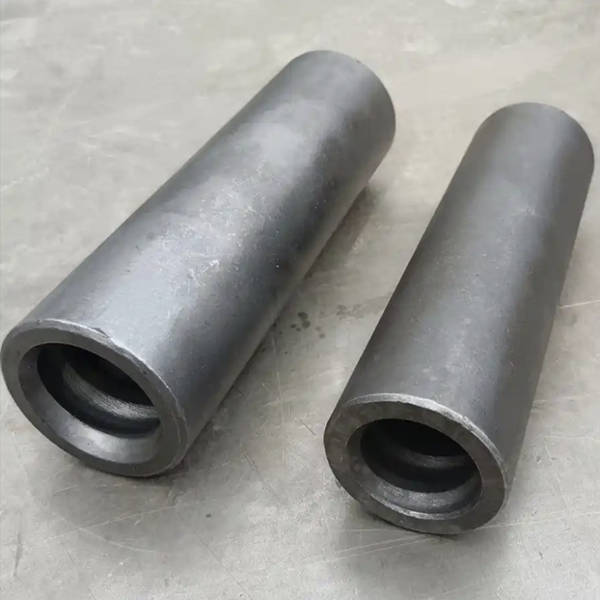
A coupling sleeve connects the shank adapter to the drill rod, one drill rod to another, or a threaded bit to the drill string. Its job is to keep the string aligned while transmitting impact energy and torque through the connection. If the sleeve is poorly matched, poorly made, or worn beyond service limits, the cost can spread quickly through the whole system.
A cheap coupling sleeve can become an expensive way to damage expensive drill steel.
What a rock drill coupling sleeve actually does
A coupling sleeve is more than a threaded tube.
During drilling, it helps maintain the alignment of connected components so that impact energy travels through the drill string efficiently. It also carries rotational torque while the steel is exposed to vibration, heat, flushing water, abrasive cuttings, and repeated loading.
That means the sleeve affects several parts of drilling performance at once:
Energy transfer from the rock drill to the bit
Thread engagement and protection
Drill-string concentricity
Flushing reliability
Connection stability during high-frequency impact
Service life of the shank adapter and drill rods
When the sleeve fits correctly, the drill string behaves as one connected system. When it does not, energy loss, thread wear, leakage, heat build-up, and abnormal fatigue can begin.
The issue is rarely isolated. A bad connection can cause damage that looks like a shank-adapter problem, a drill-rod problem, or a rig problem. In reality, the coupling sleeve may have been the weak link all along.
Thread type must match the whole string
Thread matching is the first rule.
Common threaded rock-drilling connections include T38, T45, and T51, among others. The coupling sleeve must match the selected drill rod and the rest of the connection system precisely. Thread size alone is not enough. The thread profile, manufacturing accuracy, material properties, and intended operating conditions all matter.
A loose or poorly formed thread connection can create impact loss and accelerate wear. An excessively tight or mismatched connection can make uncoupling difficult and place unnecessary stress on the threads. Either condition shortens usable tool life.
This is why it is usually safer to select coupling sleeves as part of a complete drill-string package, not as a separate low-cost purchase. A supplier that understands the shank adapter, rods, bits, and sleeves as a system can help ensure that the components are designed to work together.
Mixing parts from different sources is not automatically wrong, but it increases the need for careful verification. A nominally compatible thread may not deliver the same fit, material behavior, or service life as a properly matched system.
Sleeve length and design have a job to do
Coupling sleeves are available in different lengths, including common dimensions around 160 mm, 170 mm, 180 mm, 210 mm, and 235 mm. The right length depends on the connection design and the drilling application.
The sleeve design also matters.
Same-diameter coupling sleeves are used where connected components share the same diameter. Reducing coupling sleeves are used when the drill string transitions between different diameters. Selecting the wrong type can affect alignment and create unwanted stress at the connection.
Another important distinction is between full-bridge and half-bridge coupling sleeves.
A full-bridge sleeve provides a central stop that supports correct positioning of the connected drill-steel ends. This design can help maintain alignment and reduce the chance of improper thread engagement during coupling. In many applications, it is the preferred choice for a stable, repeatable connection.
The key is not to choose a design because it is familiar or inexpensive. Choose it because it matches the drill-string layout, the operating loads, and the site’s maintenance practice.
What failure looks like in the field
Coupling-sleeve problems do not always begin with a visible crack.
Sometimes the first warning is a connection that runs unusually hot. Sometimes it is water leakage around the drill string. Sometimes drill rods begin showing abnormal thread wear even though the rods themselves are made from good steel. In more severe cases, poor alignment or unsuitable sleeve properties can contribute to shank-adapter damage or unexpected rod failure.
One common mistake is assuming that the sleeve can be specified to a lower standard because it is cheaper to replace than a shank adapter or drill rod. That logic ignores the role the sleeve plays in protecting those higher-value components.
If the sleeve is too hard, it may accelerate wear on the mating threads. If it lacks sufficient strength or thread accuracy, it may deform or loosen under impact. If its geometry does not keep the string aligned, the system can begin working off-axis.
The cost is not just the sleeve. It is extra steel consumption, lost drilling time, more frequent tool changes, and troubleshooting that could have been avoided.
A practical coupling-sleeve selection checklist
Before ordering or replacing coupling sleeves, check the following:
Confirm the exact thread type and mating components.
Match sleeve design to the drill-string layout and diameter transition.
Verify the required sleeve length for the connection.
Check that hardness and heat treatment are appropriate for the intended drill steel.
Inspect threads for damage, corrosion, deformation, and poor engagement.
Watch for abnormal heat, leakage, difficult uncoupling, or irregular wear in service.
Replace worn sleeves before they begin damaging rods or shank adapters.
Where possible, source the sleeve, shank adapter, and drill rods from one qualified supplier.
The last point is practical, not promotional. A complete matched system makes it easier to trace thread specifications, heat-treatment requirements, and compatibility issues. When drilling conditions are demanding, that consistency is worth far more than a small saving on one component.
Treat the sleeve as part of the production plan
Drilling crews rightly pay attention to penetration rate, bit life, rod consumption, and rig performance. The coupling sleeve should be part of that same conversation.
It is a small component, but it sits at a critical junction in the drill string. Its condition influences how energy moves, how threads survive, and how reliably the system stays connected through a shift.
Do not wait for a broken shank adapter or a damaged drill rod to review sleeve selection. Check the connection before it becomes the problem.
A well-matched coupling sleeve is not an accessory. It is part of the drill string’s working foundation.