Why a Longer Rock Drill Rod Can Slow Down Your Tunnel Advance
At a tunnel heading, longer does not automatically mean faster.
It is easy to see why people think it does. A longer rock drill rod can drill a deeper hole in one pass. Fewer rod changes should mean less downtime, right? On a roomy bench or in a large tunnel, that can be true. But take the same long rod into a tight underground heading and the calculation changes quickly.
The drill arm needs more room to swing. The carrier needs more room to position. The operator has less clearance to line up holes. A rod that looked productive on paper can turn into the reason the whole drilling cycle drags behind schedule.
The better question is not, “What is the longest rod we can use?” It is, “What rod length fits this heading, this hole pattern, and this drilling cycle?”
That is how experienced crews choose rock drill rods.
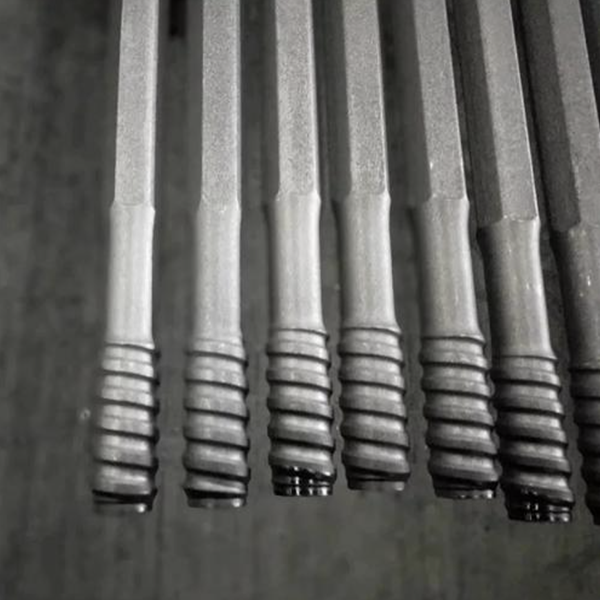
Rod length affects more than hole depth
In drill-and-blast tunneling, advance per round is closely tied to hole depth. A longer rod can let the jumbo drill deeper holes before a rod change is needed. That reduces handling time, keeps the drilling sequence moving, and can lower the physical workload on the crew.
Those are real benefits. In a large cross-section with good access, using a 3 m drill rod instead of a shorter alternative may reduce connection and disconnection time across a full face. Over dozens of holes, those saved minutes add up.
But hole depth is only one part of the cycle.
A drilling setup also depends on the tunnel profile, boom reach, machine turning space, hole angles, operator visibility, flushing arrangements, and the time needed to move between collar positions. If the rod is too long for the available space, every one of those steps becomes harder.
The lost time is rarely dramatic in a single hole. It shows up as dozens of small delays: a boom adjustment here, a slow reposition there, an awkward angle that needs a second attempt. By the end of the round, the crew has spent more time fighting the setup than drilling rock.
The practical choice: 2.5 m vs. 3 m drill rods
For many tunnel and mine-development jobs, 2.5 m and 3 m drill rods are common working lengths. Neither is universally better.
A 2.5 m rod is usually the more forgiving choice in restricted headings. It gives the drill arm more freedom to move and makes it easier to change between collar locations. In narrow drifts, small galleries, and headings where the carrier has limited room to maneuver, that flexibility matters. The operator can work through more hole positions without constantly negotiating the roof, walls, equipment, and support structures.
A 3 m rod is more at home in a larger, more open section. With enough clearance, it can support deeper single-pass drilling and reduce rod-handling interruptions. That makes it useful when the project is chasing a longer advance per round and the jumbo can move freely around the face.
The mistake is treating those two lengths as a simple “short versus long” decision. They solve different site problems.
Use the shorter rod when mobility and accurate positioning are the limiting factors. Use the longer rod when access is already good and fewer connections will genuinely improve the cycle.
Small headings punish oversized drill steel
In a tunnel with a cross-section around 2.0 × 2.0 m to 4.0 × 4.0 m, the main constraint is often not drilling power. It is space.
An oversized drill rod can restrict boom movement and make it harder to move the carrier or change drilling angles. Hole-to-hole transitions become slower. The operator’s working envelope becomes crowded. Even if the rod can technically reach the required depth, the setup may be so awkward that the crew loses the advantage of the extra length.
This is where procurement decisions can go wrong. Buying longer drill steel because it promises deeper holes ignores the actual operating environment. The rod is part of a drill string, but it is also part of a working system: the rig, the boom, the operator, the tunnel profile, the face design, and the production plan all have to work together.
A rod that is too long is not just inconvenient. It can increase the chance of poor collaring, unwanted bending loads, handling damage, and inefficient drilling angles. Those problems can shorten the usable life of the rock drill rod and create extra maintenance cost.
Match rod length to the whole drilling cycle
A reliable selection process starts with the face, not the catalogue.
First, confirm the planned hole depth and the advance required for each round. Then look at the actual tunnel or mine opening: width, height, roof profile, support system, equipment access, and available turning room. Next, consider whether the boom can comfortably align with all required holes when the rod is extended.
After that, check the drilling pattern. A burn cut, wedge cut, perimeter holes, lifters, and roof holes may not all demand the same positioning flexibility. In some headings, a mixed approach makes more sense than forcing one rod length into every task.
Finally, look at the real cycle time. Do not only count drilling minutes. Include rod changes, boom repositioning, carrier movement, hole alignment, flushing, inspections, and operator delays. The most productive rock drill rod is the one that reduces total time per completed round.
That point is easy to miss. A deeper hole is only valuable when the rest of the operation can support it.
Drill rod quality still matters
Correct length will not compensate for poor drill steel. The rod must still match the rock drill, shank adapter, coupling system, thread type, and drilling conditions. Poor thread fit, inadequate lubrication, incorrect impact energy, or bent steel can waste the benefits of even the best length selection.
Before committing to a rod specification, check:
Tunnel or heading dimensions and available boom clearance
Required hole depth and target advance per round
Drill rig model, feed length, and boom movement range
Thread type and compatibility with the existing drill string
Rock conditions and expected bending or vibration loads
Hole pattern and the number of repositioning moves per round
Actual cycle time, including handling and setup work
The field lesson is simple: do not buy rod length as a maximum number. Buy it as a fit for the job.
A 3 m rod may be the faster answer in an open heading. A 2.5 m rod may keep a confined heading moving when a longer option would slow everything down. The best drilling operation is not built around the longest tool. It is built around the right tool, in the right space, for the next round of work.