The Drill Rod Operating Manual They Should Have Given You: Before, During, and After Every Hole
Most drill rod failures aren't manufacturing defects. They're the accumulated result of small things done wrong — or not done at all — across dozens of shifts. A thread not greased. A feed pressure set by feel instead of by spec. A rod racked wet and left to rust over the weekend.
Here's how to handle rock drill rods properly from the moment they come out of storage to the moment they go back in.
Before You Drill: Three Checks That Take Five Minutes
Inspect every rod before it goes into the string. Look for bends — roll it on a flat surface if you're not sure. Check for visible cracks, especially at the thread roots and any transition shoulders. If a rod has a deformation you can see, it has stress concentrations you can't see, and those are where it'll fail.
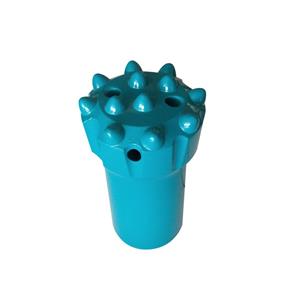
Make sure the rod matches the rig and the rest of the string. A rod spec that doesn't match the shank adapter, the coupling sleeve, or the button bit isn't just inefficient — it creates stress risers at every mismatched connection. Check the thread type and the diameter. Don't guess.
Then lubricate. Clean the threads and the connection faces, then apply a proper thread grease. Not whatever oil is sitting on the bench. Thread grease. It reduces friction during make-up, prevents galling, and makes disassembly possible without a cheater bar and a bad attitude.
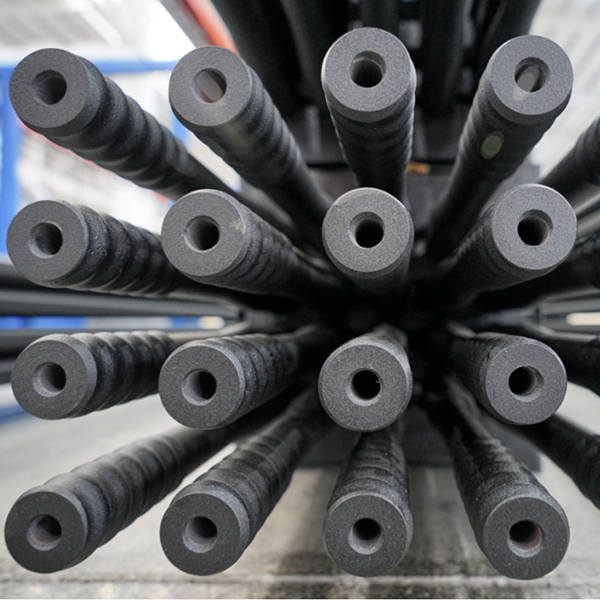
During the Hole: What to Control and What to Watch
Install the rod with proper torque, using the right tooling. A connection that's too loose will work itself apart under vibration. Too tight and you're stretching threads past their elastic limit — the damage is permanent. Follow the manufacturer's torque spec. And keep the rod concentric with the drill spindle. Any angular misalignment between the rod and the rotation axis puts a bending load through the connection with every revolution.
Feed pressure isn't one-size-fits-all. In hard, competent rock, you need enough pressure to keep the bit engaged — but stay within the rod's rated capacity. In soft or fractured ground, back off. Too much feed in easy drilling makes the rod flex and whip inside the hole, wearing the outer surface against the hole wall for no gain in penetration.
Rotation speed should follow the rock, not the other way around. Hard rock calls for slower rotation — high RPM in granite generates heat and friction without improving penetration. Soft rock can handle more speed, but watch the rod temperature. If it's coming out of the hole hot enough to sizzle water, you're spinning too fast or your flushing is inadequate.
Impact frequency needs the same logic. Hard rock benefits from higher blow frequency, but keep the impact energy within limits — you're trying to fracture rock, not the steel. In softer formations, dropping the frequency reduces unnecessary fatigue on the rod without slowing you down.
Flushing is non-negotiable. Whether you're on air or water, the cuttings have to move. If the return flow weakens, stop. Clear the blockage before you keep drilling. Packed cuttings around the rod increase friction, generate heat, and can seize the string in the hole. That's a problem you don't want to solve at depth.
And pay attention while you're drilling. If penetration rate drops suddenly, if the pressure gauge spikes, if the rod starts vibrating harder than normal — stop and investigate. Something has changed, and drilling through it hoping it'll go away is how you turn a small problem into a snapped rod.
After the Shift: The Part Most Crews Skip
Pull the rods and clean them. Rock dust left on the steel overnight absorbs moisture and starts corrosion. Mud dries into a crust that flakes off into the threads next time you make up a connection. Wash the rods, dry them, and inspect them under decent light.
Check for new damage. A hairline crack that wasn't there at the start of the shift is a rod that won't survive the next one. A thread that's started to gall will only get worse. Record what you find. A rod with minor surface wear can be dressed and returned to service. A rod with a crack or significant thread damage goes to scrap — the cost of a new rod is less than the cost of fishing a broken one out of a hole.
Apply a light coat of anti-rust oil before storing. Store rods horizontally on racks, sorted by specification, in a dry area with ventilation. Rods leaning against a wall in a damp corner will be rusted before you need them again.
None of this is complicated. None of it requires special equipment or advanced training. It just requires doing it, every shift, until it stops feeling like extra work and starts feeling like what work is.