Key Performance Requirements for Rock Drill Shanks
Key Performance Requirements for Rock Drill Shanks
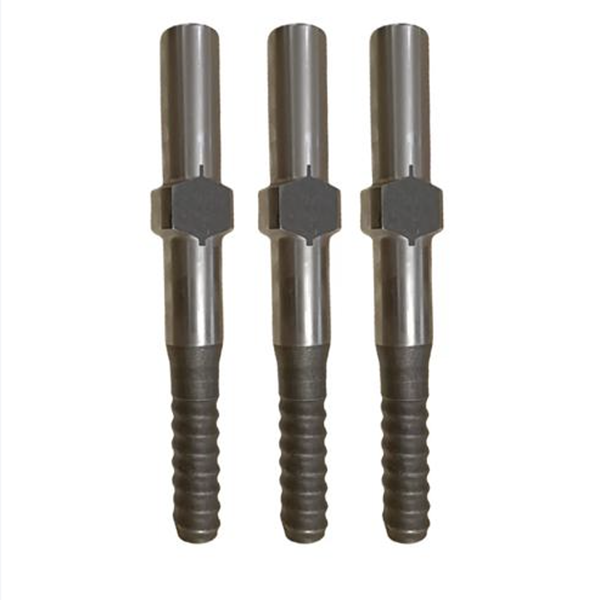
A rock drill shank is the critical transmission component connecting the rock drill to the drill rod. During drilling, it withstands repeated piston impacts, rotational torque, rod bending stress, sudden torsional loads caused by bit jamming, and erosion from high-pressure drilling water. These demanding conditions require exceptional durability and reliability.
1. Mechanical Performance
High fatigue strength is essential because the shank may experience thousands of impact loads per minute. Strong fatigue resistance directly affects service life.
The impact end, splines, outer diameter, and threads must have suitable surface hardness and wear resistance. Hardness should remain within an appropriate range to maintain accurate fits without damaging mating components.
The core should retain high toughness so it can absorb impact energy and resist brittle fracture. The ideal heat-treatment structure combines a hard surface with a tough core. High impact toughness is particularly important under abnormal conditions such as bit jamming and eccentric loading.
2. Dimensional and Fit Accuracy
Sound design of water holes, spline chamfers, thread transitions, and blended areas improves stability throughout the drilling assembly.
Critical dimensions, including center holes, outer diameters, and splines, require strict tolerance control. Good straightness is also important because bending reduces impact-transfer efficiency and increases localized wear.
The impact and thread end faces must be perpendicular to the shank axis. Full face contact allows impact energy to transfer efficiently and helps prevent premature failure. Low surface roughness on mating surfaces further reduces friction, wear, and stress concentration.
3. Environmental Resistance
Mining and tunneling environments are often wet and may contain corrosive media. Rock drill shanks therefore need appropriate corrosion resistance. In severely corrosive conditions, chrome plating or protective coatings can improve service performance.
4. Traceability
Each shank should have a unique identification mark. Traceability supports quality control, failure analysis, and continuous improvement in modern industrial manufacturing.