Rock Drill Steel Types: Integral, Detachable and Extension Tools
Rock drilling performance depends on more than the drill rig or rock drill itself. The drill steel, bit, shank connection and coupling system determine how efficiently impact energy and rotary torque reach the rock. Selecting the right rock drilling tool affects drilling speed, hole straightness, maintenance workload, tool consumption and operating cost.
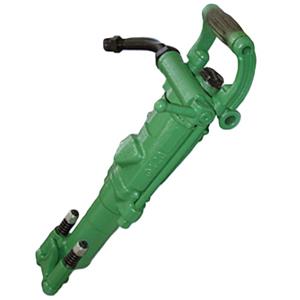
Rock drilling tools used with conventional top-hammer rock drills are commonly divided into three groups: integral drill steel, detachable drill steel and extension drilling tools. Each design has a different structure, operating range and economic advantage. Understanding these differences helps contractors, mines and quarry operators match the tool system to rock conditions and drilling depth.
How Rock Drill Steel Transfers Energy
A conventional top-hammer rock drill transmits both impact energy and rotation through the drill steel. The piston strikes the shank end, creating a stress wave that travels along the steel to the drill bit. At the same time, the machine applies rotation and feed force so that the bit repeatedly impacts new areas of rock.
This differs from down-the-hole drilling. In a DTH system, the hammer works near the bottom of the hole, immediately behind the DTH bit. The drill pipe mainly transfers rotation, feed force and flushing air; it does not carry the same repeated impact energy from a top hammer. For this reason, the tools used in top-hammer drilling are generally described as drill steels, while DTH tools are normally described as drill pipes, hammers and bits.
For top-hammer applications, the main purpose of the drill steel is to transmit impact energy and torque with minimal loss while maintaining sufficient strength, fatigue resistance and wear resistance.
Integral Drill Steel for Shallow-Hole Drilling
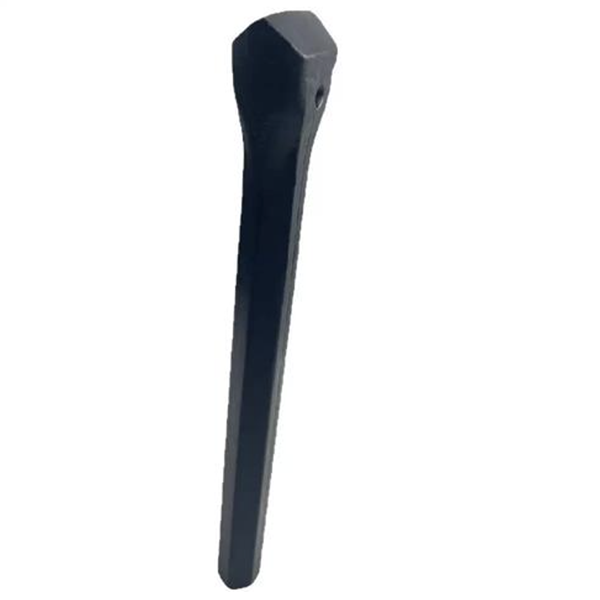
Integral drill steel is made as a single unit. One end is forged into a shank that fits the rock drill, while the opposite end is forged into a bit section fitted with carbide inserts or buttons. Common materials include hollow hexagonal drill steel, often with across-flat dimensions such as 19 mm, 22 mm and 25 mm.
Because the bit and steel are permanently connected, integral drill steel has no separate connection between the rod and bit. This gives it several advantages:
No risk of losing a detachable bit in the hole.
Good transfer of impact energy because there is no bit-to-rod joint.
High resistance to impact and torque for its size.
Easy withdrawal from shallow blast holes.
Simple operation for small-diameter, short-hole drilling.
Integral drill steel is widely used in soft to medium rock, small-diameter holes, quarry work, construction and light mining applications. It is especially practical where drilling depths are limited and fast tool changes are more important than maximum reusability.
Bit shape should be selected according to the rock. Chisel-type integral bits are easy to resharpen and can offer good economy in suitable conditions. Cross-type or multi-edge bits can improve stability in soft, fractured or heavily jointed rock because they reduce the risk of the bit binding in the hole. Three-edge designs may also provide generous flushing grooves, helping remove cuttings and reduce carbide wear.
Button-bit integral steels are generally better suited to easily penetrated rock with low abrasiveness. Their value comes from reduced resharpening needs, but the carbide and steel body should reach a reasonably balanced service life for the tool to remain economical.
The main limitation of integral drill steel is that once the bit end is seriously damaged, the whole tool may need to be retired. Operators must also maintain an inventory of multiple drill steels in different lengths, which can increase transport, storage and sharpening requirements.
Detachable Drill Steel for Flexible Tool Replacement
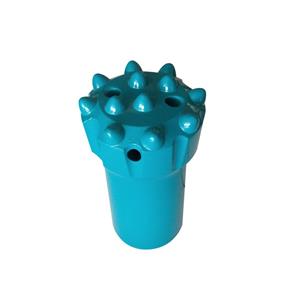
Detachable drill steel uses a removable drill bit connected to a separate drill rod. The connection may use a taper or a threaded joint, depending on the tool design and application. Removing the bit leaves the drill rod, often referred to simply as the drill steel or drill rod.
The principal benefit of a detachable system is service flexibility. When the bit wears out, it can be replaced without discarding the rod. If the rod breaks near a connection, it may sometimes be repaired by reworking the taper or thread rather than replacing the entire assembly.
A detachable system can also support deeper drilling. A single bit may drill a deep hole while rods of different lengths are exchanged as the hole advances. This makes it possible to maintain hole quality while limiting the number of complete tools that must be carried to the work face.
Other advantages include:
Lower transport volume for sharpening and bit servicing.
Separate selection of rod material and bit material.
Potentially longer usable life for the rod body.
Simplified storage of bits and rods.
Lower waste when only the bit has failed.
However, every connection introduces a possible loss of impact energy and an additional weak point. Taper connections, equal-diameter threaded connections and upset threaded connections can all have different energy-loss characteristics. Wear, poor manufacturing quality, inadequate tightening or damaged threads can allow the bit to loosen. A loose bit connection can accelerate wear, damage the bit and reduce drilling efficiency.
For this reason, detachable drill steel is most effective when connection maintenance is treated as a routine operating task. Operators should inspect threads or tapers, keep connections clean, use suitable lubrication where applicable and replace worn parts before they cause secondary damage.
Extension Drill Rods for Deeper Holes
Extension drilling tools are designed for longer holes. They consist of a shank adapter or shank section, one or more extension rods, couplings and a drill bit. This configuration is commonly used for bench drilling, drifting and other deeper-hole applications where one-piece steel would be impractical.
Modern extension rods often use threaded connections. Common thread profiles include wave-type and reverse buttress-type forms, designed to carry impact loading, rotation and feed force. Extension rods are available in various hexagonal and round dimensions, with the correct size determined by the rock drill, required hole diameter, drilling depth and expected operating conditions.
An important wear area is the thread. Under good drilling conditions, the usable life of an extension rod may be determined largely by thread wear rather than by failure of the rod body. One way to improve economic life is to use an extended thread section. When the first threaded section becomes worn, it can be removed and the second section put into service.
This approach can be particularly valuable for larger carburized drill rods. It avoids the difficulty of remachining a worn thread after the original hardened surface layer has been removed. Couplings used with longer thread sections must include an appropriate internal stop to position the rods correctly.
Choosing the Correct Drilling Tool System
The best rock drilling tool is not simply the strongest or the least expensive component. It is the system that best matches drilling depth, rock hardness, abrasiveness, jointing, hole diameter, drill model and maintenance capability.
Integral drill steel is usually the practical choice for shallow, small-diameter holes and straightforward drilling conditions. Detachable drill steel offers more economical bit replacement and greater flexibility when drilling conditions vary. Extension drilling systems are the preferred solution for deeper holes that require multiple rods and controlled connections.
Operators should also use a planned range of drill steel lengths and bit diameters. In a drill-steel set, each successive tool can differ in length and bit diameter. The appropriate length difference depends on rock hardness and feed length, while bit diameter is commonly stepped down as the hole deepens. This helps maintain drilling efficiency and allows the final hole size to remain compatible with the intended explosive charge or other hole-use requirement.