Why the Best Rock Drill on the Market Still Depends on the Steel in Front of It
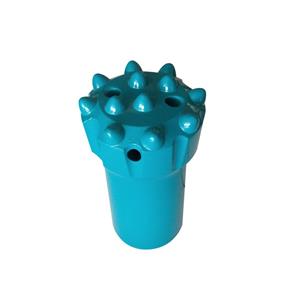
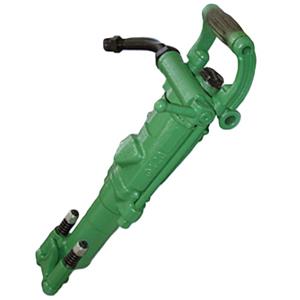
A hydraulic rock drill is an impressive piece of engineering. Modern rigs deliver two to three thousand blows per minute, with impact energy reaching a thousand joules per strike. But here's what most people don't think about: not a single joule of that energy reaches the rock directly. Everything passes through a column of steel — the shank adapter, the drill rod, the button bit — and how that steel handles the energy determines whether you're drilling efficiently or just making noise.
Stress Waves: The Physics Nobody Explains on the Jobsite
When the piston strikes the shank adapter, it doesn't push the rod into the rock like a hammer driving a nail. What actually happens is a stress wave — a compression pulse that races through the steel at roughly 5,100 meters per second. That wave travels down the drill rod, hits the bit at the rock face, and the energy transfers into the rock, fracturing it.
That's the clean version. In reality, it's messier.
The initial stress peak depends on several factors: the cross-sectional area of the piston relative to the shank adapter, the quality of contact between the two faces, and the piston's impact velocity. If the piston and shank adapter have the same diameter and make full-face contact, the stress transfers cleanly. If they don't — if there's a diameter mismatch, or the faces aren't seating perfectly — some of that energy reflects back into the piston instead of going downhole.
Then the wave hits the bit. At the rock face, part of the energy fractures the stone. Part of it reflects back up the rod as a tension wave. Then it hits the shank adapter interface and reflects again. What you end up with is a complex pattern of alternating compression and tension cycling through the drill string thousands of times per minute — and that's just under ideal conditions.
The Real World Is Even Harder on the Steel
Add in what actually happens on a drill site: axial thrust feeding the bit forward, friction between the rod and the hole wall, torque from rotation, and eccentric impact from components that aren't perfectly aligned. The shank adapter might be striking slightly off-angle because the guide bushing has a few hundred hours on it. The drill rod might have a slight bend that nobody noticed. The button bit might be worn asymmetrically, pulling the string off-center with every rotation.
Then there's the environment. Flushing water — sometimes acidic, sometimes loaded with abrasive fines — washing over the steel hour after hour. Corrosion pitting the surface, creating stress risers that the impact loading exploits. The drill string is in a genuinely brutal working environment, and it's being asked to transmit a thousand joules thirty times a second while all of this is going on.
The Tooling Makes or Breaks the Rig
Here's the point that gets lost in spec sheets: the rock drill and the drill string are one system, not two separate purchases. The most powerful hydraulic drifter on the market is useless if the stress waves it generates can't reach the rock cleanly.
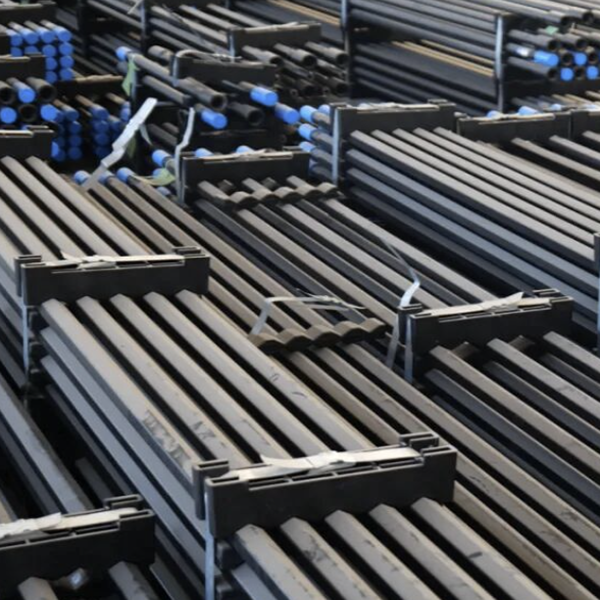
The shank adapter has to match the piston geometry. The drill rod has to handle the stress wave profile that the particular piston-adapter combination produces. The button bit has to convert that wave energy into rock fracture efficiently for the specific formation you're in. Change one component without thinking about the others, and you've changed how energy flows through the entire system.
Different rock types need different tool configurations. Different rigs need matching tool specifications. A drill string optimized for granite won't behave the same way in limestone. A bit face design that works on a high-frequency drifter might perform poorly on a lower-frequency machine. These aren't interchangeable parts — they're an engineered system, and the engineering only works if you treat it that way.