Rock Drilling Rig Operation: Mastery Comes Down to Pressure Control
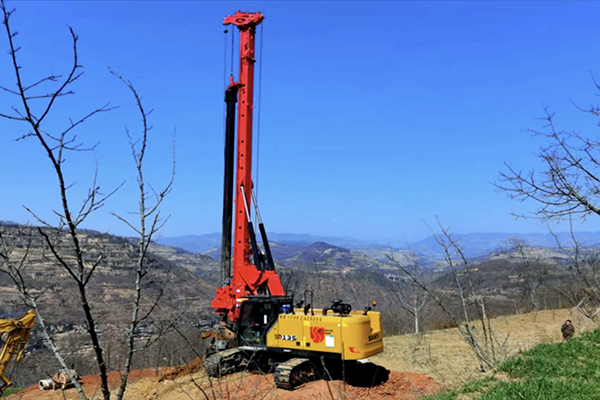
A rotary drilling rig looks imposing from the outside, and once you enter the cab, the many levers and buttons can make operation seem complicated. In reality, the full workflow does involve many actions, from machine travel and positioning, to auxiliary functions, to main drilling operations. But if you want to operate a rotary rig proficiently and achieve high productivity, one control stands out as the core: applied crowd pressure.
It is important to clarify that “pressure” here does not mean simply pushing the lever downward continuously. It means precisely controlling both force and timing based on different soil and rock conditions, and switching flexibly among operating modes such as: lifting pressure, suspension, spot float, long float, spot crowd, short-stroke crowd, long-stroke crowd, and crowd with pullback.
1) Improve Drilling Efficiency
The rig’s core function is drilling, and drilling faster with better hole quality depends heavily on pressure control. During operation, the operator must continuously adjust the pressure method according to geology, machine load, and vibration feedback.
Many operators mistakenly think crowd pressure is just a downward push on the lever. That is a common misunderstanding. The real principle is flexibility: sometimes no active crowd is needed and float mode is enough; sometimes controlled pullback pressure is necessary. Only by switching methods based on actual conditions can the rig’s performance be fully utilized.
2) Protect Critical Components
During drilling, cutter load changes constantly as the tool engages different strata. Flexible control of crowd method and force helps avoid overload, protects key components such as the Kelly bar and drilling tools, and keeps penetration continuous for faster advance.
By contrast, blindly applying constant pressure can sharply increase machine load and easily damage the Kelly bar and tooling, shortening equipment life.
3) Eliminate Operational Risks
Prevent hole deviation:
A deviated hole can trigger a chain of problems, including tool dragging, cage sticking, and casing issues. In certain challenging formations, excessive or abrupt crowd pressure can cause borehole deviation. Precise control of pressure rhythm is therefore essential.
Support Kelly unlock operations:
Unlocking a mechanical-lock Kelly bar relies on resistance from the fixed drilling bucket, and the required torque resistance is generated mainly through prior crowd action, not by directly crowding at the exact unlock moment. Proper preparation of crowd force and timing creates better unlock conditions and reduces the risk of dragging caused by incomplete locking.
4) Avoid “Bar Dropping” Damage
When using a friction Kelly bar or a sectional mechanical-lock Kelly bar in an unlocked state, especially in hard formations or when bit slippage prevents penetration, many operators apply long-stroke continuous crowd. If penetration speed does not match crowd stroke, the inner bar may be pushed upward. When crowd reaches the bottom stop or the machine reverses, the lifted bar can drop suddenly, damaging the Kelly bar or crowd cylinder and causing a bar-drop fault.
Conclusion
Rotary rig drilling depends on coordinated control of crowd pressure and torque; neither works effectively alone. Torque load can only be generated after the bit is pressed into the formation, which is why crowd control is the most influential action in main drilling operations.
Only by accurately controlling force, properly timing application, and flexibly adjusting methods to formation and job conditions can operators achieve the best overall result: high efficiency, better equipment protection, and safer operation.