Why Rock Drilling Tools Must Be Part of Rock Drill Design
A high-performance rock drill cannot deliver its full value unless its drilling tools are designed and selected as part of the same system. The drill rod, shank connection, couplings and drill bit are not passive accessories. They carry impact energy, rotation and feed force to the rock, while operating under severe repeated loading.
For mining, quarrying, tunneling and construction contractors, this is an important practical point. A rock drill may have high impact power and a high blow frequency, but poor matching between the machine, drilling tools and rock conditions can reduce penetration rate, shorten component life and increase drilling cost. The effective design unit is not the rock drill alone. It is the complete rock drill-tool-rock system.
Rock Drilling Uses Stress Waves, Not Ordinary Power Transmission
In many machines, power is transferred through gears, belts, chains or hydraulic linkages. Top-hammer rock drilling works differently. When the piston strikes the shank, it creates a stress wave that travels through the drill steel. The drill bit then transfers that energy to the rock at the bottom of the hole.
Stress waves travel through steel at very high speed. Their behavior determines how much of the rock drill’s impact energy reaches the bit and how much is reflected back through the drill string. Every interface in the system matters: piston-to-shank contact, rod geometry, couplings, threads, bit design and bit-to-rock contact all influence wave transmission.
The initial stress wave depends on the piston’s impact speed, the contact condition between the piston and shank, and the cross-sectional relationship between them. If these elements are poorly matched, useful energy is lost before it reaches the rock. If they are well matched, the system can deliver impact energy more effectively and produce more consistent drilling results.
Drill Rods Operate Under Complex Loads
A drill rod does much more than carry impact waves. During drilling, it is also exposed to axial feed force, rotational torque, friction against the hole wall and additional torsion caused by sticking or binding. These forces can act at the same time as repeated impact loading.
Misalignment creates further problems. Clearances in the shank adaptor, guide bushing, piston and cylinder can allow eccentric impact. If the mating end faces are not correctly machined or are not perpendicular to the tool axis, each blow can introduce bending stress. Over time, this may lead to fatigue cracking, poor thread life, shank damage or premature rod failure.
Water flushing also affects tool life. Pressurized water can erode surfaces, carry abrasive cuttings into contact areas and contribute to corrosion. This is why drilling tools need a suitable material specification, heat treatment, surface condition and maintenance routine. A drill rod that appears strong in a static test may still fail early if it is not designed for high-cycle impact, wear and corrosion.
The Drill Bit Is a Key Part of the Energy System
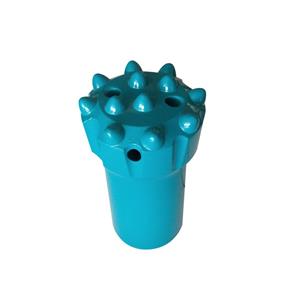
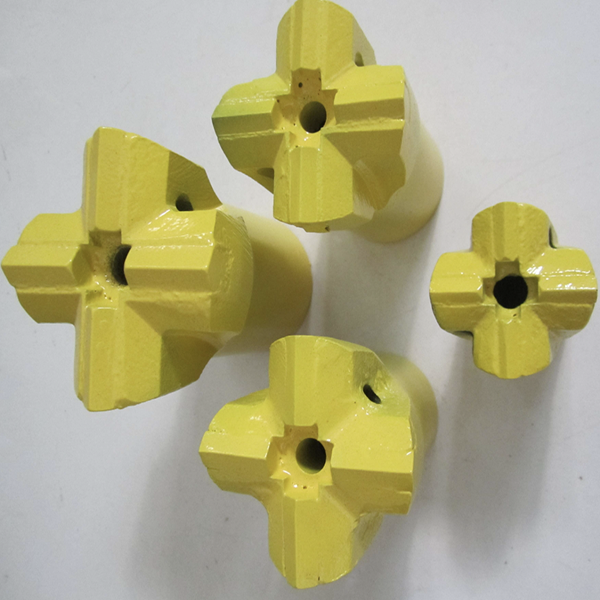
The drill bit is the final link between the rock drill and the rock. Its design influences penetration rate, hole quality, flushing performance and carbide life. Bit diameter, face shape, button arrangement, gauge protection and flushing-hole layout must all suit the intended rock formation.
Different bit styles respond differently to rock hardness, abrasiveness, fracturing and ground conditions. A bit that performs well in competent, homogeneous rock may not be the best choice in heavily jointed, soft or abrasive ground. Likewise, a drill bit must be selected with the rod, drill model and drilling method in mind. An unsuitable bit can increase vibration, promote uneven wear and reduce energy transfer.
The geometry and condition of the impact faces are also important. Damage, poor flatness or improper hardness at the piston-shank interface can disturb stress-wave transmission. At the bit end, worn carbide, poor sharpening or unsuitable button exposure can reduce the effectiveness of each blow. Maintaining these contact surfaces is therefore part of maintaining drilling productivity.
Design for the Complete Drilling System
Rock breakage is affected by stress-wave amplitude, wave duration and the way the bit contacts the rock. With a given piston mass, impact velocity has a major influence on wave amplitude. Piston geometry affects wave shape and duration. The combination of piston, drill rod and bit must therefore be considered as a system rather than as a collection of independently optimized parts.
This principle applies to drilling equipment selection as well. Two drills with similar published impact power may perform very differently when used with different drill steels, bits or rock types. The best tool package for one mine may not be the right package for another.
A systematic selection process should consider:
Rock strength, abrasiveness and degree of fracturing.
Hole diameter and required drilling depth.
Drill type, impact power, rotation and feed capacity.
Rod diameter, thread system and coupling design.
Bit face design, carbide grade and flushing arrangement.
Availability of sharpening, inspection and maintenance support.
Expected failure modes and total cost per drilled meter.
Field trials are often the best way to confirm the correct combination. A controlled test can compare penetration rate, tool life, energy consumption, hole deviation, bit wear and downtime across several tool options. This approach is especially valuable in large mines and major infrastructure projects, where small gains in drilling performance can create significant savings.
Manufacturing Quality Has a Direct Operating Effect
Tool design alone is not enough. Manufacturing quality strongly affects the service life of rock drilling tools and the rock drill itself. Rod straightness, thread accuracy, heat-treatment consistency, carbide seating, surface finish and dimensional control can all influence fatigue resistance and energy transmission.
Poorly made or worn components may create loose connections, eccentric impacts and local stress concentrations. These issues can damage both the consumable drilling tools and the more expensive rock drill. In contrast, accurately manufactured and properly maintained tools help stabilize drilling conditions and protect the entire system.
Better Results Come from Matching, Not Isolated Specifications
The most useful question is not simply, “Which rock drill has the highest impact power?” A more productive question is, “Which rock drill, drill rod, bit and operating method provide the best result in this rock?”
A successful drilling program balances machine performance with tool durability, drilling efficiency and maintenance requirements. When drill rods and bits are included from the beginning of rock drill design and selection, the system can transfer energy more effectively, operate more reliably and produce a lower cost per meter drilled.