Rock Drilling Tools: What Separates Good Tooling from the Stuff That Fails at 50 Meters
Walk through any drilling supply yard and you'll see rows of drill rods, stacks of bits, and crates of shank adapters that all look more or less identical. Same dimensions. Same thread profiles. Same spec sheets. And yet one rod outlasts three of its competitors, while the cheap one snaps at the connection on its second shift. The difference isn't visible in a photograph — it's in the design decisions made months before the steel ever touched a drill rig.
If you're buying rock drilling tools — whether you're stocking a single underground jumbo or ordering container loads for a distributor network — here are the things that actually determine whether the tooling holds up or lets you down.
Rock Breaking Efficiency Isn't About Power — It's About Match
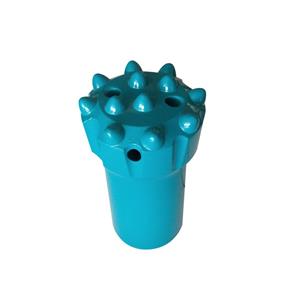
The best drill bit in the world will disappoint you if it's the wrong design for the ground you're in. A button bit with aggressive, steep-angled carbide inserts chews through soft shale like butter but shatters its inserts the moment it hits hard granite. A bit designed for hard rock, with shallow-angle spherical buttons, will last forever in quartzite but barely penetrate soft clay.
The design variable that matters most is the carbide insert profile and its rake angle relative to the bit face. In soft to medium formations, you want a sharper attack angle — the insert bites in and shears the rock rather than crushing it. In hard, abrasive formations, you need a blunter profile that spreads impact force across a larger carbide surface area, trading some penetration speed for insert survival.
But it goes beyond the inserts. The bit body geometry — how many wings, how wide the junk slots are, how the flushing holes are positioned — determines whether the cuttings get out of the way fast enough for the inserts to keep cutting fresh rock. A bit that can't clear its own chips is just regrinding powder, generating heat, and wearing itself out for no progress.
Cuttings Evacuation: The Thing Nobody Checks Until the Bit Overheats
A drill bit at the bottom of a hole is only as good as its ability to get rid of what it's just cut. Rock fines that pack around the bit face form a cushion that absorbs impact energy, insulates the bit from cooling flush medium, and accelerates wear on every surface they touch.
This is where design matters more than materials. Wide, smoothly curved junk slots don't just look different from narrow, angular ones — they create laminar flow paths that carry cuttings up and out instead of trapping them in eddies around the bit shoulder. The flushing hole placement has to direct coolant exactly where the inserts meet the rock, not somewhere vaguely in the neighborhood. A flushing hole that's 5 millimeters off from the optimal position can leave half a cutter running dry, and a dry carbide insert degrades in minutes.
The same principle applies to the drill rod. Spiral drill rods auger cuttings mechanically; smooth rods rely entirely on flush flow. In broken, blocky ground where flush medium leaks into fractures instead of returning up the annulus, a spiral rod keeps moving material when a smooth rod can't. The design choice isn't academic — it's the difference between finishing the hole and pulling out to clear a packed string.
Precision: Why a Bent Rod Isn't Just a Nuisance — It's a Liability
A drill rod that's even slightly out of straightness does more than drill a crooked hole. It whips inside the borehole, hammering the wall with every rotation. The cyclic bending stress concentrates at the threaded connections, where the wall thickness is thinnest and the stress risers are sharpest. Each rotation is a fatigue cycle, and fatigue failure doesn't give warnings — the rod just snaps, usually at the worst possible depth.
Straightness isn't checked with the naked eye. A rod that looks fine on the rack can have a runout of half a millimeter over a meter, and at 300 RPM three hundred meters down, that half-millimeter becomes a violent oscillation. Quality drill rods are centerless-ground to tight straightness tolerances and individually inspected — not batch-sampled, not spot-checked after heat treatment, but measured one by one. That's expensive, and it's why good rods cost more than cheap ones.
The bit needs symmetry too. An off-center bit doesn't just drill an oversized hole — it loads one side of the rod connection unevenly, accelerating thread wear on the loaded flank while the opposite flank barely touches. When that rod eventually fails at the thread, the operator blames the rod, but the bit started the problem.
Materials: High-Strength Alloy Steel Isn't Enough on Its Own
Every rock drilling tool starts with alloy steel — typically 23CrNi3Mo or similar carburizing grades — but the raw material is only the starting point. What transforms good steel into a tool that survives thousands of meters of percussive drilling is the heat treatment.
The ideal microstructure for a drill rod body is a carburized case with a tough, ductile core. The surface needs to be hard enough to resist abrasive wear from rock chips flowing past at high speed — typically 58 to 62 HRC on the outer surface. But if that hardness runs all the way through, the rod becomes brittle, and brittle rods snap instead of flexing under bending loads.
The trick is the case depth — hard on the outside, gradually transitioning to a softer, tougher core that can absorb impact without fracturing. Get the case depth wrong — too shallow and the surface wears through quickly, too deep and the core loses its toughness — and the rod fails early whether it looks fine on the outside or not.
For drill bits, the material story is different. The bit body needs a different set of properties than the rod: higher hot hardness because the bit runs hotter, better resistance to erosion from high-velocity flush flow through the internal waterways, and enough toughness at the crown to keep carbide inserts from popping out when they hit a hard inclusion. Bit body materials are typically higher in chromium and molybdenum than rod steels, with nickel added for toughness at the brazing temperatures used to attach carbide inserts.
Connection Design: Where Most Tooling Failures Actually Happen
If you tracked every drill string failure on a mine site for a year and plotted them by location, the threaded connections would dominate the chart. Not the bit face. Not the rod body. The threads.
This isn't surprising when you think about what a threaded connection does. It's transmitting the full torque of the drill, the full percussive impact of the piston, and the full tensile load of the string weight — all through a series of sharp-cornered helical grooves that are, by design, stress concentrators.
A well-designed connection manages this with three things: thread profile, surface finish, and lubrication. The thread flank angle determines how much of the impact load gets converted into radial expansion force that tries to split the coupling. A shallower flank angle transmits more axial force and less radial force — better for percussive drilling. The thread root radius is the single most important geometric feature; a sharp root is a crack initiation site. A generous root radius, polished smooth after machining, can double the fatigue life of the same thread design.
Surface finish at the thread flanks matters because rough threads gall under load. Galling is essentially cold welding — microscopic high points on the two thread surfaces weld together under pressure, and when the connection is unscrewed, those welds tear out, leaving torn, rough surfaces that will gall even faster on the next use. A properly finished thread with anti-seize compound properly applied should unscrew cleanly after hundreds of drilling cycles.
The Bottom Line for Buyers
When you're comparing rock drilling tools — rock drill bits, drill rods, tapered button bits, shank adapters — and the prices vary by 30% or more between suppliers, the difference isn't markup. It's the cumulative cost of centerless grinding every rod, of 100% straightness inspection instead of batch sampling, of polishing thread roots that nobody will ever see unless the rod fails, of using the more expensive alloy with the nickel content that keeps carbide inserts from brazing stress failures.
The cheap tool works fine on the first hole. It's the fiftieth hole where the shortcuts catch up.