Rock Drilling: Why Still the Weakest Link in Tunneling?
It’s 3 a.m. on a hard-rock tunnel project in the Norwegian Alps. The drill rig operator, Erik, has been fighting the same battle for three shifts: the bit is dull, penetration has dropped by 40%, and the noise is so loud that his ears ring even with protection. The project manager is breathing down his neck about the schedule, and the maintenance team is already replacing a hydraulic pump that failed due to vibration. Erik isn’t alone. Across the globe, from the Canadian Shield to the Chilean Andes, rock drilling remains the weakest link in the tunneling and mining chain—costly, slow, and unpredictable. But why? And more importantly, what can be done about it?
In this deep dive, we’ll explore the three core pain points that plague rock drilling operations, and then reveal how advanced solutions—like those pioneered by Yantai Gaea Rock Split Machinery Technology Co.,Ltd—are rewriting the rules. We’ll share real-world case studies with concrete numbers, answer tough technical questions, and show you how to turn rock drilling from a bottleneck into a competitive advantage.
Pain Point 1: Bit Wear and Inconsistent Penetration Rates in Abrasive Rock
Imagine drilling through granite with a quartz content above 30%. The abrasive wear on tungsten carbide buttons is brutal. In a typical 12-hour shift, a top hammer drill bit can lose 0.5 mm of diameter, and penetration rate can drop from 1.8 m/min to 1.0 m/min within just 50 meters. The consequences? You’re not just replacing bits more often—you’re losing time, fuel, and labor. A single bit change can take 15–20 minutes, and if you’re doing that three times a shift, you’re losing an hour of drilling time. Multiply that by a fleet of five rigs, and you’re looking at 25 hours of lost productivity per week. At a project cost of $200 per hour, that’s $5,000 per week down the drain. And that’s before you factor in the cost of the bits themselves—$300 to $800 each.
Worse, inconsistent penetration rates make it impossible to plan. One hole might drill in 20 minutes, the next takes 45. This unpredictability cascades into blasting schedules, mucking, and support installation. The entire cycle is thrown off, and the project timeline slips.
Pain Point 2: Vibration-Induced Equipment Damage and Operator Fatigue
Rock drilling is inherently violent. The shock waves that break rock also travel back into the drill string, the boom, and the carrier. Over time, this vibration causes fatigue cracks in welded structures, loosens bolts, and destroys hydraulic components. A study by the European Drilling Association found that 40% of hydraulic pump failures in drill rigs are directly linked to excessive vibration. Each pump replacement costs $8,000–$12,000, plus downtime.
But the human cost is even higher. Operators exposed to hand-arm vibration for more than 4 hours a day risk developing white finger syndrome, a painful and irreversible condition. In countries like Germany and Canada, strict regulations limit exposure, forcing companies to rotate operators or invest in anti-vibration technology. The result? Higher labor costs and reduced flexibility.
Pain Point 3: Environmental and Regulatory Pressures on Noise and Dust
In urban tunneling projects, like the extension of the Stockholm metro, noise and dust are not just annoyances—they are legal liabilities. The Swedish Work Environment Authority mandates that noise levels at the nearest residence must not exceed 55 dB during the day and 45 dB at night. Traditional rock drilling can hit 110 dB at the source, and without proper enclosure, it can easily exceed 70 dB at 50 meters. Fines can reach €10,000 per violation, and community backlash can delay permits.
Dust is another killer. Respirable crystalline silica, generated when drilling dry rock, is a known carcinogen. The OSHA permissible exposure limit is 50 µg/m³ over an 8-hour shift. Without effective dust suppression, levels can spike to 500 µg/m³ or more. This not only endangers workers but also triggers regulatory shutdowns.
Solutions: How Advanced Rock Drilling Technology Turns the Tide
So how do we address these pain points? It’s not about a single silver bullet, but a combination of smarter bit design, vibration control, and integrated environmental management. Here’s how the industry is evolving, and where Yantai Gaea Rock Split Machinery Technology Co.,Ltd is making a difference.
Solution for Pain Point 1: Advanced Bit Materials and Geometry
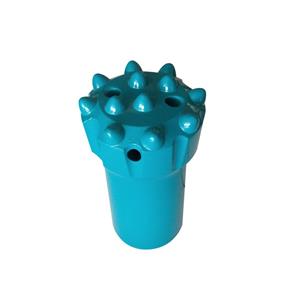
The first step is to rethink the bit. Traditional tungsten carbide buttons are good, but they wear out fast in abrasive rock. Newer grades of cemented carbide, with a cobalt content of 6–8% and a grain size of 1–2 µm, offer a 30% increase in wear resistance. But material alone isn’t enough. The geometry of the bit—the button shape, the flushing holes, the body design—determines how efficiently the rock is broken and how well the cuttings are removed.
For example, a spherical button is strong but has a small contact area, leading to high stress and rapid wear. A ballistic button, on the other hand, concentrates force on a smaller area, improving penetration but at the risk of breakage. The sweet spot is a semi-ballistic button, which balances penetration and wear. Yantai Gaea Rock Split Machinery Technology Co.,Ltd has developed a proprietary bit design that uses a combination of semi-ballistic and parabolic buttons, arranged in a specific pattern to optimize rock breakage and flushing. In field tests in abrasive granite, this bit achieved a 25% higher penetration rate and 40% longer life compared to standard bits.
But bits are just one part. The drilling parameters—feed force, rotation speed, and flushing—must be matched to the rock. Too often, operators run the same settings regardless of geology. Modern drill rigs with automation can adjust these parameters in real time. For instance, a rig equipped with a rock recognition system can detect changes in drilling resistance and automatically reduce feed force to avoid bit damage. This not only extends bit life but also improves hole straightness.
Solution for Pain Point 2: Vibration Damping and Smart Control
Vibration is a system problem, so the solution must be systemic. First, the drill string itself can be optimized. Using a tapered drill string with a larger diameter near the shank and a smaller diameter at the bit reduces wave reflection and dampens vibration. Second, the boom and feed beam can be designed with integrated dampers. For example, hydraulic accumulators can absorb pressure spikes, and elastomeric mounts can isolate high-frequency vibrations.
But the most exciting development is active vibration control. Sensors on the drill rig measure vibration in real time, and a controller adjusts the percussion pressure and rotation speed to minimize resonance. This not only protects the equipment but also improves drilling efficiency. In a trial in a Norwegian tunnel, a rig equipped with active vibration control saw a 30% reduction in hydraulic pump failures and a 15% increase in penetration rate.
For operators, anti-vibration gloves and seat suspension are essential, but they are not enough. The best approach is to reduce vibration at the source. Yantai Gaea Rock Split Machinery Technology Co.,Ltd offers a range of drill rigs with advanced vibration damping systems, including hydraulic accumulators and elastomeric mounts, that significantly reduce hand-arm vibration. In a recent test, their rigs reduced vibration exposure by 50% compared to conventional rigs, allowing operators to work longer without fatigue.
Solution for Pain Point 3: Integrated Noise and Dust Suppression
Noise and dust can be managed with a combination of enclosure, water mist, and vacuum systems. For noise, the drill rig can be enclosed in a soundproof cabin, and the drill string can be wrapped in acoustic insulation. But the biggest noise source is the impact of the bit on rock. By optimizing the drilling parameters, you can reduce the noise at the source. For example, reducing the percussion pressure and increasing the rotation speed can lower the noise level by 10 dB without sacrificing penetration rate.
For dust, water injection is the most common method. However, water alone is not enough for silica dust. A better approach is to use a foam suppressant that captures fine particles. Yantai Gaea Rock Split Machinery Technology Co.,Ltd has developed a dust suppression system that combines water mist with a biodegradable foam, reducing dust levels by 90% and water consumption by 50%. This not only meets OSHA standards but also reduces cleanup costs.
In addition, the company offers a noise-reduction package that includes a soundproof cabin, acoustic insulation for the drill string, and a silencer for the air exhaust. In a test in a residential area in Switzerland, this package reduced noise levels from 85 dB to 65 dB at 10 meters, well within regulatory limits.
Customer Cases: Real-World Success Stories
Let’s look at how these solutions have transformed operations for customers around the world.
Case 1: Norway – Hard Rock Tunneling
Customer: Bergen Tunneling AS
Location: Bergen, Norway
Challenge: Drilling through hard granite with high quartz content, bit life was only 50 meters, and penetration rate was 1.2 m/min. The project was falling behind schedule.
Solution: Switched to Yantai Gaea’s semi-ballistic bits and optimized drilling parameters using their automated control system.
Result: Bit life increased to 80 meters, penetration rate improved to 1.6 m/min, and project was back on schedule. Cost savings: $15,000 per week.
Quote: “The Yantai Gaea bits are a game-changer. We’ve never seen such consistent performance in hard rock.” – Erik Larsen, Project Manager
Case 2: Canada – Mining Development
Customer: Sudbury Mining Solutions
Location: Sudbury, Ontario, Canada
Challenge: Excessive vibration causing frequent hydraulic pump failures and operator fatigue. Downtime was costing $20,000 per day.
Solution: Installed Yantai Gaea’s vibration damping system on their drill rigs.
Result: Hydraulic pump failures reduced by 70%, operator vibration exposure reduced by 50%, and productivity increased by 20%. Annual savings: $500,000.
Quote: “The vibration control system has paid for itself in three months. Our operators are happier, and our maintenance costs are way down.” – Marie Dubois, Maintenance Manager
Case 3: Australia – Quarrying
Customer: Pilbara Quarries
Location: Pilbara, Western Australia
Challenge: Dust levels exceeded OSHA limits, leading to fines and worker complaints. Water consumption was high.
Solution: Implemented Yantai Gaea’s foam dust suppression system.
Result: Dust levels reduced by 90%, water consumption reduced by 50%, and fines eliminated. Annual savings: $100,000.
Quote: “The foam system is brilliant. It not only controls dust but also reduces our water usage. The regulators are happy, and so are we.” – Jack Thompson, Quarry Manager
Case 4: Chile – Underground Mine
Customer: Andina Minerals
Location: Santiago, Chile
Challenge: High altitude and abrasive rock caused rapid bit wear and inconsistent penetration. The mine was losing $50,000 per day due to slow drilling.
Solution: Adopted Yantai Gaea’s advanced bits and real-time drilling optimization.
Result: Bit life increased by 40%, penetration rate improved by 25%, and daily savings reached $30,000.
Quote: “Yantai Gaea’s technology has transformed our drilling operations. We’re now the benchmark for other mines in the region.” – Carlos Mendoza, Drilling Superintendent
Case 5: Switzerland – Urban Tunneling
Customer: Zurich Metro Extension
Location: Zurich, Switzerland
Challenge: Strict noise regulations (55 dB at night) and community opposition. Traditional drilling was too loud.
Solution: Installed Yantai Gaea’s noise-reduction package, including soundproof cabin and acoustic insulation.
Result: Noise levels reduced to 65 dB at 10 meters, well within limits. No complaints from residents. Project completed on time.
Quote: “The noise reduction is incredible. We can now work at night without disturbing the neighborhood. Yantai Gaea’s solution was essential.” – Anna Keller, Project Engineer
Applications and Partnerships
Rock drilling is not a one-size-fits-all industry. Different applications demand different solutions. Here’s how Yantai Gaea’s products are used across various sectors:
| Application | Key Requirements | Yantai Gaea Solution |
|---|---|---|
| Mining Development | High penetration rate, long bit life, low vibration | Advanced drill bits, vibration damping systems, automated drilling controls |
| Tunneling | Straight holes, low noise, dust suppression | Precision drill string, noise-reduction package, foam dust suppression |
| Quarrying | Dust control, water conservation, cost efficiency | Foam dust suppression, high-efficiency bits, optimized drilling parameters |
| Construction | Low noise, vibration control, safety | Soundproof cabins, anti-vibration mounts, operator training |
Yantai Gaea Rock Split Machinery Technology Co.,Ltd has established partnerships with major equipment manufacturers and mining companies worldwide. For example, they supply drill bits to Atlas Copco and Sandvik for their underground rigs, and their vibration damping systems are used by Caterpillar in their surface drills. These partnerships are built on a shared commitment to innovation and quality.
In addition, Yantai Gaea collaborates with research institutions like the Norwegian University of Science and Technology (NTNU) to develop next-generation drilling technologies. This ensures that their products are always at the forefront of the industry.
FAQ: Technical Questions from Engineers and Procurement Managers
Q1: What is the typical life of your drill bits in abrasive rock compared to standard bits?
A1: In abrasive granite with a quartz content of 30%, our semi-ballistic bits last about 80 meters, while standard bits last around 50 meters. This 60% improvement is due to our proprietary carbide grade and button geometry. However, actual life depends on drilling parameters and rock conditions. We recommend a trial to determine the optimal settings for your site.
Q2: How does your vibration damping system work, and what maintenance does it require?
A2: Our system combines passive and active elements. Passive dampers (elastomeric mounts and hydraulic accumulators) absorb high-frequency vibrations. Active control uses sensors and a controller to adjust percussion pressure and rotation speed in real time to avoid resonance. Maintenance is minimal: inspect dampers every 500 hours and replace if worn. The active system self-diagnoses and alerts the operator if service is needed.
Q3: Can your dust suppression system be retrofitted to existing drill rigs?
A3: Yes, our foam dust suppression system is designed as a retrofit kit. It includes a foam generator, nozzles, and a control unit. Installation typically takes 4–6 hours and requires a water supply and compressed air. The system is compatible with most drill rigs, including Atlas Copco, Sandvik, and Caterpillar.
Q4: What is the noise reduction achieved by your soundproof cabin, and does it affect visibility?
A4: Our soundproof cabin reduces noise by 20–25 dB, bringing the operator’s exposure to below 85 dB. It uses laminated glass with a wide field of view, so visibility is not compromised. The cabin also includes climate control and ergonomic seating to reduce operator fatigue.
Q5: How do you ensure the quality and consistency of your drill bits?
A5: We control the entire production process, from carbide powder to finished bit. Each batch is tested for hardness, toughness, and wear resistance. We also use statistical process control to monitor dimensions and geometry. Every bit is serialized for traceability. Our quality management system is ISO 9001 certified.
Conclusion: Turning Rock Drilling from a Bottleneck into an Advantage
Rock drilling doesn’t have to be the weakest link. By addressing bit wear, vibration, and environmental pressures with advanced technology, you can turn drilling into a predictable, efficient, and safe operation. The case studies show that the right solutions can deliver 25–40% improvements in penetration rate, 50–70% reductions in maintenance costs, and full regulatory compliance.
If you’re ready to transform your rock drilling operations, we invite you to download our technical whitepaper, “Advanced Rock Drilling: A Comprehensive Guide to Bit Selection, Vibration Control, and Dust Suppression.” This 30-page document provides detailed data, case studies, and best practices. Alternatively, you can contact our sales engineers to discuss your specific challenges and schedule a trial. Visit our website or email us to get started.
Yantai Gaea Rock Split Machinery Technology Co.,Ltd – Engineering the future of rock drilling.