When Hard Rock Breaks Your Carbide First: Rethinking Small Drill Bit Design
In extremely hard, tough rock, a drill bit can fail before the crew has even settled into the round.
The first few impacts arrive. One carbide insert takes a concentrated load. A small crack forms. Then a corner breaks away, or an insert chips, or the bit loses its cutting edge long before normal wear should have retired it.
This is not always a material-quality problem.
It can be a geometry problem.
For small and medium rock drill bits working in exceptionally hard and abrasive formations, the usual instinct is often to add more buttons or reduce the impact carried by each one. That can work in some conditions. But in very tough rock, a small carbide insert may simply lack the cross-section and volume needed to survive repeated concentrated impacts.
In those cases, the question is not “How can we spread the load across more inserts?” It may be “How can each insert carry more load without breaking?”
That is the idea behind single-insert load capacity.
Why extremely hard rock breaks bits early
Hard rock is not always the same as tough rock.
A highly abrasive formation wears carbide quickly. A tough formation resists fracture and can transfer high impact stresses back into the bit. When both conditions exist together, the drill bit faces a difficult combination: the carbide must resist chipping under impact while also retaining hardness and wear resistance.
At the start of each impact, the bit does not contact the hole bottom perfectly evenly. The first contact may occur at only one part of the cutting face. The stress wave then travels through the tool, crushing local rock beneath the insert or edge. In very hard rock, the contact stress can rise rapidly before the load becomes evenly distributed.
That is why early insert breakage is common in unsuitable bit designs. The rock does not yield easily enough to reduce the peak stress on the first insert that makes contact.
A bit may show chipped carbide after only a short distance, even when the drill rig, air pressure, and operating practice are otherwise reasonable.
The single-insert load principle
Carbide is hard and wear resistant, but it is still a brittle material. Its resistance to impact failure depends partly on its material properties and partly on the geometry of the individual insert.
A larger carbide insert generally has a larger load-bearing cross-section and more volume to resist localized impact. In simple terms, a thicker or larger insert can often absorb a higher impact load before it fractures.
This does not mean “bigger is always better.” An oversized insert can create other design compromises. But when early chipping is the dominant failure mode, increasing the effective size of each load-bearing carbide element can be more useful than merely increasing the number of small elements.
The same principle applies to chisel and cross-style bits. In extremely tough rock, a thicker carbide blade or stronger cutting edge may survive better than a thin edge designed for easier rock.
The design goal is to give every critical insert enough structural capacity for the load it will actually receive.
Why more buttons can sometimes make things worse
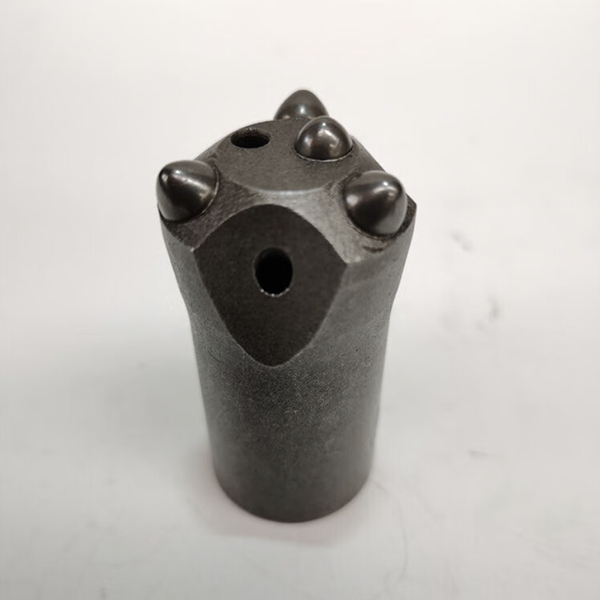
Modern button bits often use multiple carbide buttons to distribute load and improve cutting action. In many drilling conditions, this works extremely well.
But every bit has limited face area.
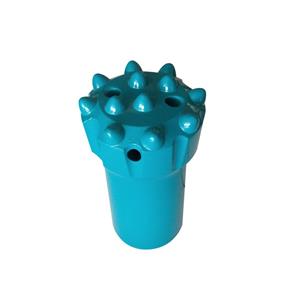
If additional buttons are added without changing the overall face design, the available impact energy is divided among more contact points. Individual buttons may become smaller or more closely spaced. Flushing space may decrease. The rock-breaking pattern can change.
In exceptionally hard and tough ground, a small button may still receive a severe localized load during initial contact. If its cross-section is too small, it can chip before the load has a chance to spread across the face.
This is why no single bit style is best for every rock formation.
A button bit with many inserts may be a strong choice in one application. A chisel, cross, three-wing, or heavy-duty mixed design may be more resilient in another. The right answer depends on rock strength, toughness, abrasiveness, drilling energy, hole diameter, flushing conditions, and the failure pattern observed in the field.
Strengthen the body as well as the carbide
Carbide inserts do not work alone. The steel body must support them.
In hard-rock drilling, the steel wings or body sections around the inserts need enough thickness and strength to hold the carbide securely. If the body flexes excessively, cracks near the insert seat, or loses support through wear, even high-quality carbide can fail prematurely.
A heavy-duty bit design may therefore include:
Larger or thicker carbide inserts
Stronger steel wings around the cutting edge
More robust insert-seat geometry
Controlled edge chamfers to reduce corner chipping
A face profile that reduces eccentric impact
Heat treatment matched to the required balance of strength and toughness
The steel body should be strong enough to support the insert, but not so brittle that it cracks under repeated impact. That balance is one of the most important parts of bit manufacturing.
Flushing remains important, but priorities can change
Efficient cuttings removal is normally essential for productive drilling. Poor flushing creates re-crushing, heat, and avoidable wear.
However, extremely hard formations can change the design priority.
If the rock produces relatively fine cuttings and drilling speed is naturally lower, flushing may be less limiting than bit durability. In that situation, it can make sense to dedicate more face area and body thickness to insert support rather than maximizing every possible flushing passage.
That is a trade-off, not a universal rule.
The bit still needs adequate flushing. But when early insert chipping is destroying bits before wear becomes the limiting factor, stronger geometry may deliver a better return than a face designed mainly for maximum chip flow.
The correct design comes from identifying the actual reason the current bit is failing.
Material selection needs balance, not extremes
For carbide inserts in tough abrasive rock, the desired properties can compete.
Higher toughness helps resist fracture and chipping. Higher hardness improves wear resistance. Increasing the binder content in a carbide grade can improve toughness, but may reduce hardness and make the insert wear faster in highly abrasive ground.
That is why carbide selection should not be based on one number alone.
A useful grade for extremely hard rock needs an appropriate balance of hardness, transverse rupture strength, toughness, density, and microstructure. The insert geometry, button-retention method, and operating parameters also affect the result.
Advanced manufacturing processes can further improve consistency, but field performance still depends on matching the complete bit design to the formation.
Watch the failure mode, not only the meterage
When evaluating a rock drill bit, do not only record total meters drilled.
Inspect why the bit came out of service.
Was it retired because the gauge diameter wore down normally? Did the carbide buttons chip? Did a cutting edge fracture? Did the steel body crack? Did the threads fail? Did the bit run hot because cuttings were not clearing?
Those details tell you what to change next.
If normal wear is the issue, a harder or more abrasion-resistant design may help. If early carbide breakage is the issue, the answer may be stronger individual inserts, improved support geometry, better alignment, or a different face style.
A bit that reaches normal wear limits is usually doing its job. A bit that chips or breaks early is telling you that the load path needs attention.
The right bit is the one that fails normally
In extremely hard rock, there may be no perfect drill bit. Every design carries a compromise between penetration rate, gauge life, flushing, insert toughness, and cost.
But the target is clear: the bit should not fail suddenly because its carbide inserts cannot handle the load.
A good hard-rock bit is one that wears predictably, maintains a stable hole, and reaches its planned service interval without early insert failure. That is where the real value lies.