Why Your New Button Bit Is Bigger Than the Label Says — And Why That's a Feature, Not a Defect
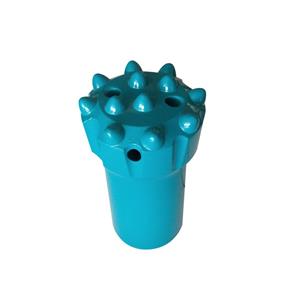
If you've ever put calipers on a fresh tapered button bit straight out of the box and found it measuring half a millimeter to a full millimeter over the stamped diameter, you're not alone in thinking something was off. I've heard the same thing from drillers on three continents: "Hey, I ordered 36 millimeter bits. These are reading damn near 37. Did I get the wrong batch?"
You didn't. What you got was a bit that was designed by someone who understands how carbide wears in the first five meters of a hole. Here's what's actually going on — and why a bit that measures true to its nominal diameter on day one is likely to let you down before the week is out.
The Wear Curve Nobody Talks About
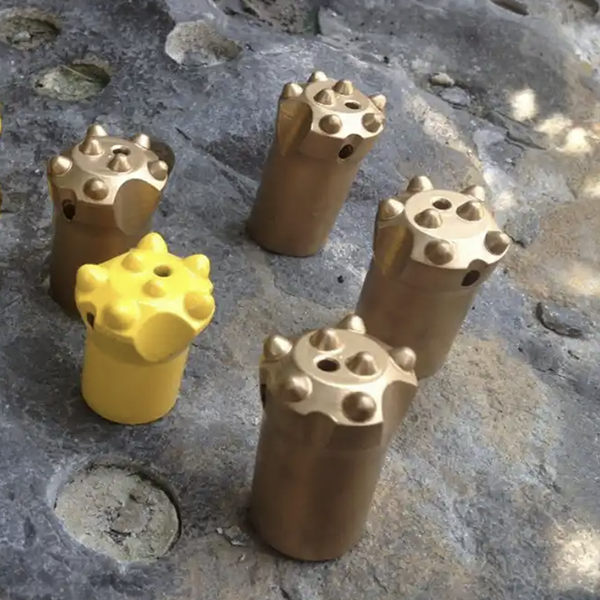
Drill bit wear isn't linear. It doesn't happen at a steady, predictable rate from the first meter to the last. In a tapered button bit — the workhorse of hand-held pneumatic drilling in quarries, small-scale mining, and construction — the fastest wear happens right at the beginning. The first few meters of a brand-new bit's life are brutal.
Here's why: a fresh bit has sharp carbide insert edges and a full-diameter gauge surface, both of which present maximum contact area to the rock. On those initial meters, every button face is scraping and crushing at full engagement, and the steel body around the gauge row is taking abrasive wear from cuttings racing past at high velocity. The bit loses diameter rapidly in this break-in phase — not because of a material defect, but because the wear rate naturally starts high and then tapers off as the contact surfaces bed in and the inserts develop a slight, stable wear flat.
After those first few meters, the wear rate flattens out dramatically. The bit has found its working diameter, the carbide inserts have developed that slight wear flat that actually helps stabilize the crushing zone, and the gauge section has smoothed into a profile that holds diameter with minimal additional loss per meter. The bit will drill at this stable diameter for the bulk of its service life, losing diameter slowly and predictably.
How Pre-Enlargement Solves the Problem Before It Starts
The industry's answer to this wear pattern is simple and clever: manufacture the bit slightly oversized so that, after the initial break-in wear, it settles right at the nominal diameter. That extra 0.5 to 1.0 millimeters on a new bit isn't a tolerance error — it's engineered headroom.
Take a standard 36 mm tapered button bit. Out of the box, it'll measure somewhere between 36.5 and 37.0 mm. Drill ten meters of medium-hard granite, pull the bit, and measure again — you'll likely see 36.0 to 36.2 mm. That's the bit settling into its working diameter, and from there it'll hold close to 36 mm for dozens more meters of hole.
Without pre-enlargement, a bit manufactured at exactly 36.0 mm new would drop to 35.5 mm or smaller after break-in. Every hole it drilled would be undersized. The next bit in the string — assuming you're using the same nominal diameter — wouldn't fit down the hole without reaming. And reaming an undersized hole is slow, hard on equipment, and hard on the bit doing the reaming.
Pre-enlargement eliminates that entire cascade of problems before it starts.
What Actually Controls the Finished Hole Size
The pre-enlargement design means a new tapered button bit produces a slightly oversized hole on the first few meters — maybe 36.5 to 37 mm instead of a clean 36 — but that's rarely a problem in production drilling. The bit then settles to nominal, and if you're using matched bits throughout the drilling program, every hole comes out consistent.
That said, the finished hole diameter isn't determined by the bit alone. Three things push it around:
The rock itself. Hard, abrasive formations — quartzite, dense granite, silicified sandstone — wear the gauge row faster, pulling the hole diameter down. Fractured, loose, or weathered formations can do the opposite: the hole wall crumbles and spalls, making the finished diameter larger and less uniform than the bit gauge would predict. Either way, the pre-enlargement buffer gives you room to absorb the variation.
The drill's operating parameters. High impact pressure combined with high rotation speed causes the bit to orbit slightly inside the hole — a subtle wobble that, over dozens of meters, can open the hole diameter by half a millimeter or more. This isn't necessarily bad drilling; it's just the physics of a percussive system with some inherent clearance. But it means that two identical bits, run at different pressures on the same rock, can produce measurably different hole sizes.
The operator's hands. Drilling angle, feed pressure consistency, and the tendency to lever the drill to "steer" the hole — all of these affect the final hole shape and diameter. An experienced driller holding a steady angle with consistent feed will produce rounder, truer holes than someone fighting the drill and varying the feed pressure. The bit's pre-enlargement can't fix operator inconsistency, but it can give you a wider window of acceptable results.
What This Means When You're Buying Bits
First: if you put calipers on a new tapered button bit and it reads larger than nominal, put the calipers away. The bit is fine. It was designed to measure that way.
Second: when you're comparing suppliers, ask about their pre-enlargement tolerance. A manufacturer that consistently holds 0.5 to 0.8 mm over nominal is doing careful process control. One where new bits vary between 0.2 and 1.2 mm over nominal — sometimes undersized, sometimes wildly oversized — is cutting corners on quality control, and that inconsistency will show up in your drilling results.
Third: match your bits to your ground. In soft, non-abrasive formations, a pre-enlargement on the lower end of the range — closer to 0.5 mm — is fine because the break-in wear is gentler. In hard, abrasive rock where the initial diameter loss is aggressive, you want bits spec'd toward the upper end — closer to 1.0 mm — to ensure the working diameter doesn't drop below nominal too early.
Fourth: pair your bits with the right tapered drill rods. A bit that's running true on a straight, well-maintained rod will wear evenly around its full circumference. Put that same bit on a slightly bent rod, and the gauge row will wear unevenly — one side scrubbing harder than the other — which accelerates diameter loss and defeats the purpose of the pre-enlargement. The rod and the bit are a system; treat them as one.