Why Heat Treatment Decides Whether a Threaded Button Bit Survives the Job
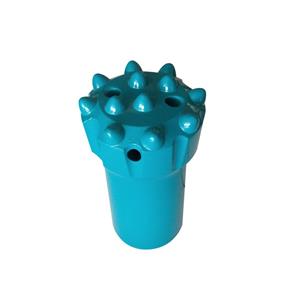
A threaded button bit can look perfect when it leaves the factory. The threads are clean. The carbide buttons sit tight. The body finish is smooth.
Then it goes underground.
A few hours of hard drilling later, the story can be very different. One bit holds its gauge, keeps the buttons secure, and comes back ready for another shift. Another develops thread damage, body cracks, abnormal wear, or loose inserts long before anyone expected.
The difference is not always visible from the outside. Often, it comes down to heat treatment.
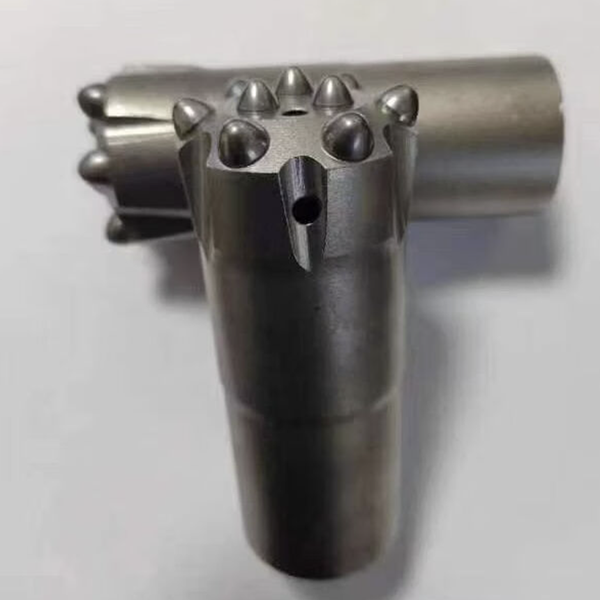
For a threaded button bit, heat treatment is not a final cosmetic step. It is the process that determines whether the steel body has the right balance of strength, toughness, wear resistance, and fatigue resistance for high-impact rock drilling.
Get that balance wrong and a good bit design can still fail in the field.
A button bit body lives under constant stress
Rock drilling is rough work. Every blow from the rock drill sends a stress wave through the shank adapter, drill rod, threads, and bit body. At the same time, the bit rotates, the carbide inserts crush and cut rock, and flushing carries abrasive cuttings through the face and grooves.
The threaded button bit body has to cope with all of it.
It needs enough hardness to resist wear around the threads, flushing holes, and button seats. It also needs enough toughness to avoid brittle cracking under impact. Too soft, and the bit wears out quickly. Too hard, and the body can become vulnerable to cracking when the drilling conditions turn severe.
That is why heat treatment must be managed as a controlled manufacturing process, not a general recipe.
Steel chemistry matters. The shape and effective cross-section of the bit matter. The furnace atmosphere, heating rate, soaking time, quenching method, and tempering cycle all matter too. Change one of those variables without understanding the others, and the final properties can drift away from what the design requires.
Start with the steel, not the furnace
The heat-treatment process begins long before a bit body enters the furnace.
Common alloy-steel choices for threaded button bits may include grades such as 45CrNiMoV or 42CrMo, depending on the design and the manufacturer’s process. These materials are selected because they can develop a useful combination of strength and toughness after controlled treatment.
But a material certificate alone does not guarantee a good bit body.
After forging, pre-treatment such as normalizing or annealing can help relieve internal stress, refine the grain structure, and produce a more uniform starting condition for machining and final hardening. Skipping this stage, or handling it inconsistently, can create trouble later in the process.
Surface preparation matters as well. Oil, scale, and contamination can affect heating and contribute to surface decarburization. That matters because the surface is exactly where thread wear, body abrasion, and fatigue damage often begin.
A bit body with an inconsistent surface layer may look acceptable at first inspection yet behave unpredictably in service.
Heating control protects toughness
One of the most common heat-treatment mistakes is treating temperature as the only number that matters.
It is not.
The target heating temperature must fit the specific steel grade and the required final properties. Industry references may list quenching ranges around 850-920°C for some alloy-steel bit bodies, but the correct setting is not universal. It must come from the approved process specification for the material, dimensions, and desired result.
Overheating is especially damaging. It can cause grain growth, reducing toughness and increasing the risk of brittle behavior under impact. A drill bit body may test hard enough after treatment but still lack the shock resistance needed for demanding drilling conditions.
Heating rate matters too. A threaded button bit is not a simple uniform block of steel. It has flushing passages, button holes, thread areas, and changes in section thickness. Rapid or uneven heating can introduce thermal stress before quenching even begins.
For complex geometries, staged heating and preheating can reduce the temperature difference between the surface and the core. This helps lower the chance of distortion or cracking during the next step.
The goal is not simply to heat the body quickly. It is to heat it evenly.
Quenching is where the risk rises
Quenching creates the hard structure needed for wear resistance, but it is also where thermal stress becomes dangerous.
The choice of quenching medium affects both cooling speed and distortion risk. Water and saltwater cool aggressively, but their rapid cooling can increase the chance of cracking or deformation. Oil is generally less severe and can provide a more controlled cooling profile for many threaded button-bit applications.
There is no universal “best” quenching medium. The decision depends on the steel’s hardenability, the bit dimensions, the geometry, and the final performance target.
What matters is consistent control.
The quenching medium needs stable temperature and circulation. The bit body must enter the medium in the correct orientation. Uneven cooling can leave one area harder, another softer, and another under excessive residual stress. In field use, those weak points tend to reveal themselves around thread roots, flushing features, or transitions in the body profile.
That is why a heat-treatment line should treat quenching as a repeatable operation, not as a simple dip-and-cool step.
Tempering gives the bit body its working balance
A freshly quenched body may be hard, but hardness alone is not the goal. Untempered or poorly tempered steel can retain excessive stress and become too brittle for percussive drilling.
Tempering reduces residual stress and adjusts hardness and toughness into a usable range.
The timing matters. Delaying tempering after quenching can increase the risk of cracking. The temperature and holding time must also be selected for the particular steel and desired properties. For example, some high-toughness drill-bit applications use tempering temperatures above 550°C, with final body hardness often targeted within a controlled range such as HRC 44-48. These figures are process references, not a substitute for a manufacturer’s qualified heat-treatment specification.
The real question is always the same: can the bit body absorb repeated impact without losing the wear resistance that protects its threads and button seats?
That is the balance a good tempering cycle is built to achieve.
Details around threads and flushing holes cannot be ignored
Not every failure begins at the face of the bit.
Sharp internal transitions, rough thread-relief areas, scratches, and poor finishing around flushing grooves can concentrate stress. Under quenching and repeated impact, those areas become likely starting points for cracks.
Good design and finishing practice use smooth radii rather than sharp corners where possible. Critical thread areas should be clean and free from damage. Flushing holes and grooves need careful attention because they combine abrasive wear with changing section thickness.
The best heat-treatment process cannot fully compensate for avoidable stress raisers in the part design or machining.
Quality control proves the process
A threaded button bit should not be judged only by appearance.
Hardness testing at multiple locations helps confirm consistency across the body. Tests around the thread root and body surface can reveal whether the treatment reached the areas that matter most. Metallographic inspection can provide another layer of control, checking for problems such as overheating, decarburization, or an unsuitable microstructure.
For drilling contractors, this is why supplier quality control matters. A low-priced bit with inconsistent heat treatment may cost more in the end through premature replacement, reduced penetration rate, thread failures, and unexpected downtime.
The bit body is the foundation that holds the carbide, threads, and flushing design together. When the heat treatment is controlled, the whole tool has a better chance of doing its job: staying intact, staying on gauge, and transmitting drilling energy efficiently through the rock.