The Dirty Detail That Can Ruin a Threaded Button Bit Before It Reaches the Mine
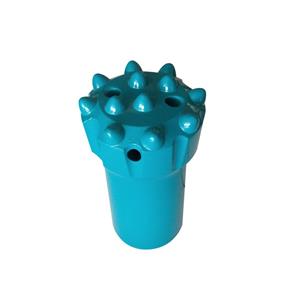
A threaded button bit can be made from the right steel, machined to the right dimensions, and fitted with the right carbide buttons. It can still fail early because of something that looks almost harmless: a thin film of oil.
Oil, machining fluid, metal chips, oxide scale, and shop dust are easy to overlook before heat treatment. They are not easy to forgive afterward.
For a rock drill bit body, heat treatment is where strength, toughness, and wear resistance are built into the steel. If the surface is contaminated before the heating and quenching cycle, that treatment can become uneven. The result may be soft spots, inconsistent hardness, distortion, cracking, or reduced service life.
The problem does not always announce itself in the factory. A bit may pass a quick visual inspection and only reveal its weakness after it begins taking repeated impact underground.
That is why proper surface cleaning is not housekeeping. It is part of threaded button bit quality control.
A clean surface helps heat treatment work evenly
Before quenching, the bit body needs to heat and cool as consistently as possible.
When oil or cutting fluid remains on the surface, it can carbonize at high temperature. This may create local insulation that changes how quickly different parts of the body heat up or cool down. In practical terms, one area of the bit may receive a different thermal history from another.
That is a problem because a threaded button bit is not a simple shape. It has button holes, flushing passages, thread roots, grooves, and changing section thicknesses. These features already make temperature control more demanding. Surface contamination adds another uncontrolled variable.
A local soft spot can reduce wear resistance around the thread or body surface. Uneven hardening can affect how the body responds to impact. In more severe cases, thermal stress can contribute to distortion or cracking.
The goal is not simply to make the bit look clean. The goal is to remove anything that interferes with stable, repeatable heat transfer.
Chips and scale cause their own problems
Oil is not the only concern.
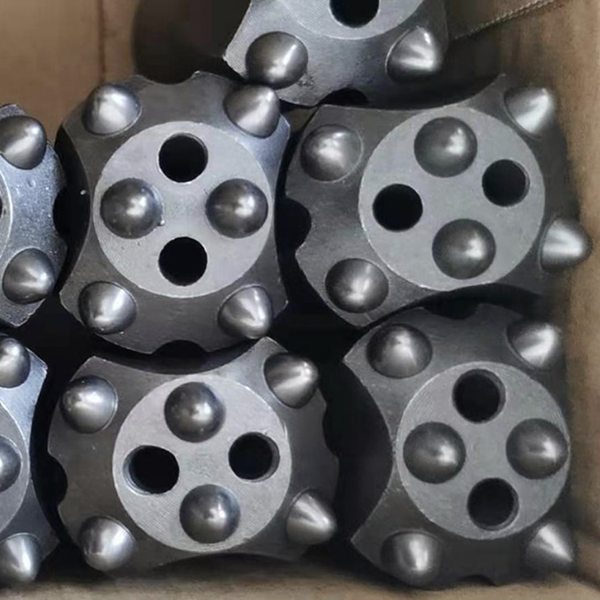
Metal chips and oxide scale can prevent the quenching medium from contacting the steel evenly. If cooling is inconsistent, the resulting microstructure can vary from one area to another. That variation may affect hardness, toughness, and fatigue resistance.
For a rock drill bit, consistency matters as much as peak performance.
The bit body must transfer impact energy efficiently while holding the carbide buttons securely. It must resist abrasive wear from crushed rock and cuttings. It must protect the threaded connection through repeated drilling cycles. One weak area can become the point where the entire tool loses reliability.
Thread roots and transitions around flushing features deserve special attention. These are already areas where stress can concentrate. If they also receive inconsistent heat treatment because of poor cleaning, the risk of early damage rises.
A bit supplier may have a good steel grade and a capable furnace, but neither can fully compensate for a contaminated surface entering the process.
Dirty parts also damage the quenching system
Surface cleaning protects more than the bit body. It protects the equipment that treats it.
When oil, chips, scale, or other debris enter a quenching oil, water, or salt-bath system, they can reduce the stability of the medium. Quenching oil may darken, degrade, or lose the properties needed for controlled cooling. Solid particles can contaminate circulation systems, restrict nozzles, and create inconsistent flow.
That means one poorly prepared batch can affect later batches too.
The cost is not limited to replacement fluid or equipment maintenance. Once cooling conditions become less predictable, the manufacturer faces a wider quality-control problem. A process that should be repeatable begins producing results that vary from part to part.
For mining contractors, this matters because variation becomes downtime. A threaded button bit that wears or cracks unexpectedly can interrupt drilling, complicate tool changes, and increase the cost per drilled meter.
Reliable manufacturing is built by removing sources of variation before they enter the process.
Safety belongs in the cleaning step
There is another reason to take cleaning seriously: safety.
Oil and volatile residues can smoke, burn, or create hazardous conditions in high-temperature equipment. In enclosed heating environments, contamination can create a more serious fire risk. Fumes may also affect workshop air quality and create unnecessary exposure for operators.
That makes the cleaning stage a production-control issue and a safety-control issue at the same time.
A disciplined process should define what must be removed, how the part is inspected, and how clean components are protected before entering the furnace. The details will differ by factory, material, and heat-treatment system, but the principle stays the same: do not let unknown residues enter a critical thermal process.
What a practical pre-heat-treatment check should cover
Before a threaded button bit body enters heat treatment, manufacturers should have a clear inspection routine. It should confirm that the part is free from visible oil, cutting fluid, chips, loose scale, dust, and other contaminants.
The process should also pay attention to areas that are easy to miss:
Thread roots and thread reliefs
Flushing holes and grooves
Button-hole edges and body transitions
Recessed surfaces where machining fluid can collect
Parts that have waited between machining and heat treatment
A clean part should also stay clean. Poor handling after inspection can undo the work quickly. Storage areas, transfer racks, gloves, and fixtures all influence whether contaminants return before the furnace cycle starts.
This is why the strongest manufacturers treat cleaning as a documented process step, not an informal instruction.
Quality is built before the furnace door closes
In rock-drilling tools, there is no single step that creates quality. Steel selection, forging, machining, heat treatment, carbide-button installation, thread accuracy, and final inspection all work together.
But heat treatment is particularly unforgiving. It can turn a well-made bit body into a durable drilling tool, or expose every shortcut taken earlier in production.
Surface cleaning may not be the most visible part of button-bit manufacturing. Customers rarely ask about it first. Yet it is one of the details that separates a controlled process from a hopeful one.
A clean bit body gives the heat-treatment process a fair chance to do its job. That means more consistent hardness, more dependable toughness, better thread durability, and fewer unpleasant surprises once the tool is working in hard rock.
For anyone buying threaded button bits, the lesson is simple: ask how the supplier controls the process before heat treatment, not only what happens after it.