Warm Extrusion for Cone Bits: A Practical Route to Better Rock Drilling Tool Manufacturing
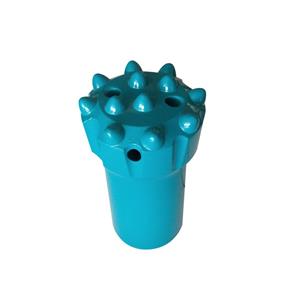
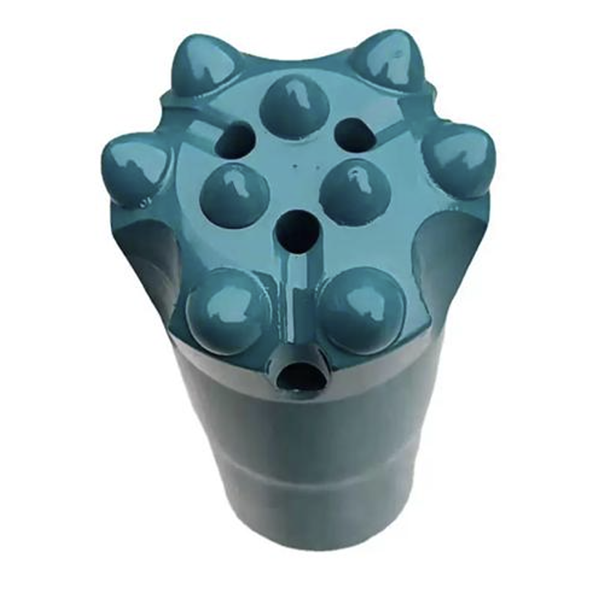
Cone bits are critical working components in many drilling and exploration applications. They operate in abrasive environments, face repeated impact loads, and are consumed in significant quantities across mining, quarrying, geotechnical drilling, and construction projects. Because of these conditions, manufacturers must balance bit strength, dimensional consistency, production efficiency, and material cost.
Traditional cone bit manufacturing often begins with round bar stock and relies on turning, milling, and other cutting processes to create the final shape. This route is familiar and flexible, but it can also create several challenges. Complex profiles require more machining time, material utilization can be low, and the interrupted metal flow created by cutting may reduce fatigue resistance in highly stressed areas.
Warm extrusion offers another manufacturing option for selected cone bit designs. By forming a heated blank in a controlled temperature range below the material’s recrystallization temperature, manufacturers may reduce deformation resistance while maintaining good dimensional control and a more continuous internal grain flow. For drilling tool producers, the goal is not simply to replace machining. It is to create a more stable production route that supports quality, productivity, and long-term tool reliability.
Why Cone Bit Forming Method Matters
A rock drilling tool must transfer impact energy efficiently from the drill string to the rock. The bit body must therefore resist repeated loads, vibration, wear, and the risk of fatigue cracking. Manufacturing quality has a direct influence on this performance.
When a cone-shaped component is produced mainly through machining, a large amount of material may be removed from the original bar. This can increase waste and extend cycle times. Machining also exposes the original metal structure rather than guiding the fiber flow around the final shape.
A forming-based process can preserve more of the material and help the internal flow lines follow the external contour of the part. In principle, this can be beneficial for components that experience cyclic loading. However, the final result depends on many factors, including material selection, heating control, die design, lubrication, forming force, heat treatment, and quality inspection.
For this reason, warm extrusion should be viewed as a controlled manufacturing system rather than a single production step.
What Is Warm Extrusion?
Extrusion processes are often divided into cold extrusion, warm extrusion, and hot extrusion according to forming temperature.
Cold extrusion can provide excellent dimensional accuracy and surface quality, but the material’s resistance to deformation is relatively high. This increases the required press capacity and tool load. Cold-formed parts may also require additional treatment to manage work hardening.
Hot extrusion reduces forming resistance significantly, but it can bring more oxidation, lower dimensional precision, and possible surface-quality concerns.
Warm extrusion is intended to provide a middle path. The workpiece is heated above room temperature but below the recrystallization range. At the right temperature, the material becomes easier to form than in cold extrusion while avoiding some of the scale and dimensional-control issues associated with high-temperature forming.
For cone bit manufacturing, warm extrusion may offer several potential advantages:
Lower forming force compared with cold extrusion
Better dimensional control than many hot-forming routes
Reduced material waste compared with extensive cutting operations
Potentially improved metal flow around the part profile
Suitability for high-volume production when tooling and process control are well established
Process Route for a Warm-Extruded Cone Bit
A typical process begins with selecting a suitable blank diameter and length. The blank should be sized carefully to minimize excessive deformation while ensuring enough material is available to fill the die cavity. Good blank preparation supports stable filling, reduces the risk of defects, and helps protect the forming dies.
The workpiece is then heated to the specified forming temperature. The exact temperature window depends on the steel grade, part geometry, deformation level, and equipment capability. For medium-carbon alloy steels such as 40Cr, the original technical discussion indicates that a controlled warm-forming range can reduce deformation resistance while avoiding severe surface oxidation associated with substantially higher temperatures.
Induction heating is commonly useful because it can provide rapid and repeatable heating. However, the target temperature should be verified through process trials and production monitoring. Overheating can increase oxidation and surface scale, while insufficient heating can raise forming load and accelerate die wear.
After heating, lubricant is applied to the workpiece and die cavity. The blank is placed into the die, positioned accurately, and pressed into shape. The die opens after the forming stroke, and an ejector system removes the completed workpiece.
This sounds simple, but each stage requires control. Uneven heating, poor lubrication, incorrect blank size, or unstable die alignment can lead to incomplete filling, sticking, dimensional variation, or premature tooling failure.
The Role of Lubrication
Lubrication is one of the most important parts of warm extrusion. A lubricant must reduce friction, protect the die surface, help the workpiece flow into the cavity, and remain effective at the forming temperature.
For cone bit production, a lubricant system may include graphite-based materials or other high-temperature formulations suitable for the selected process. The lubricant must adhere reliably to the die surface and create a stable film during forming. If lubrication is inconsistent, the press load can rise, the surface finish can decline, and the die may wear faster.
Manufacturers should validate lubricant performance through trials that consider forming temperature, dwell time, pressure, tool material, and part geometry. A lubricant that works well on one press or die design may not perform the same way in another production environment.
Die Design Considerations
Die design has a major impact on whether a warm extrusion process is stable and commercially practical. Cone-shaped workpieces often have changing diameters and complex contours, so the die must guide material flow without causing excessive friction or local stress concentration.
A split-die structure can be useful for removing formed cone bits. The taper angle of the die mating surfaces is particularly important. If the taper is too large, the mating surfaces may separate under load. If it is too small, the die may become difficult to release or may lose stability during the process.
The original technical discussion identified a 15-degree taper as an effective reference in its tested design. This value should not be treated as a universal specification. It is a process reference that must be confirmed against the actual material, part size, press tonnage, and die structure used in production.
A reliable ejector mechanism is also essential. When the formed cone bit remains tightly engaged with the punch or die cavity, manual removal can slow the cycle and create safety risks. A properly designed stop and ejection system helps separate the workpiece from the tooling and supports continuous production.
Production Benefits and Quality Control
Compared with a machining-dominant route, warm extrusion may improve material utilization and reduce the number of cutting operations. It may also improve production efficiency for repeatable, high-volume parts. The technology is especially attractive where part geometry is complex enough to make machining slow but standardized enough to justify dedicated tooling.
Still, warm extrusion is not automatically the best choice for every cone bit. Tooling investment, die maintenance, press capability, material consistency, and quality-control resources must all be considered.
A robust inspection plan should include dimensional checks, surface-condition checks, hardness verification after any required heat treatment, and evaluation of internal defects when the application demands it. Manufacturers should also monitor forming force, blank temperature, lubrication condition, and die wear trends. These records make it easier to identify process drift before it becomes a quality problem.
Conclusion
Warm extrusion provides a promising route for manufacturing cone bits and other rock drilling tool components that require strength, consistency, and efficient production. By combining controlled heating, suitable lubrication, stable die design, and reliable ejection, producers can reduce forming resistance while maintaining useful dimensional accuracy and improving material utilization.
The most important lesson is that the forming process must be engineered as a complete system. Temperature, blank geometry, tooling, lubrication, press capacity, and inspection standards all work together. With careful validation, warm extrusion can become a valuable manufacturing method for drilling tool companies seeking to improve both productivity and product durability.