What Are Retrac Thread Button Bits?
In hard rock applications such as mining, tunneling, and underground excavation, the hydraulic rock drilling jumbo is one of the core machines used to break through rock efficiently. At the front end of this powerful equipment is the drill bit—the part that directly contacts the rock and plays a decisive role in drilling speed, tool life, and overall job performance.
Among the many types of rock drilling bits available, the retrac thread button bit is widely recognized as a high-performance solution for difficult formations. In this article, we’ll explain what retrac thread button bits are, how they work, and why they are so effective in hard rock drilling.
Understanding the Two Key Features: “Retrac” and “Button”
To understand retrac thread button bits, it is essential to focus on the two words in the name: retrac and button. These two design features work together to create the bit’s unique advantages and solve some of the most common drilling problems in hard rock operations.
What Does “Retrac” Mean?
The word “retrac” refers to the bit’s ability to return easily after drilling and to reduce the chance of the drill string becoming stuck in the hole. This is one of the most important benefits of this type of bit.
During hard rock drilling, one of the most frustrating issues operators face is bit sticking. After the bit penetrates the rock, broken rock particles and drill cuttings can accumulate and become compacted between the bit body and the hole wall. Over time, this buildup can “lock” the bit in place, making it difficult to pull the bit back out. In serious cases, it may even damage the bit and drill rod, causing delays and increasing operating costs.
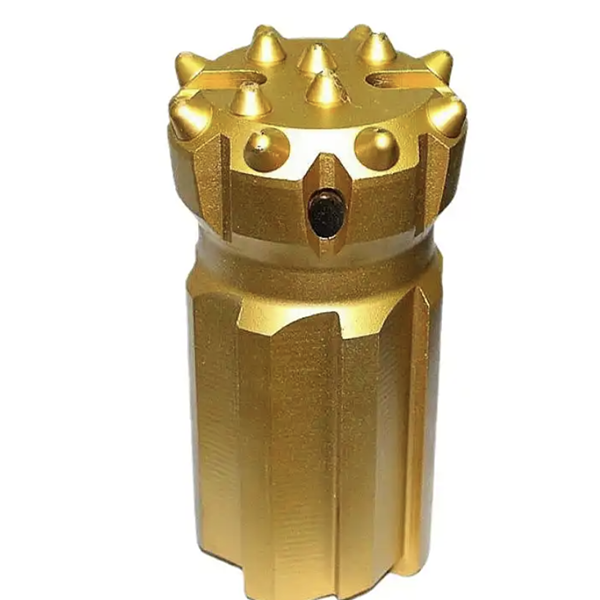
To solve this problem, the skirt body of a retrac button bit—the steel body section that connects to the drill rod—is designed with a reverse taper, also known as a retrac skirt design.
This means:
the section near the thread connection is wider,
the section closer to the bit face is narrower.
Compared with traditional straight-body or standard taper bits, this reverse taper design creates a natural clearance between the skirt body and the hole wall when the bit is withdrawn. As the bit is pulled back, accumulated rock cuttings can fall away more easily along the tapered surface instead of tightly gripping the bit.
As a result, retrac thread button bits significantly reduce the risk of jamming and make bit withdrawal much smoother and more efficient. This advantage is especially valuable in fractured formations, cuttings-heavy conditions, and complex rock layers where sticking is common.
What Does “Button” Mean?
If the retrac design is the bit’s anti-jamming advantage, then the button design is its core rock-breaking strength.
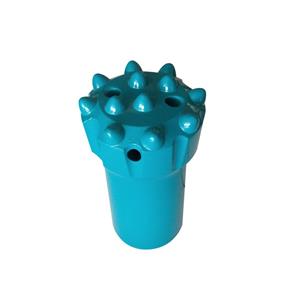
The bit face is fitted with cemented carbide buttons, which are the cutting elements responsible for breaking the rock. Common button shapes include:
spherical buttons
ballistic buttons
These carbide inserts are much harder and more wear-resistant than ordinary steel, allowing them to withstand the severe abrasion and impact generated during hard rock drilling.
Why Button Bits Perform Better Than Chisel Bits
Compared with traditional chisel bits, button bits offer several clear advantages.
Chisel bits use flat or blade-like carbide inserts with a larger contact area against the rock. This means they often require greater impact force to break the formation, which can lead to:
faster wear,
edge breakage,
more frequent regrinding or replacement.
By contrast, button bits contact the rock at smaller points, concentrating impact energy at the button tips. This allows them to break hard rock more efficiently and achieve faster penetration rates.
In addition, button inserts typically offer much better wear resistance and impact resistance. In many cases, the service life of a button bit without regrinding can be five to six times longer than that of a traditional chisel bit. This reduces replacement frequency, lowers downtime, and helps cut overall drilling costs.
Scientifically Designed Button Layout and Flushing System
The performance of a retrac thread button bit is not only determined by its carbide inserts, but also by their layout.
Most retrac button bits are designed with:
center buttons
gauge buttons
flushing holes
This arrangement helps maintain:
better hole straightness,
more accurate hole diameter,
efficient rock breaking at both the center and outer edge of the hole.
At the same time, the flushing holes allow water or air to remove rock cuttings from the hole in time, preventing excessive accumulation that could affect drilling speed or increase the risk of sticking. This contributes to higher drilling efficiency and smoother operation.
Wide Compatibility and Broad Application Range
Another major advantage of retrac thread button bits is their strong versatility.
They can be matched with various types of hydraulic rock drilling jumbos and other rock drilling equipment. Common thread sizes include:
T38
T45
T51
Available bit diameters typically range from 45 mm to 205 mm, allowing them to meet different hole size requirements.
Because of this flexibility, retrac thread button bits are widely used in:
underground mining,
drifting and tunneling,
tunnel and metro blasting holes,
slope stabilization drilling,
foundation anchoring,
other hard rock drilling applications.
Conclusion
In simple terms, a retrac thread button bit combines the high rock-breaking efficiency of carbide buttons with the anti-jamming and easy-withdrawal benefits of a reverse taper retrac skirt design.
This combination solves two major problems often found with conventional bits: bit sticking and difficult bit retrieval. At the same time, it improves drilling efficiency, extends service life, and reduces overall operating costs.
Although it may look like a small component, the retrac thread button bit plays a vital role in modern hard rock drilling and has become an indispensable tool in mining, tunneling, and infrastructure construction projects.