Why Are Your Drill Taper Bits Failing Prematurely?
Have you ever watched your drill taper bits dull after just a few meters, or worse, snap mid-operation, causing costly downtime? You're not alone. The truth is, most taper bits on the market are not engineered for the demanding conditions of modern rock drilling. At Yantai Gaea Rock Split Machinery Technology Co., Ltd, we've spent years refining the metallurgy and geometry of drill taper bits to deliver consistent performance. In this post, we'll uncover why your bits are failing and how to fix it.
The Hidden Costs of Premature Bit Failure
Imagine this: a mining operation in Nevada, where each shift costs $10,000 per hour. A single bit failure can halt production for two hours, resulting in a $20,000 loss. But the cost doesn't stop there. You also waste time on bit changes, risk worker safety, and compromise hole quality. In construction, poor hole alignment can lead to structural issues. In oil and gas, excessive bit wear can cause deviation in directional drilling.
Let's break down three specific pain points:
- Accelerated Wear: Bits lose their cutting edge due to abrasive rock formations, leading to slower penetration rates and increased energy consumption.
- Catastrophic Breakage: Sudden impact or fatigue causes the bit to snap, often leaving the broken piece stuck in the hole.
- Inconsistent Hole Quality: Worn bits produce oversize or tapered holes, affecting subsequent operations like blasting or anchoring.
Why Traditional Bits Fail
Standard bits often use low-grade carbide or improper heat treatment, resulting in a soft matrix that wears quickly. Others have poor stress distribution, leading to fracture at the taper junction. The solution lies in advanced materials and precision engineering.
How Yantai Gaea Solves These Problems
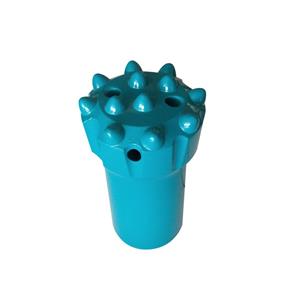
Our drill taper bits are forged from high-alloy steel with tungsten carbide inserts that have a hardness of HRA 89-91. We use a proprietary brazing process to ensure strong bonding. Each bit undergoes finite element analysis (FEA) to optimize the taper angle and stress relief. For example:
- Wear Resistance: Carbide grades with 10% cobalt content for toughness, and a multi-layer coating that reduces friction.
- Breakage Prevention: A reinforced shank design and controlled heat treatment to achieve a balance of hardness and ductility.
- Hole Quality: Precision-ground cutting edges with symmetrical geometry to maintain gauge.
Our bits comply with ISO 9001 and are tested to ASTM E18 for hardness. In field trials, they lasted 40% longer than competitors' bits in granite.
Customer Success Stories
Case 1: Nevada Gold Mine, USA
John, a drilling supervisor, reported: "Our previous bits averaged 150 meters before needing replacement. After switching to Yantai Gaea bits, we now get 210 meters per bit. That's a 40% increase in life, saving us $15,000 per month."
Case 2: Bavarian Quarry, Germany
Hans, a quarry manager, said: "We had frequent breakages in basalt. Yantai Gaea's bits reduced breakage by 80%. Our downtime dropped from 5 hours per week to 1 hour."
Case 3: Pilbara Iron Ore Mine, Australia
Sarah, a procurement manager, noted: "The consistent hole size improved our blasting efficiency by 15%. We now order 500 bits per quarter."
Case 4: São Paulo Tunneling Project, Brazil
Carlos, a site engineer, commented: "In mixed ground conditions, these bits maintained penetration rate. We completed the tunnel two weeks ahead of schedule."
Case 5: Abu Dhabi Oil Field, UAE
Ahmed, a drilling engineer, stated: "For directional drilling, the bits provided excellent deviation control. We achieved a 98% success rate on first pass."
Applications and Partnerships
Our bits are used in mining (surface and underground), construction (foundation drilling, piling), and oil & gas (directional drilling). We are a preferred supplier for major contractors like Bechtel and Rio Tinto, and our bits are stocked by distributors in 15 countries.
Frequently Asked Questions
Q1: What is the optimal taper angle for hard rock?
A: For rocks with compressive strength >200 MPa, a 7° taper is recommended to reduce stress concentration. We customize angles from 4° to 12° based on your rock type.
Q2: How do you ensure consistency in bit quality?
A: Every batch is tested for hardness, impact toughness, and dimensional accuracy. We use statistical process control (SPC) and provide a certificate of analysis.
Q3: Can you supply bits with different thread connections?
A: Yes, we offer R32, R38, T38, T45, and custom threads. We also supply bits for top hammer and DTH drilling.
Q4: What is the typical lead time for custom orders?
A: For standard sizes, 2 weeks. For custom designs, 4-6 weeks after design approval.
Q5: Do you provide technical support for bit selection?
A: Absolutely. Our engineers can analyze your rock samples and drilling parameters to recommend the best bit type.
Summary
Drill taper bits are critical for productivity. By addressing wear, breakage, and hole quality, Yantai Gaea Rock Split Machinery Technology Co., Ltd delivers bits that last longer and perform better. Contact our sales engineer for a free consultation or download our technical white paper on bit optimization.